

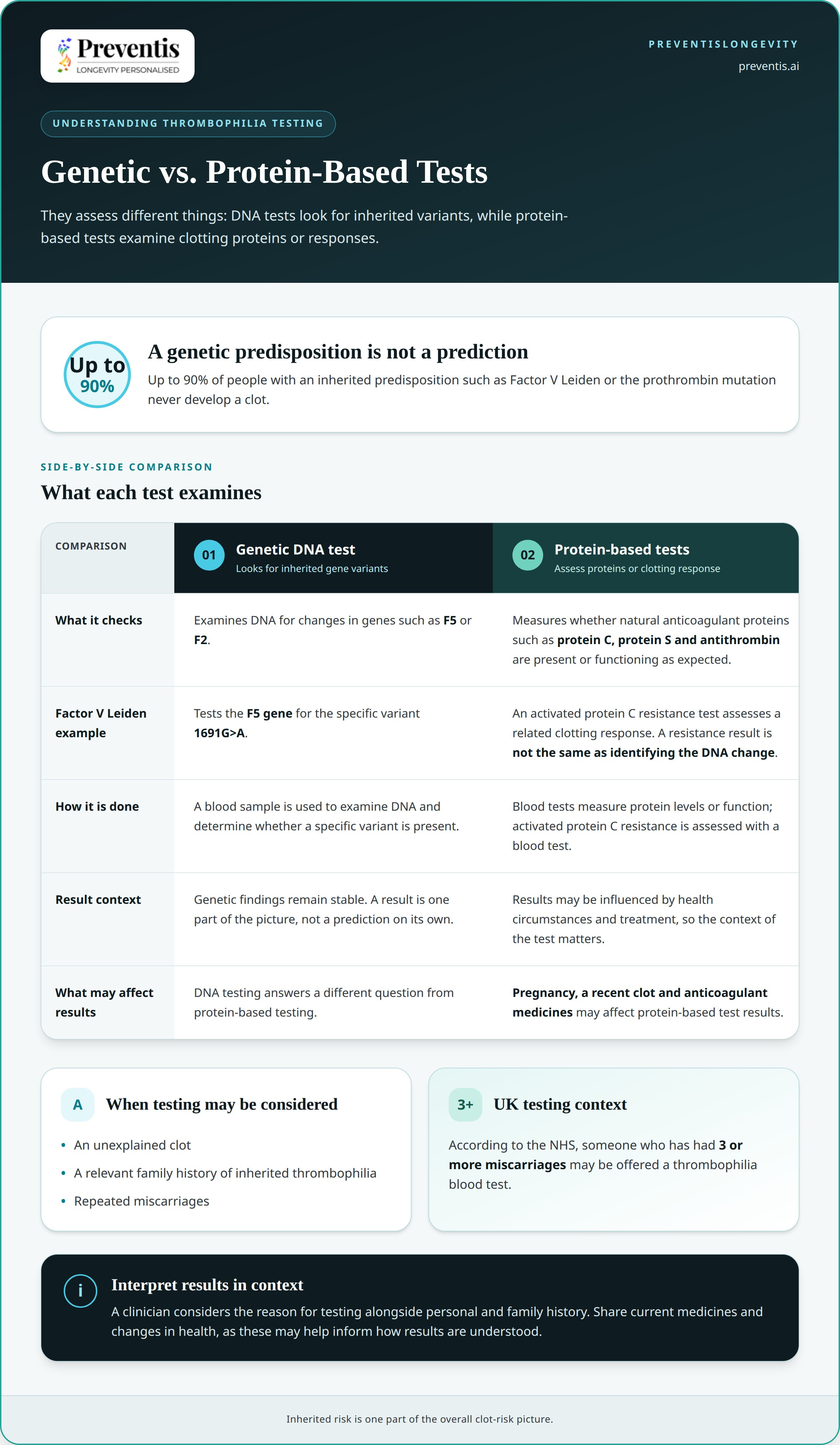
A positive genetic result doesn’t mean a blood clot is inevitable: up to 90% of people with an inherited predisposition such as Factor V Leiden or the prothrombin mutation never develop one. A genetic risk for blood clots test can look for variants including Factor V Leiden (F5 1691G>A), prothrombin (F2 20210G>A) and, in some panels, MTHFR variants.
It’s understandable to want a clear answer if you have a family history of blood clots or are wondering how inherited risk could affect your health. A genetic result is only one part of the picture. It should be considered alongside your personal and family history, not treated as a prediction on its own.
This article explains thrombophilia, what inherited variants a genetic test may identify, and how genetic counselling can help you understand the findings. It also explores how genetic information may contribute to a broader assessment of clot risk and discussions about prevention.
Key Takeaways
- Understand how inherited and acquired thrombophilia differ, and why genetic predisposition is only one part of clot risk.
- Learn which circumstances may lead to thrombophilia testing in the UK, including a relevant family history or repeated miscarriages.
- See how Factor V Leiden testing can involve either a genetic test or an assessment of activated protein C resistance.
- Recognise the F5, F2 and MTHFR variants that may appear on a genetic panel, and why results need careful interpretation.
- Discover how genetic counselling can put findings in context and help guide informed conversations about next steps.
Inherited and acquired thrombophilia
Thrombophilia is a tendency for blood to clot more readily than usual. It may be inherited through gene variants or acquired through health conditions and other factors.
Inherited and Acquired Forms
Inherited thrombophilia results from gene variants passed down through a family, while acquired thrombophilia develops during a person’s life. An inherited predisposition can be present even if someone has never had a clot. Acquired thrombophilia may improve when its underlying cause is treated. The distinction matters: family history can suggest inherited risk, while changes in health may help explain an acquired tendency.
Dominant Inheritance and Gene Copies
Each person inherits two copies of each gene, one from each parent. With an autosomal dominant clotting-disorder mutation, one altered copy can increase risk. A person with a mutation in one copy is heterozygous; a mutation in both copies is homozygous. First-degree relatives of someone with an autosomal dominant clotting-disorder mutation have a 50/50 chance of having the mutation, according to the NHS. The pattern helps make sense of family history, but does not establish whether a relative will develop a clot.
Prevalence of Common Mutations
Prevalence describes how often an inherited mutation occurs in a population. Factor V Leiden is present in 1 in 20 individuals of European ethnic origin in the UK, while Prothrombin 20210 occurs in 2 in 100 people of European origin. These figures provide context, not an individual prediction. A less common variant can still matter when it appears alongside other risk factors or a strong family history.
Factors That Shape Thrombophilia Risk
Clot risk reflects inherited variants alongside a person’s health, medical history and lifestyle. Age, previous clots and family history all contribute to an overall assessment. A genetic predisposition is one part of that picture, not a stand-alone measure. Considering these factors together helps a healthcare provider interpret genetic findings and discuss which modifiable factors may influence risk.
When Inherited Thrombophilia May Be Suspected
An unexplained clot, particularly in someone under 50, can raise suspicion of an inherited cause. A close relative with inherited thrombophilia or a family pattern of clotting disorders may also be relevant. These clues do not prove a mutation is present, but they help frame the assessment. A provider can consider the person’s clot history alongside family history and other health factors when deciding whether testing may be useful.
Genetic tests for thrombophilia
Genetic tests examine DNA for inherited variants, while protein C, protein S and antithrombin tests measure blood proteins. In the UK, a GP may assess your history and arrange testing when appropriate. Preparation depends on the test and your clinical circumstances.
A genetic test can identify changes in genes such as F5 or F2. It uses a blood sample to examine DNA, and the result indicates whether a specific variant is present. Protein tests answer a different question: they assess whether key natural anticoagulant proteins are present or functioning as expected. Genetic findings remain stable, while protein results may be influenced by health circumstances and treatment.
Thrombophilia itself may not cause noticeable symptoms. A clot can cause pain, tenderness, warmth or swelling in one leg, particularly with deep vein thrombosis. A pulmonary embolism may cause sudden breathlessness, chest pain or coughing up blood. These symptoms need urgent medical attention. Genetic testing is not a substitute for assessing a suspected clot.
Who May Be Offered Testing
A thrombophilia blood test may be considered after an unexplained clot, a relevant family history or repeated miscarriages. In the UK, someone who has had 3 or more miscarriages may be offered a thrombophilia blood test, according to the NHS. A close family member with inherited thrombophilia can also be relevant. Testing decisions are guided by the reason for assessment and the person’s medical history.
Factors Affecting Test Results
Clinical factors can affect some thrombophilia test results, so findings need to be interpreted in light of the circumstances in which the sample was taken. Pregnancy, a recent clot and anticoagulant medicines may affect protein-based tests. DNA testing looks for inherited variants and answers a different question. Tell your clinician about current medicines and changes in your health so they can interpret each result appropriately.
Arranging and Preparing for Testing
In the UK, discuss testing with a GP when a clot has no obvious cause, inherited thrombophilia runs in the family, or pregnancy history raises concern. The clinician considers the reason for testing and whether genetic or protein-based tests are relevant. Preparation varies by test, so share current medicines, pregnancy status and previous clotting results during the assessment. A genetic counsellor can help explain what a DNA result may mean; genetic counselling support can help put findings into context.
Factor V Leiden and activated protein C resistance testing
Factor V Leiden is an inherited change in the F5 gene that can increase blood clot risk. Testing can look for the gene mutation directly or assess activated protein C resistance, a related clotting response.
What the Tests Examine
Activated protein C helps regulate clotting by switching off factor V. With Factor V Leiden, factor V is less responsive to this control, which can make clotting more likely. A blood test can assess activated protein C resistance, while genetic testing examines the F5 gene for the specific variant, 1691G>A.
A resistance result is not the same as identifying the DNA change. A blood test showing activated protein C resistance indicates a 90-95% likelihood of a factor V gene mutation. Genetic testing can identify the mutation directly. Which method is used depends on the clinical question and the assessment being carried out.
Understanding the Result
Factor V Leiden is present in 1 in 20 individuals of European ethnic origin in the UK. That prevalence describes a population, not an individual’s likelihood of developing a clot. The number of affected gene copies also matters: heterozygous means one copy carries the mutation, while homozygous means both copies do.
Heterozygous Factor V Leiden is associated with about eight times the risk of venous thrombosis compared with not having the mutation. Homozygous Factor V Leiden is associated with about 80 times the risk compared with not having the condition. These comparisons describe relative risk, not a prediction that a particular person will have a blood clot.
Reducing Controllable Risks
Genetic findings can help frame discussions about other clotting risks, including prolonged inactivity, smoking and health circumstances. Avoiding prolonged inactivity, exercising regularly and maintaining a healthy weight can help address controllable factors. Before surgery, hospitalisation or starting a prescription medicine such as hormonal contraception, tell the relevant healthcare professional if you have a known Factor V Leiden result.
For example, someone with an inherited variant who is planning surgery can discuss it alongside their medical and family history. The result provides useful context, but it does not replace assessment of symptoms or other risk factors.
Private Testing Costs in the UK
There is no single cost for every private test. The amount depends on whether testing checks only the F5 variant, includes broader genetic analysis, or comes with interpretation support.
F5, F2 and MTHFR variants tested
Genetic panels may examine variants in F5, F2 and MTHFR, but the exact genes included can differ. Each result relates to a particular DNA change, so understanding the variant tested matters when interpreting a report.
Tests for Factor V Leiden and the prothrombin variant look for specific DNA changes: F5 1691G>A and F2 20210G>A. These targeted tests assess whether the named variant is present. Their result is specific to the changes examined; it does not identify every possible inherited contributor to clotting risk or establish that a person will develop a blood clot.
How accurate are tests for Factor V Leiden and prothrombin gene mutations? A genetic test examines DNA for the specific F5 or F2 change, rather than measuring clotting activity. The result answers whether that variant was detected, but it does not predict with certainty whether an individual will experience a clot.
The F5 variant affects factor V, a protein involved in blood clotting. A report may describe a person as heterozygous when one gene copy carries the variant, or homozygous when both copies do. That distinction can affect the associated risk assessment. For example, two people with a detected F5 mutation may have different results because they carry the variant in different numbers of gene copies.
F2 20210G>A is another inherited variant associated with thrombophilia. Heterozygous F2 20210G>A is associated with a 2-5x increased thrombosis risk, while homozygous F2 20210G>A is associated with a thrombosis risk greater than 5x. These are relative risk associations, not a diagnosis of a current clot. A healthcare professional considers the result alongside personal and family history.
Some panels also examine MTHFR variants 677C>T and 1298A>C. Their significance differs from F5 and F2: homozygous MTHFR 677C>T is associated with increased thrombosis risk if folate levels are low. Having both MTHFR 677C>T and 1298A>C is also associated with increased risk when folate is low. The result therefore needs to be read with relevant health information.
A genetic result can inform discussions about planned surgery, pregnancy or prescription medicines, where other clotting risks may affect decisions. It does not replace assessment of symptoms or a clinical diagnosis. A parent with an inherited variant may pass it to a child, so family history can provide useful context. The practical value is understanding which variants were tested and how each finding relates to the person’s overall risk profile.
Genetic counselling and interpreting genetic risk
Genetic testing can identify the variants included in a test, but it cannot predict with certainty whether someone will develop a clot. Up to 90% of people with an inherited predisposition such as Factor V Leiden or the prothrombin mutation never develop one.
Thrombophilia describes a tendency to clot more readily, which inherited changes can influence, but any result needs context. A genetic counsellor can explain what a finding means, how it relates to family history and what questions it raises. For example, a prothrombin variant indicates an inherited risk factor, not an active blood clot or a diagnosis of one.
Interpretation begins with the specific variant and the number of affected gene copies. A person with a variant in one copy has a different genetic pattern from someone with variants in both copies. A counsellor can explain how this distinction relates to risk without treating it as a stand-alone forecast. The same principle applies when results identify more than one variant.
The broader picture matters too. Age, medical history, family history and lifestyle all contribute to an overall clot-risk assessment. A previous clot, a close relative’s diagnosis or a planned pregnancy can put a genetic result in practical context. These details help guide an informed discussion about what the finding could mean for future decisions.
DNA and protein tests answer different questions. Genetic testing looks for inherited variants, while tests for protein C, protein S or antithrombin assess proteins involved in clot regulation. A genetic finding does not establish a protein deficiency, and a protein result does not reveal which inherited variant is present. Interpretation depends on the purpose of the test and its findings.
It’s important to understand the limitations before acting on a result. A negative result means only that the variants examined were not detected; it does not assess every possible cause of clotting risk. A positive result does not mean a clot will occur. Before testing, discuss how the information could affect care, including conversations about surgery, contraception or pregnancy.
Genetic counsellors help translate genetic concepts into clear, personal information and explain potential family implications. An online genetic counsellor service can support discussion of results, inheritance and possible next steps. This can help you bring focused questions about your genetic risk and medical history to a healthcare professional.
Genetic counsellors can explain genetic concepts and risks, but decisions about care should be made with a knowledgeable healthcare provider. Before pursuing testing, discuss with that provider how the information may be used in medical management. Someone with a genetic thrombophilia finding who has never had a blood clot may not need preventive measures or treatment. This is why results should be considered alongside personal circumstances, rather than assuming a positive finding requires intervention.
PreventisLongevity: Preventis 17 Gene BRCA/Lynch
PreventisLongevity offers Preventis 17 Gene BRCA/Lynch for people seeking genetic insights related to inherited cancer risk. It is distinct from a thrombophilia test, which looks for clot-associated variants such as Factor V Leiden or prothrombin G20210A. Choosing a test that matches your health question helps keep results relevant.
For broader genetic information, Preventis Whole Genome is an option. Preventis also offers an Online genetic counsellor service to help you understand genetic findings and consider questions to discuss with a healthcare professional. These services support understanding; suspected or active blood clots need medical assessment.
If you’d like to discuss which genetic information may suit your goals, contact PreventisLongevity.
Turn genetic insight into a considered next step
A genetic risk for blood clots test is most useful when it addresses a specific health question. Before taking action, consider what you want the information to clarify, such as how family history could inform a conversation with your healthcare professional. A genetic result can contribute to that discussion, while decisions about symptoms, treatment or prevention should reflect your personal circumstances.
For broader preventive health insights, PreventisLongevity offers Preventis Max Prevention and Preventis Preventive panel. These are distinct from a thrombophilia-specific assessment, so the right next step depends on whether you want clot-related genetic information or a wider view of health. If you’re unsure which direction suits your goals, a conversation can help clarify what you want testing to answer.
Contact PreventisLongevity about genetic risk to discuss a thoughtful next step. Clear questions can help turn health information into more confident decisions.
Frequently Asked Questions
What is Thrombophilia?
Thrombophilia is a tendency for blood to clot more readily, and it can be inherited or acquired. It does not prove that a clot is present. Someone may carry an inherited clotting variant without ever having had a clot, while another person’s tendency may be linked to an acquired health condition. This distinction helps clarify whether an assessment focuses on genetic factors, current health or both.
What inherited genetic conditions increase the risk of blood clots?
Inherited conditions associated with clot risk include Factor V Leiden, the prothrombin G20210A variant, and deficiencies of antithrombin, protein C or protein S. Factor V Leiden and prothrombin variants affect clotting proteins; antithrombin and protein deficiencies involve natural anticoagulant systems. A family history can be a useful clue, but the specific condition matters because different variants and deficiencies have different implications for assessment and family discussions.
What genetic tests are used to assess inherited thrombophilia?
A genetic risk for blood clots test may examine DNA variants such as Factor V Leiden in F5 or prothrombin G20210A in F2. These tests identify specified inherited changes. Separate blood tests can assess protein C, protein S or antithrombin levels or activity, rather than looking for DNA variants. The clinician selects tests according to the clinical question, since a DNA result and a protein result provide different information.
Who should be offered genetic testing for blood clot risk in the UK?
Testing may be considered after an unexplained blood clot, particularly at a younger age, or when close relatives have inherited thrombophilia. A history of repeated pregnancy loss can also prompt assessment. The decision depends on whether the result could inform care, for example, discussions about future pregnancy, surgery or medicines. Family history alone does not establish that testing is needed.
Can I get a blood clot genetic test on the NHS, and what are the criteria?
NHS testing may be offered after clinical assessment, rather than routinely to everyone with a relative who has had a clot. In the UK, the NHS says someone who has had 3 or more miscarriages may be offered a blood test for thrombophilia. An unexplained clot or a close family member with inherited thrombophilia may also be relevant when clinicians consider whether testing could affect care.
What does a positive inherited thrombophilia test result mean for treatment and prevention?
A positive result identifies an inherited risk factor; it does not automatically mean medication is needed. Treatment decisions take account of previous clots, family and medical history, and other risks. Someone who has never had a clot may not need preventive treatment if their overall risk is low. If anticoagulants are prescribed, healthcare professionals assess their suitability and monitor treatment. Share your result before planned procedures or starting new prescription medicines.


