

Lynch syndrome genetic testing without referral may be available privately in the UK. NHS testing generally follows clinical pathways based on diagnosis, tumour results and family history. Lynch syndrome is an inherited condition that increases the risk of certain cancers, particularly bowel and womb cancer. Understanding which route suits your circumstances is an important first step.
It’s understandable to want a clear answer about access, especially when family history has raised questions. Private and NHS testing differ in how they’re accessed and supported, but either route should help you understand what a result could mean before deciding whether to proceed.
This guide explains what Lynch syndrome is, when NHS testing may be offered and how private testing differs. It also covers genetic counselling, consent and questions to consider, so you can approach testing with greater clarity.
Key Takeaways
- Lynch syndrome is linked to inherited changes in mismatch repair genes, and family patterns of bowel or related cancers can inform whether testing is considered.
- Understand how NHS eligibility pathways and private testing differ before deciding which route may suit your circumstances.
- Genetic testing is optional; consider what a result could mean for your health decisions and your relatives before giving consent.
- A negative result may not rule out inherited risk, so the wider family and clinical context can still matter.
- Explore how a Lynch-focused genetic panel and genetic counselling can support a more informed next step.
What is Lynch syndrome?
Lynch syndrome is an inherited condition caused by changes in genes that normally help repair DNA. These changes can increase the risk of bowel, womb and other cancers. The genes commonly involved are MLH1, MSH2, MSH6 and PMS2; rare harmful changes in EPCAM can also cause the condition. A person may inherit a relevant gene change from either parent.
Family history can help identify when assessment may be useful, but it does not confirm a diagnosis. Concern may rise, for example, when a close relative developed bowel or womb cancer at a young age, or related cancers appear across generations. Multiple bowel polyps can also be relevant, particularly alongside a family pattern of cancer.
One commonly used family-history pattern is the modified Amsterdam criteria. According to NHS Borders guidance, this includes at least three Lynch-related cancer cases across at least two generations, with at least one person diagnosed by age 50. One affected family member must also be a first-degree relative of the other two. Separately, diagnosis of colorectal or endometrial cancer before age 50 is a criterion for considering genetic counselling and testing.
During genetic counselling, a professional discusses your cancer history and cancers affecting relatives. They may ask about each relative’s relationship to you, cancer type and age at diagnosis. These details help assess whether the pattern could indicate inherited risk and whether testing is appropriate. Recording each diagnosis matters, particularly when relatives have had different cancers, because Lynch syndrome is associated with several cancer types.
A positive result identifies a Lynch-associated gene change and can guide conversations about future screening. It may also help relatives understand their own inherited risk. According to the NHS, people with MLH1 or MSH2 variants are advised to have a colonoscopy every 2 years from age 25; people with MSH6 or PMS2 variants are advised to have one every 2 years from age 35.
Family conversations can feel personal. A result may affect relatives who have not chosen testing, so counselling can help someone consider whom to tell and how to share the information clearly. A genetic counsellor can also explain that each child of a person with a Lynch-associated gene change has a 50% chance of inheriting it. This can help families discuss testing and screening with greater understanding.
Family history is a starting point, not a complete record of inherited risk. Small families, missing diagnoses or relatives who were never tested can make patterns harder to interpret. A professional can consider these gaps alongside the available cancer and polyp history, then explain what testing could clarify.
Differences between private testing and NHS testing
In the UK, testing may follow an NHS clinical pathway or be arranged privately. The main differences are how testing is accessed, what prompts it and how results are interpreted.
Testing Without a GP Referral
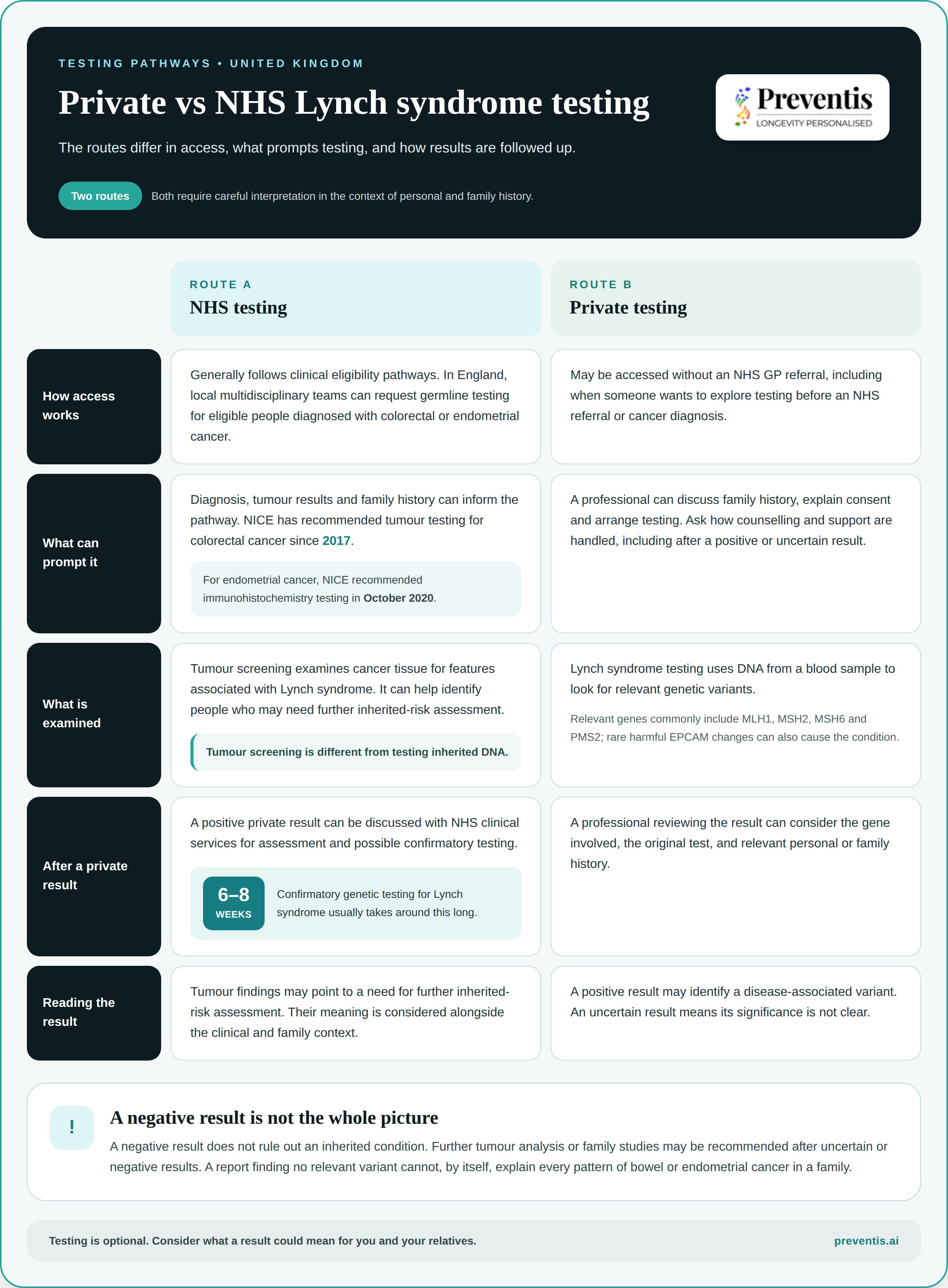
Private Lynch syndrome testing may be accessed without an NHS GP referral, while NHS testing follows clinical eligibility pathways. This distinction may matter if you want to explore testing before an NHS referral or cancer diagnosis.
In an online private pathway, a professional can discuss your family history, explain consent, arrange testing and help interpret the report. Lynch syndrome testing uses DNA from a blood sample to look for relevant genetic variants. Ask how counselling fits into the process and what support is available after a positive or uncertain result.
In England, local multidisciplinary teams can request germline testing for eligible people diagnosed with colorectal or endometrial cancer. NICE has recommended tumour testing for colorectal cancer since 2017, using immunohistochemistry or microsatellite instability testing. This tumour screening helps identify people who may need further inherited-risk assessment; it is different from testing a person’s inherited DNA.
A positive private result can be discussed through NHS clinical services for assessment and possible confirmatory testing. Confirmatory genetic testing for Lynch syndrome usually takes around 6-8 weeks. The professional reviewing the result can consider the gene involved, the original test and relevant personal or family history.
Test Accuracy and Result Meaning
Test accuracy depends on what the laboratory examines and how it classifies the result; one accuracy figure cannot describe every test. A positive result may identify a disease-associated variant, while an uncertain result means its significance is not clear.
A negative result does not rule out an inherited condition. Further tumour analysis or family studies may be recommended after uncertain or negative results, and findings need to be interpreted alongside family history. For example, a report finding no relevant variant cannot, by itself, explain every pattern of bowel or endometrial cancer in a family.
Before proceeding, consider whether the test examines genes relevant to Lynch syndrome, how a professional will explain the result, and whether follow-up is available. A genetic counsellor can discuss implications for relatives and the limits of a result. For people diagnosed with endometrial cancer, NICE recommended immunohistochemistry testing in October 2020, providing another route for identifying cases that may need inherited-risk assessment.
Testing and tumour screening answer different questions: inherited testing looks for a genetic change present in the person’s DNA, while tumour tests examine cancer tissue for features associated with Lynch syndrome. If you’re considering private testing, online genetic counselling can help you understand consent, family implications and what a result may mean.
Deciding whether to have genetic testing
Testing is a personal choice, not a requirement for standard care. The decision depends on what a result could clarify about inherited cancer risk.
Factors in the Testing Decision
Consider what you hope a Lynch syndrome test will answer, such as whether a family pattern has an inherited explanation. A professional can discuss your personal and family history, including bowel cancer, womb cancer and previous genetic results. This context helps clarify what the test may reveal and which questions remain outside its scope.
Think about how each possible result could affect your next decisions. A positive result may inform discussions about screening and relatives’ potential risk. A negative result may offer less certainty if family history remains concerning. An uncertain finding may need further interpretation, so consider whether you feel ready for information that does not provide a clear yes or no.
Practical considerations matter too. Before consenting, understand which genes the test examines, how results will be explained and what follow-up is available. A test focused on Lynch syndrome-related genes addresses a different question from broader genetic testing. Ask the professional to explain the scope and limits in plain language, then take time to decide.
Family implications may influence your choice. A result could be relevant to biological relatives, but sharing it is a personal decision. Consider whether you would want to discuss the outcome with family members and whether counselling could help you plan that conversation. Testing is optional, and choosing not to proceed does not affect the standard of care you receive.
Testing Risks and Limitations
The main limitations are uncertainty and the possibility that a result will not explain a family’s cancer history. A negative Lynch syndrome test does not rule out an inherited condition, while a variant of uncertain significance may not show whether cancer risk is increased. These results can leave important questions open rather than provide a definitive answer.
Testing can also bring difficult information about personal risk or relatives. Before proceeding, discuss how positive, negative and uncertain findings will be communicated, and what support is available afterwards. A professional can explain which results might lead to further tumour analysis or family studies, and how surveillance recommendations are considered when the genetic answer is unclear.
No single result predicts exactly who will develop cancer. A pathogenic variant indicates inherited risk, not a cancer diagnosis, and a negative finding cannot erase relevant family history. For example, if several relatives developed bowel cancer but testing finds no Lynch-associated variant, clinical assessment may still take that family pattern into account.
Weigh the value of clearer risk information against the possibility of an ambiguous result and its family implications. A genetics professional can review the test’s scope, explain what each outcome could mean and discuss your concerns before consent. That conversation gives you a practical basis for deciding whether testing suits your needs now.
Genetic counselling and consent
Genetic counselling helps you understand what Lynch syndrome testing can reveal before deciding whether to proceed. A counsellor discusses your health, family history and the possible implications of results. For example, a relative’s bowel or womb cancer diagnosis may help explain why testing is being considered. The conversation also gives you space to raise concerns and understand unfamiliar genetic terms.
Before testing, the counsellor can explain which genes are being examined, such as MLH1, MSH2, MSH6 and PMS2. They can clarify what a positive, negative or uncertain result may mean for your risk of developing cancer. A positive result identifies a relevant gene variant, but it does not mean cancer is present or inevitable. A negative result does not rule out every inherited cause.
Consent means deciding to proceed after understanding the test’s purpose and potential outcomes. Testing is optional, and choosing not to test does not affect the standard of care you receive. You can discuss whether you want testing now, need more time or would prefer to ask about a particular result first. Clear answers help make the decision informed rather than rushed.
Consider the family implications before giving consent. A result may be relevant to biological relatives, who can make their own decisions about testing and screening. Counselling can help you plan how to share information while respecting that relatives may respond differently. For instance, you might want to explain a result to a sibling before discussing it more widely.
Results can carry different emotional weight. A positive finding may bring clarity about inherited risk while raising questions about future screening and family conversations. An uncertain result may not provide a clear answer. Discussing these possibilities beforehand can help you decide what support you want when results are explained.
After testing, counselling can put the report into context. The professional can explain the variant identified, how it relates to Lynch syndrome and what follow-up discussions may be relevant. If the result is uncertain or negative despite a notable family pattern, further tumour analysis or family studies may be considered. This helps avoid treating one result as the whole story.
Before consenting, make sure you understand the test’s scope, possible result categories and how each could affect your next decisions. You can ask the counsellor to explain a term such as “pathogenic variant” in plain English, or to clarify how an uncertain result differs from a positive one. This shared understanding supports a considered choice and clearer discussion after results arrive.
When genetic testing for Lynch syndrome may be offered
Testing may be considered when a cancer diagnosis, tumour findings or a family pattern raises concern. The key distinction is whether evidence points to an inherited gene variant, rather than cancer risk alone.
A person can have Lynch syndrome testing considered without a known family history. A personal diagnosis or tumour result may raise suspicion, and families may have incomplete medical histories or few relatives. In England, NICE recommends testing everyone with colorectal cancer for Lynch syndrome using immunohistochemistry or microsatellite instability testing. NICE recommended immunohistochemistry for people diagnosed with endometrial cancer in October 2020.
These tumour tests examine cancer tissue, not inherited DNA. If findings suggest Lynch syndrome, eligible patients diagnosed with colorectal or endometrial cancer in England may have germline testing requested by local multidisciplinary teams. Germline testing looks for an inherited variant, which can clarify whether risk may also matter to relatives. A tumour result can therefore signal the need for further assessment, rather than provide a genetic diagnosis by itself.
Age at diagnosis can also matter. Bowel cancer diagnosed before age 50 is a recognised risk factor for hereditary bowel cancer. Criteria described in NHS Borders guidance include a mismatch-repair-deficient tumour diagnosed before age 70 when specified tumour results suggest Lynch syndrome. A Wimmer score greater than 3 for a patient with cancer is another criterion for considering testing.
Family history may prompt assessment even when no tumour test is available. Criteria in NHS Borders guidance include at least three Lynch-related cancer cases across at least two generations, with one case diagnosed by age 50. Other patterns include a first-degree relative diagnosed with colorectal cancer before age 50, or two first-degree relatives with colorectal cancer at any age. Relevant cancers can include bowel, womb and ovarian cancer.
Polyps may contribute to the assessment. NHS Borders guidance includes at least five adenomatous polyps diagnosed before age 40, or at least ten diagnosed before age 60. It also includes colorectal cancer before age 60 alongside at least five polyps. These findings do not establish Lynch syndrome alone; they form part of the wider clinical picture.
The practical takeaway is that eligibility may arise from personal cancer or tumour findings, family history, or a combination. A patient with bowel cancer may enter assessment through tumour screening, while an unaffected person may be considered under family-history criteria. The reason for testing shapes what test comes next and how the result is interpreted.
If a diagnosis or family pattern has raised questions, discuss Lynch syndrome testing with an online genetic counsellor to understand the testing pathway and what the findings may mean.
PreventisLongevity: Preventis 17 Gene BRCA/Lynch
PreventisLongevity offers Preventis 17 Gene BRCA/Lynch for people considering genetic testing related to Lynch syndrome. It provides a private testing option to discuss alongside your family history, previous cancer diagnoses and questions about inherited risk.
If you’re weighing up testing or need help understanding what results could mean, Preventis offers an Online genetic counsellor service to discuss genetic information and its implications. A counselling conversation can help you consider whether testing aligns with your needs and what questions to raise before deciding.
For broader preventive health interests, Preventis Max Prevention and the Preventis Preventive panel are also available, although they serve different purposes from a Lynch-focused genetic test.
To discuss your options, contact PreventisLongevity.
Make your next step an informed one
Your next step can be a conversation, not an immediate decision to test. Set out what you want to understand, such as how testing relates to your family history or what support you would value when results arrive. A focused discussion can help turn those priorities into a clear, personal plan.
If you’re considering Lynch syndrome genetic testing without referral, weigh the information you want against the questions that may remain. You can also decide how you feel about sharing relevant information with family members. The choice to proceed is yours, and you can make it after a discussion that gives you space to consider the implications.
Contact PreventisLongevity to discuss testing and explore a next step that fits your circumstances. A thoughtful decision begins with the questions that matter most to you.
Frequently Asked Questions
How do I know if I am at risk?
A personal or family pattern of related cancers can indicate that inherited risk is worth discussing. Several relatives with bowel, womb or ovarian cancer, or a diagnosis at a young age, may prompt assessment. A clinician can consider cancer types, ages at diagnosis and how relatives are related. Family history helps guide that discussion, but it cannot confirm or exclude Lynch syndrome by itself.
Is colorectal cancer inherited?
Some colorectal cancers are linked to inherited gene variants, but most are not explained by Lynch syndrome. Inherited gene variants account for about 5-10% of colorectal cancers. An inherited variant can increase a person’s chance of developing cancer, while not determining that cancer will occur. A family pattern can be a reason to discuss risk assessment, especially when relatives had related cancers or younger diagnoses.
What does being tested involve?
For the Preventis 17 Gene BRCA/Lynch test, a physician orders the test and the sample is collected using a saliva kit. The laboratory performs whole-exome sequencing and analyses the selected genes. A report is sent to a genetic counsellor, who discusses the findings with the patient. Pre-test and post-test counselling are available upon request, helping explain the test and its results.
How much does private Lynch syndrome genetic testing cost in the UK?
There is no single UK-wide price for private genetic testing; the cost depends on the test’s scope and the professional support included. A Lynch-focused panel and broader genetic analysis may examine different genes. Counselling and interpretation may also form part of the service. Before deciding, clarify what the fee covers, including the test, results review and any counselling.
What genes and variants are included in a Lynch syndrome test?
The Preventis 17-genes Breast & Ovarian Cancer + Lynch Syndrome panel examines 17 genes: BRCA1, BRCA2, BARD1, ATM, TP53, STK11, RAD51D, RAD51C, PTEN, PALB2, MSH6, MSH2, MLH1, EPCAM, CHEK2, CDH1 and BRIP1. Its detection includes single-nucleotide variants, small insertions and deletions, and copy-number variants. The panel also covers genes associated with breast and ovarian cancer.
Does Lynch syndrome testing require genetic counselling before or after the test?
For the Preventis 17-genes Breast & Ovarian Cancer + Lynch Syndrome panel, pre-test and post-test genetic counselling are available upon request. Before testing, counselling can help clarify the panel’s scope and possible result types. After testing, a genetic counsellor discusses the report with the patient. This support can help connect findings with personal questions and family considerations.


