

Could your genes signal a greater chance of atrial fibrillation without telling you whether you’ll develop it? Family history can raise questions about inherited risk, but a genetic result is not a diagnosis or a certain prediction. A genetic test for atrial fibrillation risk estimates inherited susceptibility, which is one part of your health picture.
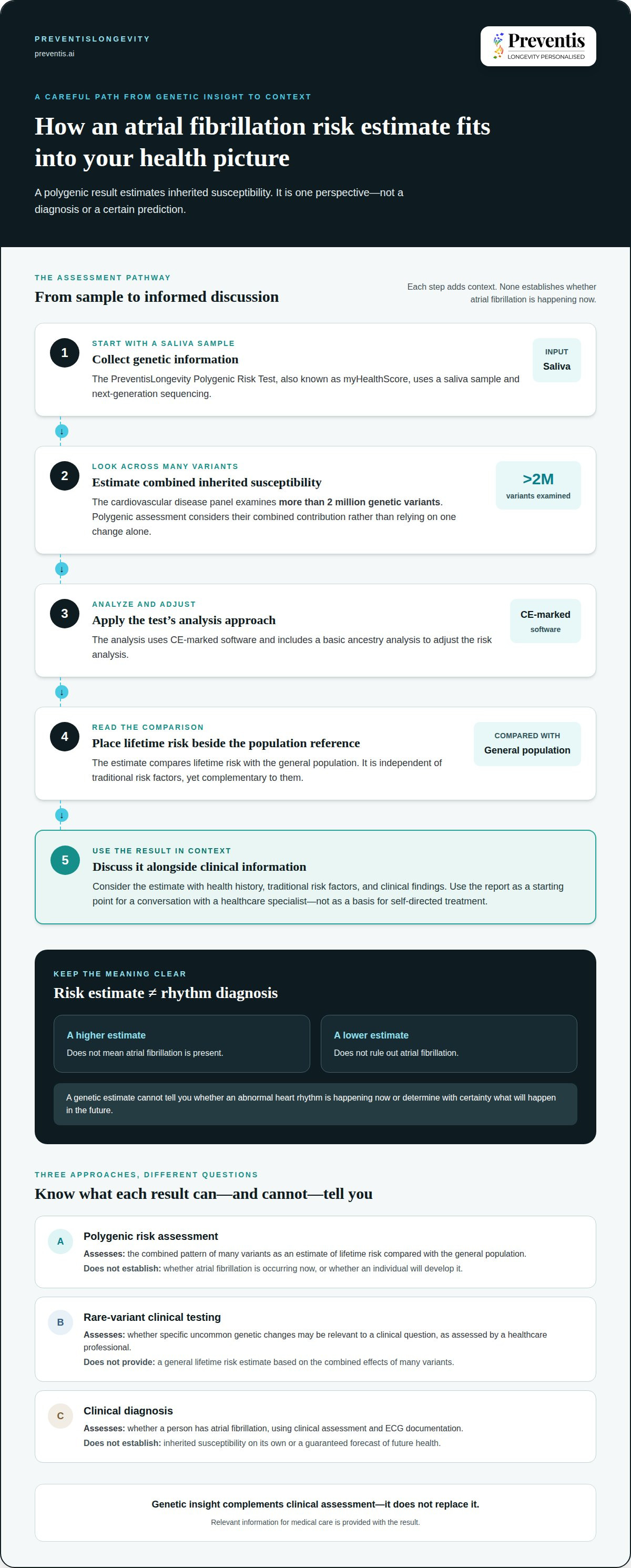
The PreventisLongevity Polygenic Risk Test, also known as myHealthScore, is intended for adults and estimates lifetime risk compared with the general population. Its cardiovascular disease panel examines more than 2 million genetic variants using a saliva sample and next-generation sequencing. The analysis uses CE-marked software and includes a basic ancestry analysis to adjust the risk analysis. Results are independent of, and complementary to, traditional risk factors, and are provided with relevant information for medical care.
This article explains what polygenic risk can and can’t tell you, how to interpret a result cautiously, and how it may support a conversation with a healthcare specialist. Genetic insight complements clinical assessment rather than replacing it.
Key Takeaways
- A genetic test for atrial fibrillation risk estimates inherited susceptibility. It cannot tell you whether you currently have atrial fibrillation.
- Polygenic risk assessment, rare-variant testing and clinical diagnosis address different questions.
- Compare a test’s purpose, intended population, risk scope, sample and interpretation to understand what its result means.
- Use your report as a starting point for a discussion with a healthcare specialist, not as a basis for self-directed treatment.
- Consider genetic insight alongside traditional risk factors when discussing appropriate prevention strategies.
What does a genetic test for atrial fibrillation risk actually assess?
Genetic testing estimates how inherited DNA variations may contribute to a person’s risk of developing a condition. It doesn’t reveal whether atrial fibrillation is happening now or determine with certainty what will happen in the future. A genetic test for atrial fibrillation risk is one source of information about predisposition, considered alongside health history and other risk factors.
Genetic risk is not a diagnosis. A risk estimate cannot confirm an abnormal heart rhythm. Atrial fibrillation is assessed clinically, with ECG documentation used to identify the rhythm. For background on the condition and its assessment, see this clinical overview of atrial fibrillation.
How can genetic factors relate to atrial fibrillation risk?
Polygenic means that the combined contribution of many genetic variants is considered, rather than relying on one change alone. Individual variants contribute to an overall estimate of inherited susceptibility. The estimate is not a complete account of health, and it does not replace clinical assessment. Two people with similar genetic results may have different health histories and circumstances, so the same result should not be treated as a personal forecast.
What is the difference between polygenic risk and rare variants?
Polygenic assessment considers patterns across many variants to estimate lifetime risk. Rare-variant testing asks a different question: whether a person has a particular uncommon genetic change that may be relevant to an inherited condition. These approaches are not interchangeable. One estimates the combined influence of many variants; the other investigates specific findings in a clinical context.
The distinction matters because the question being asked affects how a result is interpreted. A polygenic estimate can add perspective to a prevention discussion. In some clinical situations, a specialist may consider rare-variant testing. The European Society of Cardiology’s discussion of genetics in atrial fibrillation provides context for these distinct clinical questions, but it should not be read as evidence that a polygenic risk test detects rare variants.
A higher polygenic estimate does not mean atrial fibrillation is present, while a lower estimate does not rule it out. Neither result determines whether or when someone will develop the condition. The value lies in interpreting inherited information carefully as one part of a broader conversation about cardiovascular health.
How does genetic risk assessment differ from clinical testing for atrial fibrillation?
These approaches address different questions. A polygenic assessment estimates inherited lifetime susceptibility; clinical genetic testing investigates specific variants in a clinical context; and clinical diagnosis establishes whether atrial fibrillation is present. Keeping those purposes distinct helps clarify what a result can contribute to care.
| Approach | What it assesses | What it cannot tell you |
|---|---|---|
| Polygenic risk assessment | The combined pattern of many genetic variants, expressed as an estimate of lifetime risk compared with the general population. | Whether atrial fibrillation is occurring now, or whether an individual will develop it. |
| Rare-variant clinical testing | Whether specific uncommon genetic changes may be relevant to a clinical question, as assessed by a healthcare professional. | A general lifetime risk estimate based on the combined effects of many variants. |
| Clinical diagnosis | Whether a person has atrial fibrillation, using clinical assessment and ECG documentation. | Inherited susceptibility on its own, or a guaranteed forecast of future health. |
What does a polygenic risk estimate tell you?
A polygenic estimate puts inherited risk in context by comparing lifetime disease risk with that of the general population. It is independent of traditional risk factors, yet complementary to them: it adds a genetic perspective rather than replacing information such as health history or clinical findings.
Read the result as a comparison, not a personal certainty. A higher estimate does not confirm atrial fibrillation, and a lower one does not rule it out. The genetic basis of familial atrial fibrillation provides context on inherited changes that can affect heart function. A polygenic estimate and a finding in a family with a suspected inherited condition are not the same kind of evidence. For broader cardiovascular context, see this heart health DNA screening guide.
What can clinical genetic testing address in early-onset cases?
Clinical genetic testing may be considered by specialists when a person’s circumstances raise a specific question about an inherited condition. The European Society of Cardiology’s discussion of genetics in early-onset atrial fibrillation focuses on clinical investigation and rare-variant findings. This differs from population-level polygenic risk assessment, which estimates inherited susceptibility rather than looking for a specific rare variant or diagnosing an active rhythm.
If you’re exploring inherited cardiovascular risk, Preventis myHealthScore risk assessment offers a way to bring polygenic insight into a broader conversation about prevention with a healthcare specialist.
What should you compare when evaluating an atrial fibrillation risk test?
Start with what the test is designed to tell you, not with a headline about how many genetic variants it analyses. Check whether it estimates inherited susceptibility, investigates specific rare variants or detects an existing heart rhythm. These are different purposes, and a large variant count alone does not show how a result applies to atrial fibrillation.
Use these criteria to understand a test’s scope and the role its result can play:
- Purpose: Is the test estimating risk, looking for a specific genetic finding, or assessing a current clinical condition?
- Population: Who is the test intended for, and in what care context should results be interpreted?
- Risk scope: Does it assess atrial fibrillation specifically, a broader cardiovascular risk profile, or another defined set of conditions?
- Sample and method: Is the sample type clear, and does the provider explain how genetic information is analysed?
- Result interpretation: Does the report explain the comparison group and make clear that an estimate is not a guarantee of future disease?
Does the test measure atrial fibrillation risk specifically?
The Preventis Polygenic Risk Test assesses cardiovascular disease polygenic risk, including atrial fibrillation. Its cardiovascular panel examines more than 2 million genetic variants. This figure applies to the panel as a whole, not to atrial fibrillation alone. The estimate is not a diagnosis and cannot determine whether atrial fibrillation is occurring.
Look for clear wording about the conditions covered and how the result is expressed. An estimate compared with the general population describes relative lifetime risk, not an individual’s certainty of developing the condition. Genetic information alone does not provide a complete view of risk. The CDC guidance on atrial fibrillation risks and management provides broader context for cardiovascular care.
How should you assess the method and intended use?
The Preventis Polygenic Risk Test uses a saliva sample and next-generation sequencing. CE-marked analysis software is used, and a basic ancestry analysis is included to adjust the risk analysis. These details describe the method and software; they do not mean the test can diagnose atrial fibrillation or detect a current rhythm disturbance.
The test is intended for adults, and results are provided with relevant content for medical care. The intended use is to inform preventive strategies and lifestyle changes with healthcare-specialist input. A specialist can consider the estimate alongside traditional risk factors and personal health information. A genetic result should support that discussion, not dictate a treatment decision on its own. For adults considering this kind of insight, Preventis myHealthScore provides polygenic cardiovascular risk assessment as part of a broader approach to prevention.
How can you use an atrial fibrillation genetic risk result responsibly?
A genetic result is most useful when it informs a thoughtful conversation, rather than being treated as a verdict. Whether the estimate is higher or lower, interpret it alongside your health information and traditional risk factors. It adds an inherited-risk perspective, but it does not replace clinical care or establish whether atrial fibrillation is present.
How should you interpret a higher or lower estimate?
The estimate compares lifetime risk with the general population. It is not a guarantee that you will or will not develop atrial fibrillation, and it does not identify an exact age of onset. A higher estimate is a reason to understand the result in context, not to assume a diagnosis. A lower estimate should not be taken as proof that the condition cannot occur.
There is no score-based action that applies to everyone. Avoid changing medication, treatment or monitoring based on a genetic result alone. If you want wider context on preventive testing, this comprehensive preventive health panel guide explains how genetic insights can sit within a broader view of health.
What belongs in a healthcare discussion after testing?
Bring the report to a healthcare specialist and consider it alongside your personal health information, family history and traditional risk factors. The result includes relevant content for medical care, helping a specialist consider whether preventive strategies or lifestyle changes may be appropriate for you. Next steps should reflect your circumstances, not a score in isolation.
A practical way to approach the result is to move through these steps:
- Review the report. Note what risk is being estimated, the comparison group used and any explanation of the result’s limits. Write down terms or figures you’d like clarified.
- Discuss it with a healthcare specialist. Share the report and ask how its findings relate to your health history and existing care.
- Consider the wider context. Look at the genetic estimate alongside traditional risk factors and other information your specialist considers relevant. Neither a higher nor lower estimate tells the whole story.
- Agree on appropriate next steps. Use the discussion to consider personalised prevention and lifestyle strategies. Don’t start, stop or adjust medication, treatment or monitoring solely because of the genetic result.
This measured approach makes genetic insight a starting point for informed care. A result can support a more personalised discussion, but it cannot promise a particular outcome or take the place of clinical assessment. For adults looking to put inherited cardiovascular risk into context, explore Preventis myHealthScore as part of a considered approach to prevention.
How the Preventis Polygenic Risk Test assesses cardiovascular risk
The Preventis Polygenic Risk Test, also referred to as myHealthScore, assesses lifetime polygenic risk for cardiovascular disease, including atrial fibrillation. It estimates inherited susceptibility to support a broader understanding of cardiovascular health. It does not diagnose atrial fibrillation, identify a current irregular rhythm or predict with certainty whether someone will develop the condition.
What is included in the cardiovascular risk assessment?
The cardiovascular disease panel examines more than 2 million genetic variants. This is the total for the panel, not a separate count for atrial fibrillation. The result estimates lifetime risk compared with the general population, offering a reference point rather than a precise forecast of an individual’s future health.
A saliva sample is used, and the analysis is carried out using next-generation sequencing. CE-marked analysis software supports the risk calculation, and a basic ancestry analysis is included to adjust the risk analysis. These features provide a structured assessment of inherited risk across the cardiovascular panel.
Genetic risk assessment is independent of, and complementary to, traditional risk factors. The result contributes a genetic perspective, while clinical information and other factors remain relevant to understanding personal health. A genetic test for atrial fibrillation risk is one source of insight, not a substitute for clinical assessment or care.
Who is the test intended for, and what is the next step?
The test is intended for adults who want to take a proactive approach to their healthcare. Results are provided with relevant content for medical care and are intended to inform healthcare specialists. A specialist can consider the findings alongside traditional risk factors and personal health information, then use them to inform appropriate preventive strategies and lifestyle changes.
This interpretation helps turn a complex result into a useful healthcare discussion. Rather than acting on a risk estimate alone, you can review what the report says with a specialist and consider whether it adds meaningful context to existing prevention conversations. Any next steps should be individualised. The test does not replace clinical diagnosis or treatment, and its findings cannot guarantee that a particular health outcome will be prevented.
If you’re exploring genetic insight as part of a considered approach to cardiovascular health, you can Explore Preventis genetic testing. The aim is to support informed conversations about prevention, with the result interpreted in the context of your wider health rather than treated as a prediction or diagnosis.
Turn genetic insight into a confident next step
Curiosity about inherited risk can be a useful prompt to take a more active role in your long-term health. Before pursuing a genetic test for atrial fibrillation risk, consider what you hope to understand and how that insight could support a wider conversation about prevention. Starting with a clear question can make complex information more relevant and easier to discuss.
Genetic insight is most valuable when it helps you make informed choices with appropriate clinical guidance. Treat it as another perspective for your health planning, not a verdict about your future. Explore the approach, reflect on what matters to you, and bring your questions into a healthcare conversation.
Explore the Preventis Polygenic Risk Test to learn whether genetic insight fits your approach to proactive health. A thoughtful question can help you move forward with greater clarity.
Frequently Asked Questions
Can a genetic test tell me whether I will develop atrial fibrillation?
No. A genetic test for atrial fibrillation risk estimates inherited susceptibility; it cannot tell you with certainty whether you’ll develop the condition. It is one piece of information, not a forecast. A result may prompt you to discuss your cardiovascular health with a specialist, but it cannot determine your personal future or the timing of a health change.
Is atrial fibrillation always inherited?
No. Genetic factors can contribute to atrial fibrillation risk, but the condition is not always inherited. Having a relative with atrial fibrillation does not mean you’ll develop it, and not having a family history does not rule out risk. Share relevant family history with a healthcare professional, who can consider it alongside your own health information.
Can a genetic risk test diagnose atrial fibrillation that I have now?
No. A genetic risk test does not detect an active irregular heart rhythm or establish whether you currently have atrial fibrillation. Diagnosis requires clinical assessment, including ECG documentation. If you’re concerned about a current or recurring change in your heartbeat, seek medical advice rather than relying on a genetic result. A risk estimate has a different purpose from assessing your heart rhythm now.
Does a higher genetic risk mean I should change my medication?
No. Don’t start, stop or change medication based only on a genetic risk estimate. A score is not a prescription or an individual treatment plan. If the result raises questions about your current medicines, discuss them with a healthcare professional who can consider your circumstances and care. Keeping a list of your medicines and questions can help focus the conversation.
Does a lower genetic risk mean I cannot develop atrial fibrillation?
No. A lower estimate does not rule out atrial fibrillation or guarantee that it won’t develop. It reflects the genetic risk assessment, not every factor that may affect your health. Discuss relevant symptoms, family history and health concerns with a healthcare professional, even if your result appears reassuring. Use the report as context for care, not as a reason to dismiss new concerns.
Does ancestry affect the Preventis Polygenic Risk Test?
A basic ancestry analysis is included to adjust the risk analysis. This provides context for the genetic assessment, but it does not turn the result into a diagnosis or a definite prediction. When reviewing your report with a healthcare specialist, ask how the ancestry analysis relates to the estimate and what limitations to consider when interpreting your result.
Can I take the Preventis Polygenic Risk Test more than once?
No. The Preventis Polygenic Risk Test is performed once in a lifetime. It provides an estimate of lifetime risk, rather than a measurement to repeat as your health changes. If your circumstances or health information change, discuss them with a healthcare specialist, who can consider them alongside the existing genetic result and your wider clinical context.


