

Yes, testing for some inherited causes of dementia is available in the UK. However, genetic screening for dementia risk is different: the NHS does not currently offer testing for risk variants such as APOE. Genetic test results should be interpreted cautiously, as they cannot say for certain whether someone will develop dementia. The appropriate test depends on the genes assessed and the family history behind the concern.
It is understandable to want clarity when dementia runs in your family. This guide explains which tests are available, how NHS and private testing differ, and what to know about costs. It also outlines what genetic screening for dementia risk can reveal and where its limitations matter.
You’ll learn how age at symptom onset and patterns across relatives can influence whether diagnostic testing is considered, and how genes such as APOE, APP, PSEN1 and PSEN2 relate to dementia. Understanding genetic screening for dementia risk in this context can help you interpret what a result may mean, and which questions it can’t answer.
Key Takeaways
- Genetic tests for rare inherited causes of dementia are available through the NHS in selected circumstances; NHS testing for risk variants such as APOE isn’t currently offered.
- Learn why the genes being tested and whether testing is NHS or private affect what to expect from the process and its cost.
- Understand how APOE relates to susceptibility, while APP, PSEN1 and PSEN2 can be linked to rare familial Alzheimer’s disease.
- Age when symptoms begin and patterns of dementia across relatives can help determine whether diagnostic testing may be considered.
- Explore how genetic counselling and relevant PreventisLongevity offerings can support informed decisions about genetic health insights.
How much does genetic testing for Alzheimer's cost?
There is no single cost for every genetic test for Alzheimer’s disease. The price depends on what the test examines: a known change in a family, a small group of genes, or broader genomic information. Its purpose matters too. Diagnostic testing investigates a suspected inherited cause, while predictive testing asks whether someone without symptoms carries a known familial gene change.
In the UK, NHS genetic testing for single-gene causes of dementia is available in selected circumstances. The NHS National Genomic Test Directory sets out genomic tests and the clinical criteria for access. A doctor may consider testing when Alzheimer’s disease is likely and symptoms began below 55, or when one or more first- or second-degree relatives developed Alzheimer’s before 65. A strong family pattern, especially with unusually early onset, can also prompt assessment through a memory clinic or clinical genetics service.
These distinctions help separate suspected inherited disease from a general wish to understand future risk. The NHS does not currently offer testing for risk variants such as APOE. Anyone considering private testing should first clarify whether they are investigating a specific cause already identified in the family or broader susceptibility. Test scope and clinical interpretation affect what a test can tell you and what its cost includes.
For suspected familial Alzheimer’s, testing may focus on APP, PSEN1 or PSEN2. Changes in these genes can cause rare inherited forms, often associated with symptoms before 65. If a disease-causing change is already known in a family, predictive testing can establish whether an at-risk relative inherited that particular change. A negative result for that change doesn’t rule out dementia from other causes.
Predictive testing may help relatives make informed plans, but results can also bring uncertainty or emotional strain. It cannot diagnose current symptoms, and a risk result cannot say exactly when or whether disease will develop. Genetic counselling before and after testing gives people space to consider these possibilities. For a known dementia gene, people considering predictive testing should have at least two pre-test appointments before testing proceeds.
Testing can have implications for more than the person tested. Families may learn about inherited risks shared by relatives, while genomic testing may reveal incidental findings or suggest another dementia syndrome. Counselling supports informed consent and discussion of these possibilities. A practical first step is clinical assessment of symptoms, age at onset and family history, followed by referral to a genetics specialist if an inherited cause is suspected.
Genetic susceptibility to sporadic Alzheimer's disease
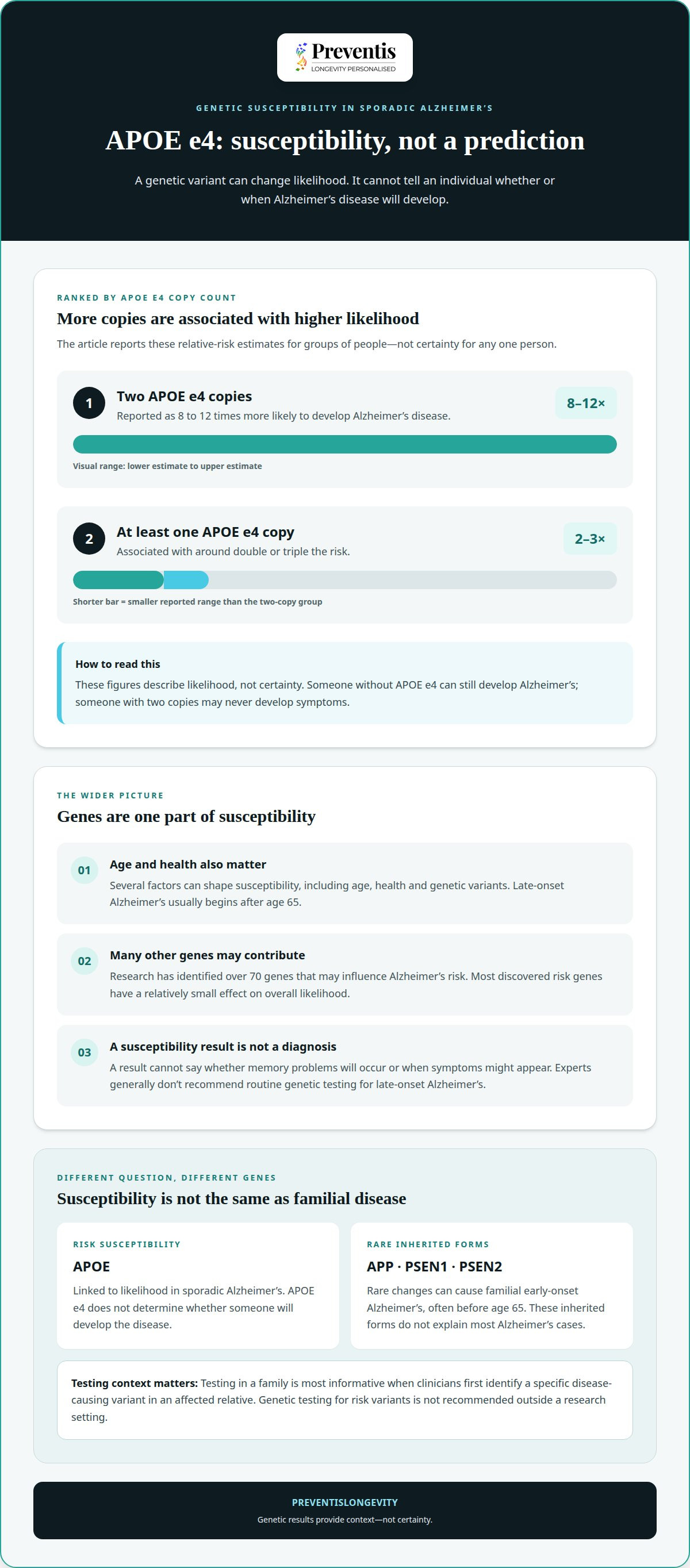
Sporadic Alzheimer’s usually has no single inherited cause. Instead, several factors can shape susceptibility, including age, health and genetic variants. Late-onset Alzheimer’s disease usually begins after age 65. A genetic result can add context to a person’s risk, but it cannot provide a diagnosis or tell when symptoms might appear.
APOE is one of the best-known genes linked to this susceptibility. Each person inherits two copies, one from each parent. The APOE e4 variant is associated with a higher likelihood of Alzheimer’s disease, but having it does not mean someone will necessarily develop the disease. People with at least one e4 variant have around double or triple the risk; people with two copies are 8 to 12 times more likely to develop Alzheimer’s disease.
Those relative-risk figures describe groups, not an individual’s certainty. A higher likelihood does not reveal whether memory problems will occur, or when onset might happen. Other influences also matter. A person without APOE e4 can still develop Alzheimer’s, while someone with two copies may never develop symptoms. This is why experts generally don’t recommend routine genetic testing for late-onset Alzheimer’s.
Research has identified over 70 genes that may influence Alzheimer’s risk. Most discovered risk genes have a relatively small effect on overall likelihood. Researchers continue to investigate how these variants interact with other causes and whether findings can improve prevention or care. Genetic testing for risk variants is not recommended outside a research setting, so a research study’s aims and testing process differ from a clinical diagnosis.
Familial Alzheimer’s is different from sporadic disease. Rare changes in APP, PSEN1 and PSEN2 can cause early-onset Alzheimer’s, often before age 65. A person with a disease-causing variant in one of these genes can pass it to a child, though inheritance does not explain most Alzheimer’s cases. Testing in a family is most informative when clinicians first identify a specific disease-causing variant in an affected relative.
That distinction can guide the next step: a susceptibility test asks about likelihood, while diagnostic testing looks for a gene change that may explain disease in a family. Neither replaces assessment of symptoms or memory changes. For readers considering broader genetic information, whole genome sequencing can provide a wider view of genetic data, which requires careful interpretation in the context of personal and family history.
Is there a genetic test for dementia?
Yes. Genetic testing can examine inherited dementia-causing changes or variants associated with risk, but these tests answer different questions. A result cannot, by itself, diagnose dementia or predict exactly what will happen.
What Dementia Genetic Tests Can Estimate
A genetic test may identify a variant linked to increased susceptibility or a specific inherited cause. APOE testing estimates Alzheimer’s risk, while testing for a known familial change looks for that particular cause. APOE results indicate likelihood, not certainty. This distinction matters: a risk estimate may inform decisions, but it cannot establish whether someone’s symptoms are due to Alzheimer’s disease.
Accuracy of Genetic Screening
Accuracy depends on the test, the variant examined and the laboratory method. Direct-to-consumer dementia tests may not be accurate and are less reliable than testing in an accredited genetics laboratory. Even a technically accurate result has limits: a genetic risk test does not diagnose current dementia. Risk-variant testing is not recommended outside a research setting, so its purpose should be clear before testing.
Interpreting Results and Symptom Timing
A positive result may identify a risk variant or show that someone carries a known disease-causing change in their family. It cannot reliably predict when symptoms will begin. A negative result for a specific familial change means that change was not detected, but it does not rule out dementia from other causes. Results may also reveal an incidental finding or suggest another dementia syndrome.
Consequences of Test Results
Results can influence future planning and affect how relatives think about their own chance of inheriting a familial change from a parent. A predictive result may also carry emotional consequences, so deciding whether to know is personal. In the UK, insurers cannot require a predictive dementia test or demand its results. Under the UK Code on Genetic Testing and Insurance, the stated exception concerns life insurance applications over £500,000.00 for a Huntington's disease test, according to UK Government and Association of British Insurers.
Before predictive testing, counselling with a trained professional supports informed consent and discussion of possible outcomes. Anyone considering testing for a known dementia gene should have at least two pre-test appointments before testing proceeds. Counselling can continue after the result, helping the person understand what the finding means for them and their relatives.
Diagnostic genetic testing usually involves a blood sample. Consent should be informed, and results should be confidential. These protections matter because a result may concern both the person tested and their family. Before taking a sample, a doctor or genetics specialist can explain the test’s purpose, the information it may produce and how the results relate to the family history.
Age at onset and family-history criteria
The age at which symptoms begin and the pattern of dementia among relatives can help show when an inherited cause might be considered. These details give a doctor a clearer basis for discussing assessment and testing.
Age at Onset and Testing Criteria
Age at onset means the age when dementia symptoms first appear, and it can influence whether genomic testing is considered. UK guidance says testing should be considered for likely Alzheimer’s disease beginning below 55. A family history may also support testing when one or more first- or second-degree relatives developed Alzheimer’s before 65. These criteria help distinguish a possible inherited cause from later-onset disease.
Young-onset dementia describes symptoms starting before 65, while young-onset Alzheimer’s symptoms can appear between 30 and 60. The age alone doesn’t establish a genetic cause. A strong family history becomes especially relevant when symptoms start before 50 and close relatives also developed Alzheimer’s at a younger age. A doctor may gather medical history spanning three generations to look for a consistent pattern.
Young-Onset Dementia and Family Patterns
Family history is more informative when it records who was affected, their relationship to the person, and their age at onset. For example, Alzheimer’s beginning before 65 in a parent and another close relative gives a specialist a different pattern to assess than one older relative with later-onset symptoms. A family history can guide whether genetics assessment is appropriate, but it does not prove inheritance.
The history should include more than Alzheimer’s diagnoses. Related neurological conditions, including motor neurone disease and Parkinson’s disease, may be relevant when clinicians assess suspected genetic Alzheimer’s. For frontotemporal dementia, familial forms are most common between 40 and 60. Sharing accurate details about relatives’ symptoms, diagnoses and ages can help make the pattern clearer for a doctor or genetics service.
If a pattern of young-onset dementia in your family concerns you, discuss the family history with your doctor. Clinical genetics services can provide counselling and consider genomic counselling and predictive testing for at-risk relatives. Predictive testing is most informative when a disease-causing gene change has already been identified in the family. A negative result for that specific change does not rule out dementia from other causes.
Family history is only one part of future risk. Moderate exercise for 20 to 30 minutes per day, at least five days per week, is recommended to help delay the onset of genetic dementia. This is a practical health measure, not a way to remove an inherited gene change. Age at onset, family findings and lifestyle therefore offer different kinds of information, each with a distinct role in planning.
Genetic risk factors versus deterministic genes
Genetic findings may indicate increased susceptibility or point to a specific inherited cause. Understanding which type of result a test examines helps clarify what it can and cannot tell you.
Risk Genes and Dementia Risk
Risk genes influence the likelihood of developing a type of dementia, but they don’t determine an individual outcome. APOE e4 is associated with increased Alzheimer’s risk, and also with cardiovascular disease and vascular dementia. Other influences contribute to whether disease develops. This distinction matters because finding a risk variant does not mean someone will develop dementia, and not carrying one doesn’t rule it out.
Risk is different from diagnosis. A genetic finding cannot establish that memory or thinking changes are caused by Alzheimer’s, nor predict exactly when symptoms may begin. Researchers have identified over 70 genes that may increase Alzheimer’s risk, but most known risk genes have relatively small effects on overall likelihood. Genetic risk testing therefore offers a limited part of a wider health picture.
Inherited Genes and Deterministic Effects
Deterministic genes are rare changes that can directly cause inherited dementia, rather than simply shifting risk. APP, PSEN1 and PSEN2 are linked to familial Alzheimer’s, while MAPT, GRN and C9orf72 can cause frontotemporal dementia. A disease-causing variant can be passed from a parent to a child. Identifying a known family variant can clarify whether a relative inherited that specific change.
Dementia caused directly by a single inherited gene accounts for about 1 in 100 cases. In familial Alzheimer’s, APP, PSEN1 and PSEN2 are associated with symptoms before 65. Familial frontotemporal dementia has a stronger genetic contribution, with around 30-40% of cases genetic. These figures describe different types of dementia, so they shouldn’t be treated as a single estimate for one family.
The genes involved may also point to the type of dementia being considered. SNCA and SNCB are associated with familial dementia with Lewy bodies, although vascular dementia and dementia with Lewy bodies are rarely genetic overall. Parkinson’s disease may be relevant when clinicians assess family history, as related neurological diagnoses can help clarify the pattern.
For relatives, the key question is whether a disease-causing variant has been identified in an affected family member. A negative result for that specific change means it was not inherited, but it cannot exclude dementia from other causes. Discuss genetic findings with an online genetic counsellor to understand how risk and inherited variants differ. Whole Genome testing can also provide broad genetic information, which needs careful interpretation rather than being treated as a prediction.
PreventisLongevity: Preventis 17 Gene BRCA/Lynch
Preventis 17 Gene BRCA/Lynch is a genetic testing panel for BRCA- and Lynch-related findings, not a dementia-risk test. If your concern is dementia, an online genetic counsellor service can help you understand how family history and different types of genetic testing relate to your question.
For a broader preventive health perspective, Preventis Max Prevention and Preventis Preventive panel offer proactive health insights through diagnostic kits. These are distinct from NHS diagnostic testing for suspected inherited dementia, so they should not replace clinical genetics assessment when a family has a known dementia-causing gene change.
Choosing a test starts with clarifying what you want to learn: a specific inherited cause, a risk estimate or broader health insights. Contact PreventisLongevity to discuss which available genetic or preventive offering best fits your goals.
Make your next step match your question
Genetic information is most useful when it addresses a clearly defined concern. Genetic screening for dementia risk can help frame questions about susceptibility, while a family pattern may call for a different kind of clinical assessment. Keeping that distinction in mind can help you choose a next step that fits your priorities.
If you’re considering genetic screening for dementia risk, focus on what you hope to learn and how the result could inform your decisions. For broader preventive health insights, Preventis Max Prevention and Preventis Preventive panel offer different routes to explore personal health. Preventis 17 Gene BRCA/Lynch focuses on BRCA- and Lynch-related findings, not dementia risk.
If you’d like to explore which genetic or preventive options align with your priorities, contact PreventisLongevity to discuss testing. A considered next step can help turn questions into a clearer, more informed plan.
Frequently Asked Questions
Alzheimer's genes: Are you at risk?
Your risk depends on the genes you carry, your age and other influences, so a family history alone cannot provide a personal prediction. APOE e4 is associated with increased susceptibility, while rare changes in APP, PSEN1 or PSEN2 can cause familial Alzheimer’s. If several relatives developed dementia unusually young, record their diagnoses and ages at onset. That information gives a clinician a clearer starting point for assessing inherited risk.
Does a negative result mean a person won't get dementia?
No. A negative result only means the particular gene change included in that test wasn’t found. It cannot exclude dementia caused by other genetic or non-genetic factors. For example, a relative who tests negative for a known familial variant may still develop dementia for an unrelated reason. Read the result in light of the test’s scope: a report about one variant cannot answer questions about every gene linked to dementia.
How long do the results take?
For private genetic testing, results are usually ready 6 to 8 weeks after the blood sample is taken. The timing relates to laboratory analysis and interpretation, rather than the time needed to collect the sample. Diagnostic testing and predictive testing may follow different clinical pathways. Before a test begins, establish what sample is required and how results will be explained, so the waiting period and next steps are clear.
Is dementia hereditary?
Some forms of dementia can be inherited, but most dementia is not directly caused by a single inherited gene. Rare familial Alzheimer’s and frontotemporal dementia can involve disease-causing gene changes passed through families. By contrast, variants such as APOE e4 influence susceptibility rather than guaranteeing disease. A family pattern can therefore be a useful clue, but it doesn’t establish that every relative will develop the same type of dementia.
What are the benefits of predictive testing?
Predictive testing can show whether someone has inherited a known disease-causing variant already identified in their family. This information may help with personal planning and conversations with relatives. It can also bring difficult uncertainty, and it cannot predict an exact age for symptom onset. Counselling before testing gives someone time to consider whether knowing the result would help with decisions, including whether they want to receive the information at all.
Who should consider genetic testing for inherited dementia in the UK?
Testing may be considered when likely Alzheimer’s begins below 55, or when one or more first- or second-degree relatives developed Alzheimer’s before 65. A strong family pattern of young-onset dementia can also prompt clinical assessment. The relevant history includes diagnoses and ages at onset, plus neurological conditions such as motor neurone disease or Parkinson’s. People concerned about such a pattern can raise it with their doctor for assessment.
What does private dementia genetic testing cost in the UK?
There is no single price for every private genetic test for dementia. The cost depends on whether testing targets a known family variant or examines a broader set of genes, as well as what laboratory analysis and interpretation are included. These differences matter more than the label “dementia test”. Before deciding, clarify which question the test answers and whether counselling is included, rather than comparing tests with different purposes.
What is the difference between direct-to-consumer DNA tests and clinical genetic testing for dementia?
Clinical genetic testing for suspected inherited dementia uses an accredited genetics laboratory and is interpreted as part of a clinical assessment. Direct-to-consumer tests may not be accurate, and their results may not guide a clinical referral. A consumer report about a risk variant is not a dementia diagnosis. Clinical testing also considers family history, symptoms and the specific test question together, helping make the result more meaningful.


