

Could a pattern of cancer in your family matter even if you feel well? It’s understandable to wonder whether your history makes genetic screening for lynch syndrome relevant, or to worry that a genetic test might tell you whether you have cancer. It doesn’t: inherited testing looks for gene variants that may inform risk and clinical decisions.
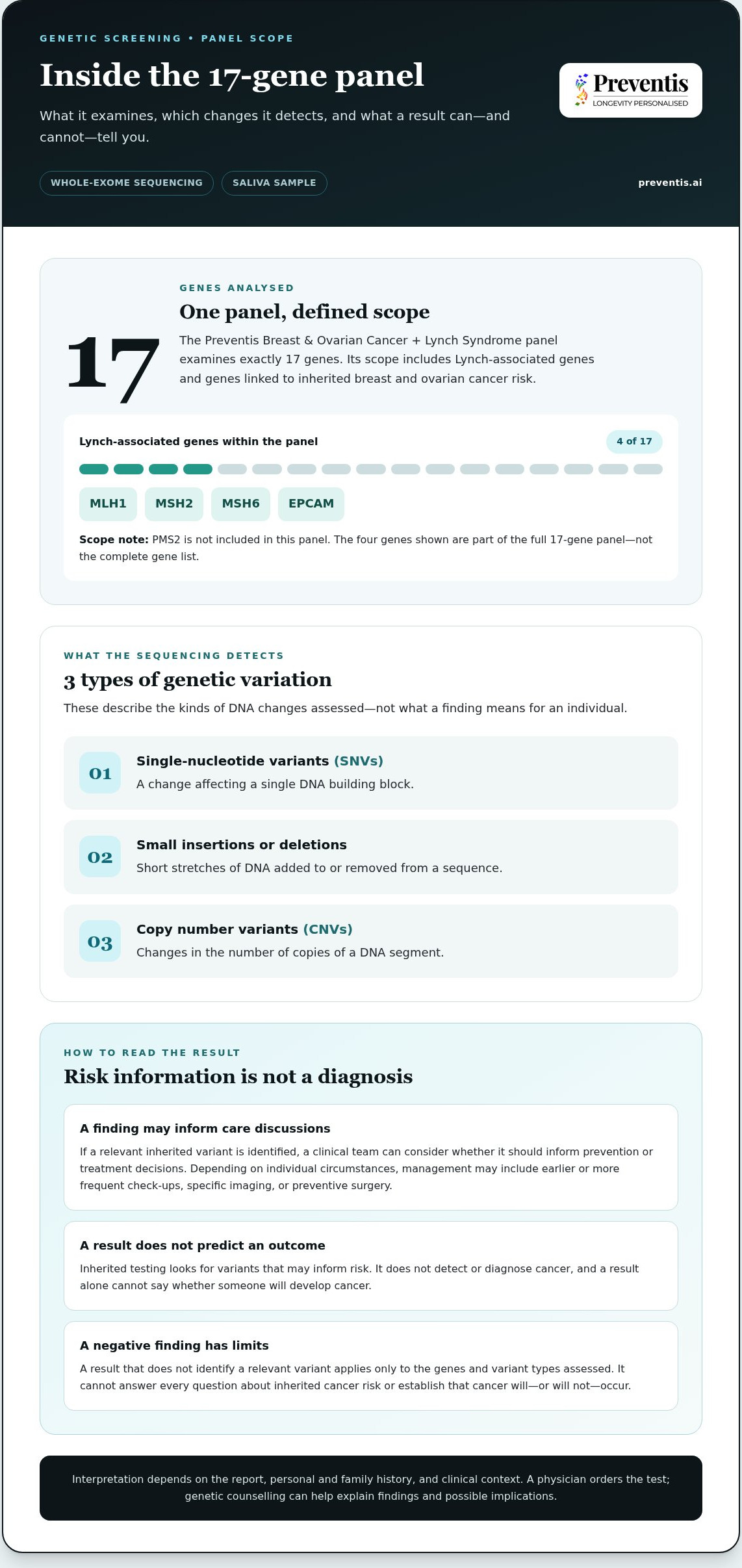
This guide explains who may consider testing, what a result can and can’t tell you, and how physician and genetic-counsellor support can put findings into context. It also explains what the 17-gene panel analyses. It includes the Lynch-associated genes MLH1, MSH2, MSH6 and EPCAM, but not PMS2. That distinction matters when considering the panel’s scope.
You’ll learn how the test uses a saliva sample to assess specific types of genetic variants, and why results are not a diagnosis. A physician orders the test, and a genetic counsellor discusses the report with you. Together, they can help put complex information into context for your care and, where relevant, your family.
Key Takeaways
- See how personal and family cancer history can inform a conversation with a physician about genetic screening for lynch syndrome.
- Learn what the 17-gene panel examines, including SNVs, small insertions/deletions and copy number variants (CNVs), and understand its defined scope.
- Understand how inherited-risk findings differ from a cancer diagnosis and how results can support personalised clinical decisions without predicting an outcome.
- Explore the physician-led testing pathway, expert-reviewed report and pre-test and post-test genetic counselling, available upon request. PreventisLongevity information: care@preventislongevity.com and preventislongevity.com.
What is Lynch syndrome genetic screening, and who may consider it?
Lynch syndrome is an inherited condition associated with gene variants that can increase a person’s risk of developing certain cancers. Genetic screening for lynch syndrome looks for inherited variants that may be relevant to that risk. It does not detect or diagnose cancer, and a result alone cannot say whether someone will develop cancer.
The test’s purpose is to provide information for a physician-led discussion about risk and possible next steps, not to make a diagnosis or predict an outcome. Personal and family history, along with the genes analysed, all matter when interpreting a result.
Which personal or family histories can make screening relevant?
A conversation about testing may be relevant for someone diagnosed with a cancer related to Lynch syndrome, or for someone whose family history includes Lynch-syndrome-associated cancers. The panel also assesses inherited breast and ovarian cancer risk, so a history of these cancers may be relevant to a discussion about its scope.
The Preventis 17-genes Breast & Ovarian Cancer + Lynch Syndrome panel is intended for people with any cancer related to Lynch syndrome, as well as people with a family history of breast, ovarian or Lynch-syndrome-associated cancers. These are circumstances in which testing may be considered, not a fixed eligibility rule. A physician orders the test and can consider the person’s history in deciding whether it is appropriate. For information, visit preventis.ai or email care@preventis.ai.
Family history can provide useful context, but a known pattern in relatives is not the only reason to discuss testing. A family history of cancer does not establish that an inherited variant is present, and not knowing of such a history does not answer the question of whether testing may be relevant. The decision depends on the clinical context and the scope of the test.
What can inherited risk information contribute?
If a result identifies a relevant inherited variant, the clinical team can consider whether the information should inform prevention or treatment decisions. Depending on the individual circumstances, clinical management may include earlier or more frequent check-ups, specific imaging or preventive surgery. The appropriate approach is based on clinical assessment, not on a genetic result in isolation.
A result that does not identify a relevant variant is limited to the genes and types of variants assessed. It cannot answer every question about inherited cancer risk. Genetic counselling can help explain the findings and their potential implications for the person tested and, where relevant, their family.
In practical terms, genetic screening can add information to a broader care discussion. It cannot guarantee that cancer will or won’t occur. A physician can consider the findings alongside the person’s circumstances when discussing care.
What does a Lynch syndrome genetic panel analyse?
To understand a panel’s scope, look at both the genes it examines and the kinds of DNA changes it can detect. The Preventis 17-genes Breast & Ovarian Cancer + Lynch Syndrome panel uses whole-exome sequencing of a saliva sample to analyse exactly 17 genes. Four are Lynch-associated, and the panel also covers inherited breast and ovarian cancer risk. For information about the panel, visit preventis.ai or email care@preventis.ai.
Which Lynch-associated genes are included in the panel?
The panel includes MLH1, MSH2, MSH6 and EPCAM. These four Lynch-associated genes are part of the full 17-gene panel, not its complete gene list. The remaining genes extend the panel’s scope to inherited breast and ovarian cancer risk. Knowing this can help you understand what the test examines and what it does not claim to cover.
The Preventis 17 genes panel analyses 17 genes in total, including the Lynch-associated genes MLH1, MSH2, MSH6 and EPCAM. This distinction can be useful when discussing a multi-gene panel with a physician. The physician can consider its defined scope alongside personal and family history when ordering the test. For information, visit preventis.ai or email care@preventis.ai.
Which genetic variant types can the test detect?
The panel uses whole-exome sequencing and detects three types of genetic variation:
- Single-nucleotide variants (SNVs): changes affecting a single DNA building block.
- Small insertions or deletions: short stretches of DNA added to or removed from a sequence.
- Copy number variants (CNVs): changes in the number of copies of a DNA segment.
These terms describe types of genetic changes, not what a particular finding means for an individual. The report’s variant interpretation and clinical context are important: a detected variant is not itself a diagnosis or a prediction of future cancer. The panel’s stated detection capabilities also do not mean that it identifies every inherited cause of cancer. Findings relate to the genes and variant types analysed and the reason for testing.
If you’re considering genetic screening for lynch syndrome, these details can help focus a discussion with your physician: which genes are included, which variant types are assessed and how the report will be interpreted. Additional genes may be studied at the physician’s discretion without taking a new sample. Visit Preventis’ genetic testing information or email care@preventis.ai to learn more about the panel.
What can screening results tell you, and what can they not establish?
Genetic screening for lynch syndrome can provide inherited-risk information for a clinical team to consider when discussing prevention or management. It is not a cancer test: a genetic finding does not show that cancer is present, and a result cannot guarantee whether someone will or won’t develop cancer.
| Inherited genetic testing can help show | It cannot establish |
|---|---|
| Whether the analysis identified a variant in a gene included in the panel that may be relevant to inherited cancer risk. | Whether a person currently has cancer or will develop it in the future. |
| Information for a physician-led discussion about prevention and personalised management. | A complete account of every possible inherited or other cause of cancer risk. |
The distinction is practical. A result can inform a care discussion, but it needs to be considered alongside medical and family history. Decisions about monitoring or treatment depend on the clinical team and individual circumstances; testing does not promise a particular outcome.
How should a result be interpreted in clinical context?
For the Preventis 17-genes Breast & Ovarian Cancer + Lynch Syndrome panel, a team of expert geneticists reviews the report and variant interpretation. The physician orders the test, and the report is sent to the genetic counsellor, who discusses the findings with the patient. Pre-test and post-test genetic counselling are provided upon request. For information, visit preventis.ai or email care@preventis.ai.
This discussion helps put the findings in context: what the panel assessed, what the report says and how the information may relate to the person’s history. It also gives the patient an opportunity to raise questions about potential implications for family members, without treating a result as a diagnosis.
Why does a panel result not answer every cancer-risk question?
The Preventis panel analyses exactly 17 genes. It does not detect all hereditary breast, ovarian or Lynch-syndrome-associated cancers. Its findings relate to the genes and variant types assessed, so a result without a relevant finding does not settle every question about inherited risk.
Adding Lynch-syndrome genes to the panel enables detection of an additional 10%-15% of hereditary ovarian cancer cases. This figure refers specifically to hereditary ovarian cancer cases, not to all ovarian cancers or to an individual’s personal probability. It does not mean that every such case will be detected by the panel.
Where further investigation is clinically appropriate, additional genes may be studied at the physician’s discretion without taking a new sample. The report should be understood within its defined scope and the broader clinical picture. It provides information for care planning, not a standalone answer to every question about cancer risk. For information about the panel, visit preventis.ai or email care@preventis.ai.
How does physician-led genetic screening for Lynch syndrome work?
Testing follows a clinician-led pathway, from the physician’s decision to order the panel through to discussion of the report. The process uses a saliva sample, and a genetic counsellor discusses the findings with the patient. This support connects the results to the reason for testing and the wider clinical context.
What happens before and during sample collection?
The Preventis 17-genes Breast & Ovarian Cancer + Lynch Syndrome panel uses a saliva sample. The physician orders the test, after which Preventis supplies a saliva-collection kit. The sample is then used for genetic analysis. Follow the instructions provided with the kit for collecting the sample.
The pathway can be summarised in four steps:
- The physician orders the test. The physician considers the clinical context and orders the panel. Preventis supplies a saliva-collection kit.
- The patient provides a saliva sample. The sample is collected using the supplied kit and its instructions.
- The sample is processed and analysed. Whole-exome sequencing is used to analyse the panel’s specified genes. The report includes expert review and variant interpretation.
- The report is discussed with the patient. The report is sent to the genetic counsellor, who discusses the findings with the patient.
This sequence connects the physician’s decision to test with analysis of the saliva sample and a supported discussion of the report. The findings are considered in relation to the reason for testing, rather than treated as a standalone diagnosis.
Who discusses the report and provides genetic counselling?
The genetic counsellor discusses the report with the patient and can help explain its findings. Pre-test and post-test genetic counselling are provided upon request. A pre-test discussion can help clarify the purpose and scope of testing. After testing, counselling provides an opportunity to review the report and raise questions.
The report informs a conversation; it does not make care decisions by itself. The physician is part of the testing pathway and can consider the findings alongside the patient’s history and needs. The physician and genetic counsellor can help address questions that arise from the results.
To explore the physician-led genetic testing pathway, visit preventis.ai or email care@preventis.ai. The process links testing with expert review and discussion of what the findings may mean.
How can the Preventis 17 genes panel support a Lynch screening pathway?
The Preventis 17-genes Breast & Ovarian Cancer + Lynch Syndrome panel can provide inherited-risk information within a clinician-led care pathway. It analyses exactly 17 genes using whole-exome sequencing of a saliva sample. The findings are not a diagnosis or a substitute for medical care. Their relevance depends on the clinical question and the person’s health and family history. For information, visit preventis.ai or email care@preventis.ai.
What makes the panel relevant to Lynch-associated cancer risk?
Four of the panel’s 17 genes are associated with Lynch syndrome: MSH6, MSH2, MLH1 and EPCAM. The panel detects single-nucleotide variants (SNVs), small insertions/deletions and copy number variants (CNVs). This defined scope can support a focused clinical discussion, but the panel does not detect every inherited cause of breast, ovarian or Lynch-syndrome-associated cancer.
A team of expert geneticists reviews the report and variant interpretation. The physician and genetic counsellor can then help put the findings in context. The panel is one source of information for that discussion, not a complete assessment of every aspect of cancer risk. For details, visit preventis.ai or email care@preventis.ai.
What is a sensible next step after learning about screening?
If your personal or family history raises questions, discuss them with a physician. It may help to note which relatives had cancer and, if known, the cancer type and age at diagnosis. This information can help the physician consider the reason for testing and whether the panel’s scope is relevant. The panel information does not set family-history thresholds for testing.
The physician orders the test, and Preventis supplies the saliva-collection kit. After sample processing and analysis, the report is sent to a genetic counsellor for discussion with the patient. Pre-test and post-test genetic counselling are provided upon request, offering an opportunity to discuss the purpose of testing and understand the report. Clinical decisions remain part of the physician-led care pathway.
Genetic screening for lynch syndrome is most useful when its findings are interpreted alongside clinical history and expert guidance. A result may support personalised prevention or management decisions, but it cannot guarantee a particular outcome. For further information, explore the Preventis 17 genes panel or email care@preventis.ai.
Take a thoughtful next step with your cancer-risk questions
Considering genetic screening for lynch syndrome doesn’t mean you need to make decisions alone or immediately. A useful first step is to discuss your personal and family history with your physician and consider what information could help guide your care. Testing is most valuable when its purpose and limits are clear.
The Preventis 17-genes Breast & Ovarian Cancer + Lynch Syndrome panel analyses exactly 17 genes, including MLH1, MSH2, MSH6 and EPCAM, using whole-exome sequencing of a saliva sample. Expert geneticists review the report. The physician orders the test, and a genetic counsellor discusses the report with the patient. For information, visit preventis.ai or email care@preventis.ai.
To explore the panel and discuss the testing pathway with your physician, view the Preventis 17-genes Breast & Ovarian Cancer + Lynch Syndrome panel or email care@preventis.ai.
Frequently Asked Questions
What is genetic screening for Lynch syndrome?
It’s a test that examines inherited DNA for variants in specified genes associated with Lynch syndrome and related cancer risk. The information can help a physician consider whether inherited risk may be relevant to your care. It doesn’t show whether you currently have cancer or predict with certainty whether you’ll develop it. A physician can help put the test’s purpose and scope in context.
Who should consider genetic screening for Lynch syndrome?
It may be relevant to people with a cancer related to Lynch syndrome and people with a family history of Lynch-syndrome-associated, breast or ovarian cancers. The panel’s stated indications also include women diagnosed with breast or ovarian cancer and men diagnosed with breast cancer. These are reasons to discuss testing, not automatic eligibility criteria. A physician orders the test and can consider your history.
Which genes are included in the Preventis 17 genes panel for Lynch syndrome?
The panel includes MLH1, MSH2, MSH6 and EPCAM among exactly 17 genes. It also covers genes associated with inherited breast and ovarian cancer risk, so it isn’t limited to Lynch-associated genes. For information about the Preventis 17-genes Breast & Ovarian Cancer + Lynch Syndrome panel, visit preventis.ai or email care@preventis.ai.
Does a Lynch syndrome genetic test diagnose cancer?
No. Inherited genetic testing looks for DNA variants that may be relevant to risk; it doesn’t establish whether cancer is present. If you have concerns about cancer, discuss them with your physician. A genetic finding can contribute to a clinical conversation, but it isn’t a cancer diagnosis or a guarantee about future health.
Can a saliva sample be used for Lynch syndrome genetic testing?
Yes. The Preventis panel uses a saliva sample for whole-exome sequencing. In the physician-led process, the physician orders the test before Preventis supplies a saliva-collection kit. The sample is then processed for analysis of the panel’s specified genes. Follow the instructions provided with the kit. For details, visit preventis.ai or email care@preventis.ai.
Is genetic counselling available before and after testing?
Yes. Before testing, counselling can help you consider the purpose and scope of the test. After testing, the genetic counsellor discusses the report with you and can help explain its findings. The physician orders the test, and clinical decisions should be considered within your broader care.
Can the panel detect every hereditary cancer risk?
No. It analyses exactly 17 genes and does not detect every inherited cause of breast, ovarian or Lynch-syndrome-associated cancer. Its findings relate to the genes and variant types assessed, so a result without a relevant finding does not rule out all inherited risk. If clinically appropriate, additional genes may be studied at the physician’s discretion without taking a new sample.


