

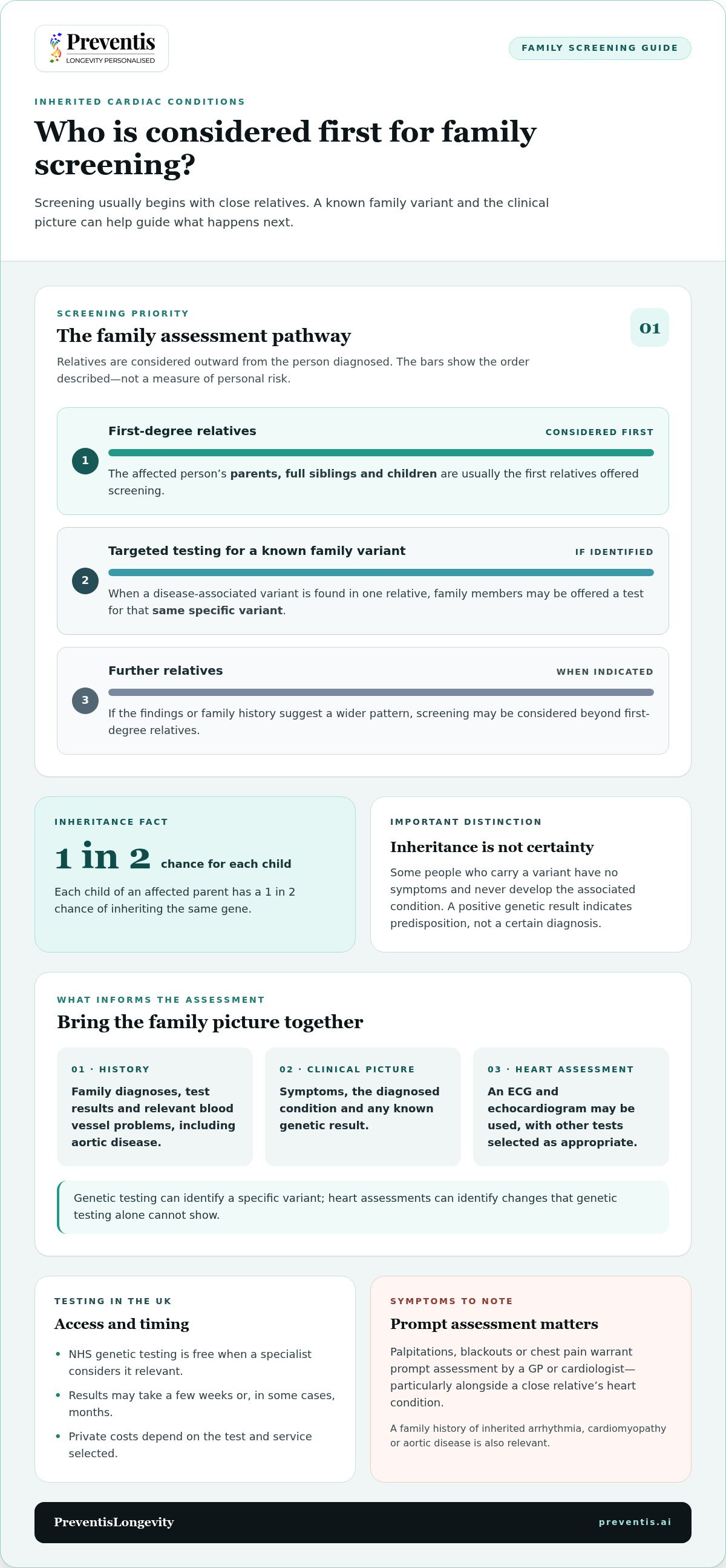
When an inherited cardiac condition is diagnosed, screening should first be offered to the person’s parents, full siblings and children. If a genetic cause has been identified, close relatives may be offered testing to check whether they carry the same genetic alteration. Inherited cardiac conditions screening can help clarify who in the family may need further assessment.
It’s understandable to wonder whether a diagnosis affects only one person or may also have implications for relatives. Knowing which family members could benefit from assessment can clarify next steps without assuming that everyone will develop the condition.
This guide explains who may be offered screening, how genetic testing and heart assessments work, and what inherited variants can mean for family risk. It also explains how a positive result differs from a diagnosis, and how genetic insights can inform a personalised approach to long-term health.
Key Takeaways
- Start by identifying parents, full siblings and children of the person diagnosed; they’re the first relatives typically considered for screening.
- A genetic result can help clarify which relatives may benefit from targeted testing and follow-up.
- Heart assessments may combine an ECG and echocardiogram with other tests chosen to investigate the family’s history and symptoms.
- Inheriting a gene variant doesn’t always mean someone will develop the associated condition, so results need to be understood in context.
- Learn how specialist services and genetic insights can help shape the next steps for your family.
Do my family members need to be tested?
After an inherited cardiac condition is diagnosed, screening should first be offered to the affected person’s parents, full siblings and children. Their assessment can help determine whether they share a family variant or have heart changes that affect their care.
How Heart Conditions Pass Through Families
Inherited heart conditions arise when a genetic alteration passes from parent to child. Each child of an affected parent has a 1 in 2 chance of inheriting the same gene. Inheritance doesn’t mean the condition will inevitably develop: some carriers have no symptoms. Knowing the pattern helps relatives understand why an assessment may be relevant even when they feel well.
Assessing First-Degree Relatives
First-degree relatives are parents, full siblings and children, and are usually considered first after a diagnosis. A specialist can review the family history alongside symptoms, the diagnosed condition and any known genetic result. Include other blood vessel problems, such as aortic disease, in that history. This broader picture can help identify which relatives need clinical assessment and whether screening should extend further.
Testing for a Known Family Variant
If genetic testing identifies a disease-associated variant in one relative, family members may be offered testing for that same variant. This targeted approach checks for a specific genetic change rather than investigating the family without that information. The result can help clarify which relatives may need ongoing assessment. The patient’s consultant explains the result and its possible implications for them and their family.
This process is called cascade screening: relatives are assessed outward from the person diagnosed, beginning with first-degree family members. If the findings or family history suggest a wider pattern, further relatives may be considered. A known variant can clarify the family connection, while heart assessments can identify changes that genetic testing alone cannot show. Keep a record of diagnoses, test results and relevant blood vessel problems to support a focused family history.
NHS genetic testing for an inherited heart condition is free when a specialist considers it relevant. In the UK, results may take a few weeks or, in some cases, months; private costs depend on the test and service selected.
Palpitations, blackouts or chest pain warrant prompt assessment by a GP or cardiologist, particularly alongside a close relative’s heart condition. A family history of inherited arrhythmia, cardiomyopathy or aortic disease is also relevant.
If screening identifies a condition, the consultant explains the findings and their implications, then uses them to guide further assessment and treatment planning. Activity advice depends on the specific diagnosis and clinical findings, so discuss exercise and any restrictions with the treating team.
What is genetic testing?
A genetic test examines DNA for changes associated with inherited heart conditions. In the UK, testing follows a discussion with a specialist, who considers the clinical findings and family history.
Genetic Testing for Heart Conditions
For heart conditions, a genetic test looks for variants linked to a suspected diagnosis. It can support diagnosis and guide further treatment, while clinical assessment helps interpret what a result means for an individual. Testing is most informative when considered alongside the person’s symptoms, heart findings and family history. In the UK, the NHS provides relevant testing free when a specialist considers it appropriate.
Penetrance and Mutation-Associated Risk
Penetrance describes how often people with a particular genetic variant develop associated features. Someone can carry a variant linked to an inherited cardiac condition without ever developing the condition or its symptoms. This distinction matters: a positive genetic result indicates a predisposition, not a certain future diagnosis. The variant, clinical findings and family history together inform how risk is understood.
A genetic result can be positive, negative or inconclusive in relation to the suspected condition. A positive result may identify a relevant variant; a negative result may leave the clinical picture unresolved. An inconclusive finding needs careful interpretation because it does not establish that a variant causes disease. The consultant explains the result and its possible implications for the person and their family.
Specialist support helps make testing a considered part of healthcare, rather than an isolated laboratory result. Genetic counselling can explain what the test may reveal, how results could affect relatives and what different outcomes mean. Before testing, people can discuss their family history and concerns; afterwards, the consultant explains the findings and their implications. This conversation supports informed decisions.
A cardiac genetics multidisciplinary team brings together expertise in heart conditions and genetics to interpret clinical and genetic information. This connects laboratory findings with the person’s medical assessment, helping the team consider appropriate follow-up. Great Ormond Street Hospital works with genetic specialists and genetic counsellors when families consider screening, illustrating how genetic expertise can support decisions across a family.
Testing is not a substitute for clinical assessment. A specialist considers the suspected condition and the person’s findings before recommending a genetic test. For instance, the Cardiac Genetics Clinic may use an ECG to assess heart rhythm and an echocardiogram to examine heart structure. These assessments provide context for interpreting a genetic result and planning further care.
For help understanding how genetic counselling can support decisions about testing and family risk, explore online genetic counselling support.
What tests are used to diagnose genetic heart problems?
Assessment combines heart tests with the patient’s symptoms and family history. The specific investigations depend on the inherited heart condition under consideration and what clinicians need to examine.
A hospital or specialist clinic may use several types of assessment. Each provides different information about heart structure, electrical activity or overall health.
- Physical examination: helps clinicians assess general signs relevant to a suspected heart condition.
- Blood tests: may contribute to the wider assessment of inherited heart problems.
- ECG: records electrical activity and can help assess heart rhythm, including an arrhythmia.
- Echocardiogram: uses ultrasound to assess heart structure.
- 24-hour heart monitor: records heart rhythm over a longer period during everyday life.
An ECG provides a snapshot of electrical activity, while a 24-hour monitor records rhythm over a longer period. This can help clinicians investigate rhythm concerns that may not appear during a brief recording. The monitor is worn during ordinary activities, and the recording is reviewed as part of the wider clinical assessment. It does not replace the family history or other test findings.
An exercise test may be considered when the assessment needs to examine the heart during exertion. Unlike a resting ECG, it involves monitoring during exercise. A clinician considers the patient’s symptoms, known diagnosis and previous results when selecting investigations. The test plan therefore reflects the clinical question, rather than applying the same set of tests to every patient or relative.
For children and adults, screening timing and repeat assessments are guided by the diagnosed condition, the family’s pattern of disease and clinical findings. The age at which relatives developed symptoms and earlier test results help shape the timing of follow-up.
Abnormal findings from a screening session need thorough assessment at an Inherited Cardiac Condition Clinic. A single result is interpreted alongside other evidence, such as an echocardiogram, ECG, symptoms and family history. This helps distinguish a finding that needs further investigation from one that fits the person’s broader clinical picture.
For relatives, sharing existing reports can help focus an assessment. Useful records include the affected family member’s diagnosis, genetic findings and previous heart test results. If a genetic cause has been identified, the specialist can consider how that information relates to the tests chosen for each relative. Together, clinical and genetic findings help guide further care.
Gene variants and inheritance probabilities
Genes carry instructions that influence how the heart develops and functions. A disease-associated variant can help explain an inherited condition and how it appears across a family.
Gene Variants
A gene variant is a difference in DNA that may affect how a gene works. Each gene has 2 copies, one inherited from each parent. Some variants are associated with conditions such as hypertrophic cardiomyopathy or long QT syndrome. Identifying a relevant variant can help explain a diagnosis and inform which relatives may benefit from targeted assessment.
The genes associated with a condition vary. MYBPC3 is linked to 40%-50% of hypertrophic cardiomyopathy cases, while MYH7 is linked to 35%-40%. For long QT syndrome, KCNQ1 is associated with 40-55% of cases, and KCNH2 with 30-45%. These figures describe gene associations among cases, not the chance that an individual carrier will develop symptoms.
A genetic cause is identified more often in some conditions than others. A gene responsible for hypertrophic cardiomyopathy can be identified in two-thirds of cases, while about one-third of dilated cardiomyopathy cases are inherited. These differences help explain why testing may identify a cause in one family but not another.
Inheritance Probabilities
For an inherited heart condition caused by a faulty gene, each child of an affected parent has a 1 in 2 chance of inheriting that gene. The same 50:50 inheritance chance applies to children of parents with hypertrophic cardiomyopathy, dilated cardiomyopathy or Brugada syndrome. A probability describes the chance of inheriting the variant, not certainty about symptoms.
For example, a parent with a gene variant linked to Brugada syndrome may pass it to a child. The child’s result can clarify whether the variant was inherited, while clinical assessment helps interpret what it means for their health. A positive result does not establish that symptoms will develop.
Family history adds context to these probabilities. Note which relatives were diagnosed, the condition named and any known genetic test findings. If several family members have a similar syndrome, that pattern can help specialists assess whether a shared variant may be involved. Symptoms and heart findings also matter, because inheritance probability alone cannot determine an individual’s clinical picture.
These distinctions are useful when discussing children and relatives: inheritance risk concerns a gene, while diagnosis concerns a person’s health. A specialist can interpret the genetic result alongside the family history and relevant heart assessments, helping determine appropriate follow-up.
Inherited cardiovascular condition services
Inherited cardiac care brings together clinical assessment, family history and genetic information to guide appropriate follow-up. Services consider different conditions, including cardiomyopathies, rhythm disorders, aortic disease and familial high cholesterol. The key point is that care is shaped by the suspected condition, the person’s findings and the degree of family connection, not by a genetic result alone.
Hypertrophic cardiomyopathy affects about one in 500 people in the UK, according to the NHS. This inherited condition can cause areas of the heart muscle to become thickened and stiff, making it harder for the heart to contract and pump blood. Its effects vary between people. A specialist assessment can consider the diagnosis, symptoms and family pattern to determine which investigations and follow-up are appropriate.
Inherited cardiac services assess both the person diagnosed and relatives who may share a risk. A cardiologist at an Inherited Cardiac Condition Clinic determines which clinical tests are needed, with genetic testing considered when appropriate. This connects a person’s heart findings with the family history and any known genetic cause. If testing identifies a familial variant, that information can help focus relatives’ assessments, while clinical findings remain important.
Different services may be relevant to different conditions. Cardiomyopathy affects heart muscle, while inherited arrhythmias concern the heart’s electrical rhythm. Aortic disease involves blood vessels, and familial hypercholesterolaemia can raise the risk of early heart disease. These diagnoses are not interchangeable, so each relative’s history, symptoms and existing test results help shape the clinical question and next assessment.
Care also involves coordination. The NHS England inherited cardiac conditions service specification says the multidisciplinary team should meet regularly at least once within a 12-month period. In Scotland, inherited cardiac genetic services are managed by specialist hospital doctors in 4 regional centres. These arrangements connect specialist expertise with assessment and follow-up, including where children’s care later transitions to an adult service.
For families, practical preparation can help focus a specialist review. Record the diagnosed condition, affected relatives, known genetic findings and any history of blood vessel disease. Include details such as rhythm symptoms or a reported heart muscle diagnosis. This information helps clinicians understand whether family members may need assessment and which service pathway fits the clinical picture.
If your family history raises questions about inherited heart risk, explore a personalised next step.
PreventisLongevity: Preventis 17 Gene BRCA/Lynch
PreventisLongevity’s Preventis 17 Gene BRCA/Lynch focuses on genetic variants associated with BRCA- and Lynch-related cancer risk, not inherited cardiac conditions. It may be relevant if your family history raises questions about these cancer risks, but it doesn’t replace cardiac assessment or testing for a known heart-condition variant.
For heart-related concerns, use your family’s diagnosis and any existing genetic findings to guide a discussion with a cardiac specialist. Keeping cancer and cardiac genetic questions distinct helps you choose a test that matches the question you need answered. PreventisLongevity also offers an online genetic counsellor service to support discussions about genetic information.
Visit preventis.ai to explore the available genetic testing and counselling options.
Make your next health decision with clarity
Use your family history to shape a focused conversation about the health questions that matter most. For suspected inherited heart disease, cardiac assessment remains the way to evaluate heart-specific risk; broader genetic testing serves a different purpose and should not be treated as a substitute.
PreventisLongevity offers the Preventis 17 Gene BRCA/Lynch, Preventis Max Prevention and Preventis Preventive panel. These provide options for exploring genetic and preventive health questions, while the BRCA/Lynch panel addresses cancer-related genetic risk rather than diagnosing an inherited cardiac condition. Choose an option based on the question you want answered, and discuss heart concerns with an appropriate healthcare professional.
Taking a considered approach to inherited cardiac conditions screening means matching the test to the health question and interpreting findings in context. Explore PreventisLongevity’s testing options and consider which next step fits your wider health goals.
Clear information can help you move forward with purpose and confidence.
Frequently Asked Questions
Which conditions can be inherited?
Inherited heart conditions include cardiomyopathies, electrical rhythm disorders, aortic disease and familial hypercholesterolaemia. Examples include hypertrophic cardiomyopathy, long QT syndrome and Brugada syndrome. The affected part of the body differs: cardiomyopathies involve heart muscle, while aortic conditions affect major blood vessels. If your family has several different diagnoses, record each condition by name; a specialist can consider whether they might share an inherited cause.
How do I know if I have an inherited heart problem?
You may have no symptoms, so family history can be an important clue. Palpitations, blackouts or chest pain need medical assessment, particularly if a close relative has had a heart condition. For example, tell your GP about a parent’s cardiomyopathy even if you feel well. Bring any diagnosis or genetic test information your family can access, as these details help shape the assessment.
What is genetic screening?
Genetic screening looks for DNA variants associated with a condition or inherited risk. For a heart condition, testing is most informative when a specialist has considered the clinical picture and family history. If a disease-associated variant has already been identified in a relative, testing can look specifically for it. A genetic result describes what was found in DNA and needs clinical interpretation to understand its relevance.
What is hypertrophic cardiomyopathy?
Hypertrophic cardiomyopathy is an inherited condition in which areas of the heart muscle become thickened and stiff. This can make it harder for the heart to contract and pump blood. The condition can affect relatives differently, so a family diagnosis can be relevant even when another member feels well. Assessment considers the person’s heart findings and family history, rather than relying on symptoms alone.
Which inherited cardiac conditions can cause sudden cardiac death?
Some inherited cardiomyopathies and electrical conditions can be associated with sudden cardiac death. Examples include hypertrophic cardiomyopathy, arrhythmogenic cardiomyopathy, long QT syndrome and Brugada syndrome. Risk depends on the specific condition and the person’s clinical findings; a family diagnosis alone does not establish an individual outcome. If a relative has died suddenly or had a diagnosed inherited condition, share that history with a GP or cardiologist.
Who should be offered screening for inherited cardiac conditions in the UK?
After an inherited cardiac condition is diagnosed, screening should first be offered to the affected person’s parents, full siblings and children. This is the starting point for inherited cardiac conditions screening because close relatives may share a genetic cause. Assessment considers the named diagnosis, family history and any identified variant. If the findings suggest a wider family pattern, specialists can consider further relatives.
What are the NHS screening recommendations for first-degree relatives of someone diagnosed with an inherited heart condition?
First-degree relatives, meaning parents, full siblings and children, should be offered screening after a diagnosis. Clinical assessment can include heart tests, with genetic testing considered when a specialist finds it relevant. If a familial variant is known, relatives may be tested for that specific change. Findings help determine whether follow-up should focus on those relatives or extend to other family members.
What tests are used to screen for inherited cardiac conditions, such as ECG, echocardiogram and genetic testing?
Assessment can include a physical examination, blood tests, an ECG and an echocardiogram. An ECG records the heart’s electrical activity and helps assess rhythm; an echocardiogram examines heart structure. A 24-hour heart monitor records rhythm over a longer period. Genetic testing looks for relevant DNA variants and is discussed with a specialist. The tests selected depend on the suspected condition, clinical findings and family history.


