

A screening result is a starting point, not a diagnosis. Screening looks for possible signs of a health condition before it causes symptoms; in England, for example, everyone aged 50 to 74 is offered a bowel cancer home test kit every 2 years, according to NHS England. For anyone comparing preventative health screening kits in the UK, the key is understanding what each test can tell you, and what it can’t.
It’s natural to want a clearer picture of your health and to understand how a kit works and whether its results can guide useful next steps. This guide explains what screening means, how UK packages differ, how samples are collected and processed, and what to expect from results. It also outlines the benefits and limits of screening, helping you interpret health information and make informed decisions about your wellbeing.
Key Takeaways
- Distinguish routine screening from diagnostic testing, and match a package to the health information it is designed to provide.
- Understand how at-home samples are collected, returned and prepared for laboratory analysis.
- Learn what can affect result timing and how reports communicate findings and possible next steps.
- Use screening results as information to guide decisions, not as a diagnosis; NHS screening tests are not 100% accurate, according to the NHS.
- Recognise the benefits and limits of screening so you can decide how it fits into your wider approach to health.
Do you offer a range of health screening packages?
Preventative health screening kits in the UK can focus on specific risks rather than offer one universal health check. Compare the conditions tested, the sample required and how the results may inform your next step.
Cardiac, Diabetes and Cancer-Risk Screening
Cardiac screening may assess selected markers linked to cardiovascular health, while diabetes testing may measure blood indicators of glucose regulation. Cancer-risk screening can include genetic testing, which looks for inherited risk rather than diagnosing cancer. Check which conditions and markers a package covers and whether its report explains the limits of each result. Blood tests and genetic tests answer different questions.
For cancer risk, distinguish between screening for signs of an existing condition and estimating inherited susceptibility. A genetic result can inform a discussion about personal risk, but it does not detect a tumour. PSA testing measures prostate-specific antigen in the blood and may form part of a discussion about prostate cancer risk. Interpret the result in context, including why testing was considered and what follow-up may involve.
For lung cancer, screening programmes and private tests are not interchangeable. Some parts of England contact people aged 55 to 74 who have ever smoked about lung cancer screening. A screening invitation is different from buying a general kit: check the condition being assessed and whether the test is designed for people with particular risk factors.
Private Kit Costs
Private health screening kits are paid services, and the cost depends on the package’s scope, sample type and laboratory analysis. A focused test and a broader panel provide different information, so compare what each includes rather than choosing by price alone. Look for clear details about the tests performed, the report and any follow-up pathway. There is no single price for every kit.
Personal health data may include contact details, sample identifiers and test results. Before sending a sample, read the provider’s privacy information to understand what data it collects, why it uses it, how long it keeps it and who can access it. Check how results are delivered and whether you need to take action to share them with a clinician. These steps help you understand how sensitive information is handled.
NHS screening programmes are available in England, but they target defined conditions and groups rather than replacing every private package. For example, everyone aged 50 to 74 in England is offered a bowel cancer screening home test kit every 2 years, according to NHS England. The UK National Screening Committee advises the NHS in all 4 UK countries on which programmes to offer. An NHS screening invitation and a private test therefore serve distinct purposes.
Bowel cancer screening uses a home test kit, with eligibility and invitation timing set by the screening programme. Read the instructions carefully, collect the sample as directed and return it using the stated method. A private package may test different markers, so check whether bowel cancer screening is among its named tests. Screening may identify a reason for follow-up, but it does not diagnose a condition by itself.
Laboratory processing and result turnaround
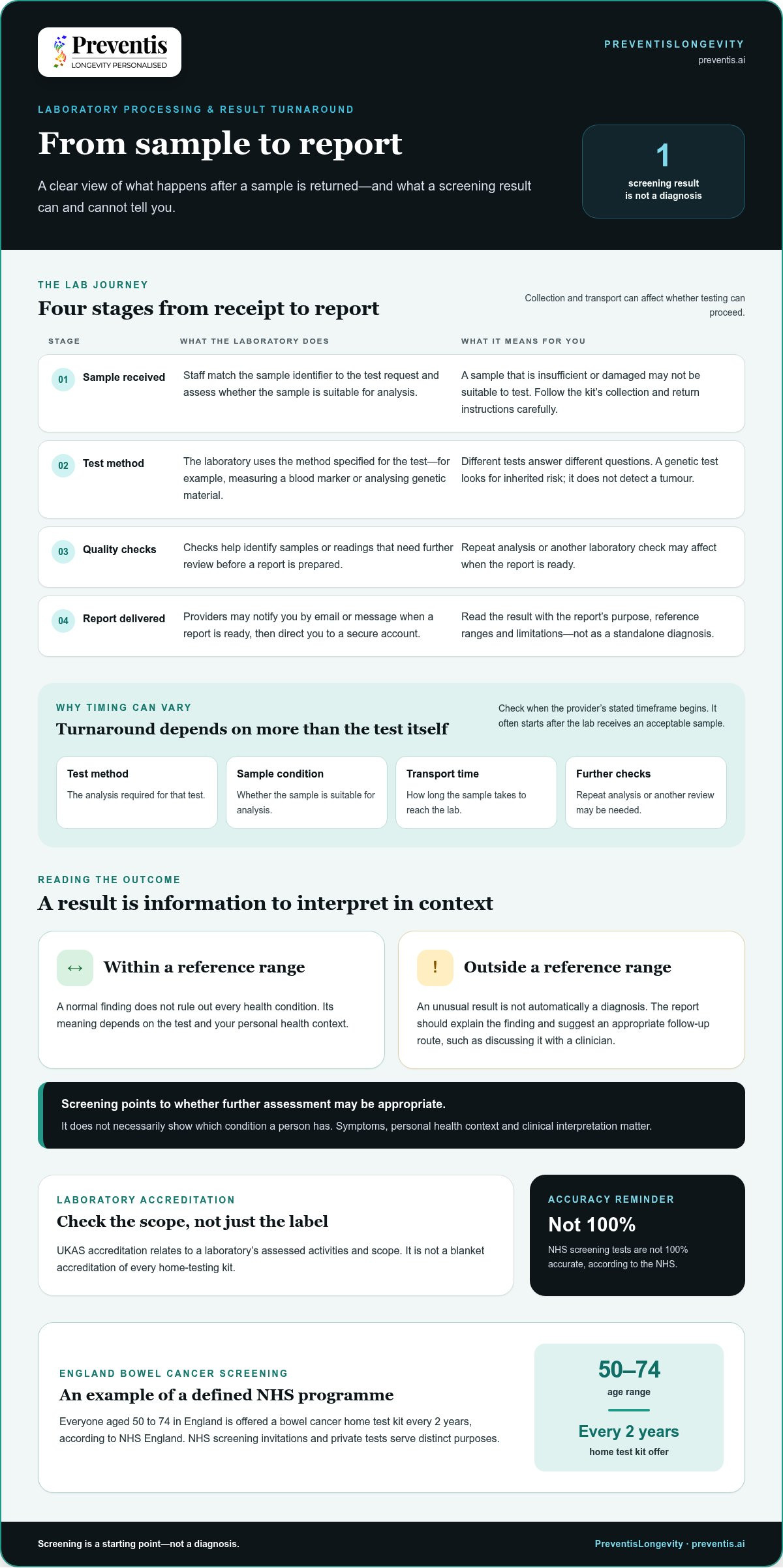
When a sample reaches the laboratory, staff match its identifier to the test request and assess whether it is suitable for analysis. The laboratory then uses the method specified for that test, such as measuring a blood marker or analysing genetic material. Quality checks help identify samples or readings that need further review before a report is prepared.
Turnaround depends on the test method, sample condition, transport time and whether repeat analysis is needed. A provider’s stated timeframe should explain when it begins, often after the laboratory receives an acceptable sample, and how results are delivered. Delays can occur if a sample is insufficient, damaged or requires another laboratory check. Follow the kit instructions closely, as collection errors can affect whether testing can proceed.
Online access usually means receiving an email or message when a report is ready, then signing in to a secure account. Read the report alongside its explanations of the test’s purpose, reference ranges and limitations. A result outside a reference range is not automatically a diagnosis; its meaning depends on the marker, symptoms and personal health context. Screening results indicate whether further assessment may be appropriate, not necessarily which condition a person has.
Are at-home blood test kits in the UK accurate and UKAS-accredited? Accuracy depends on the test, the sample and laboratory quality controls. UKAS accreditation relates to a laboratory’s assessed activities and scope, not a blanket accreditation of every home-testing kit; NHS screening tests are not 100% accurate, according to the NHS.
An abnormal result needs a clear explanation and an appropriate follow-up route. The report should identify the finding and explain what action it suggests, such as discussing it with a clinician or arranging further assessment. Clinical support can put a marker into context rather than treating one number as the whole picture. An online GP service can help you understand findings and prepare informed questions about next steps.
Before choosing an advanced test, understand what its laboratory method measures and what the report can establish. A result can be useful without being definitive: a normal finding does not rule out every health condition, while an unusual finding can require clinical interpretation. For support with interpreting results and planning follow-up, clinical guidance on test results can help connect laboratory data with practical decisions.
Benefits, risks and limitations of screening
Screening can provide information about possible health risks before symptoms prompt testing. If you have symptoms or are monitoring a diagnosed condition, seek medical advice rather than relying on an at-home screening kit.
Screening Benefits
A well-chosen screening test can flag a finding that warrants timely clinical assessment. This information may help you discuss appropriate next steps, understand a risk factor or decide whether further investigation is relevant. The benefit depends on the condition being tested, the test’s purpose and whether the result can guide a useful action. A private kit is most helpful when you know what question it answers.
Screening can also make health conversations more informed. For example, a result about inherited cancer risk raises a different question from a test for signs of cancer now. Likewise, a hormone result should be interpreted in light of the specific marker and reason for testing. Before ordering a kit, identify what you hope to understand and how the result could inform a discussion with a clinician.
Screening Risks and Limitations
No screening result gives a complete account of health. NHS screening tests are not 100% accurate, according to the NHS. A false negative can miss a condition, while a false positive can prompt concern and follow-up when the condition is absent. An unusual result is not itself a diagnosis. Its meaning depends on the test, personal context and any further assessment.
The UK National Screening Committee recommends screening only when it considers the benefits to the group offered screening to outweigh the harms. Potential downsides include anxiety, further tests and findings that may not become a health problem. A kit may also focus narrowly on selected markers, leaving other conditions outside its scope. Before deciding, read what the test detects and what its result cannot establish.
Who should avoid at-home screening kits or seek medical advice before testing? Anyone with new or worsening symptoms should seek clinical advice rather than use screening to investigate them. People already under investigation or treatment should discuss how an additional result fits into their care, since a kit cannot replace clinical context.
Screening is a choice. The decision depends on the test’s purpose, possible follow-up and your willingness to receive uncertain findings. For a genetic result, counselling can help explain what a finding may mean for you and your family. Weigh that value against the test’s limits, then choose a next step that supports an informed conversation rather than treating one result as a final answer.
Report access and turnaround time
To interpret a screening result, first establish when the stated turnaround period begins. A provider may count from sample receipt or from laboratory acceptance after initial checks. Read the kit instructions and order information to find the starting point. Then note the dispatch date and any tracking details, so you can distinguish delivery time from laboratory processing.
Processing time depends on the test method and whether the sample is suitable. A sample requiring repeat analysis follows a different path from one accepted for testing immediately. Genetic analysis and blood-marker testing also involve different laboratory steps. The advertised timeframe is most useful when you know what it covers and whether it includes report preparation and notification.
Reports are commonly delivered through a provider’s online account or another stated channel. Follow the access instructions, use the account linked to your order and keep the sample or order reference available. If you expect an email notification, check the address used at registration and its junk folder. These simple checks can help you find a completed report without confusing it with a delivery or login message.
Read the report in order. Start with the test name and result summary, then check which marker was measured, its unit and any reference range shown. A flagged result means the value differs from the range stated in that report; it does not diagnose a condition by itself. The test’s purpose matters: a test designed to detect one marker cannot answer questions about unrelated health risks.
Use the interpretation notes to understand what the result supports and what it cannot establish. For example, a result within a reference range describes the tested marker, not every aspect of your health. If the report recommends clinical follow-up, keep that recommendation with the result and share both during the discussion. A clinician can consider the finding alongside symptoms, health history and other checks.
If your report has not arrived within the advertised timeframe, check when that timeframe starts before treating it as overdue. Confirm whether the laboratory received the sample, whether the provider requested a replacement and whether the notification went to the account or email address used for the order. Contact the provider through its stated support route with your order reference and dispatch details. This gives the team specific information to trace the report.
For an informed decision, compare the advertised timeframe with the steps it covers instead of relying on a headline estimate. A clear report should identify the test performed, present the finding in understandable terms and explain the next step if further assessment is indicated. This makes the result easier to use when considering your health.
At-home sample collection and return
At-home collection starts with matching the kit to the test. Blood, saliva, stool and swab samples each require a different collection method, container and handling process. Read the instructions before opening the equipment, then check that the collection device, sample tube, label and return packaging are present. Follow the requirements for your specific test, rather than relying on general guidance.
Prepare a clean, well-lit surface and follow the instructions in order. For a finger-prick blood test, use the supplied lancet and collection tube as directed; for a saliva test, avoid eating or drinking if the kit instructions require it. A stool test may use a collection device to keep the sample separate from toilet water. These methods are not interchangeable, so follow the specific steps for your kit.
Correct identification matters. Complete the requested details and attach the sample label as directed, matching it to the order without adding information the form does not ask for. Seal the container and place it in the specified packaging. If the kit gives instructions about when to collect the sample, follow them. The laboratory needs a suitable, correctly identified sample for analysis.
Return instructions also vary by test. Some home HPV self-sampling kits arrive in discreet packaging and can be returned by prepaid mail through a local postbox. Use the return packaging supplied with that kit and check whether it requires a particular postbox or collection method. Keep any tracking or dispatch information until the laboratory confirms receipt, if those details are provided.
Before posting, check that the container is securely closed, the label is legible and the return address is visible. Don’t use ordinary packaging if the kit provides dedicated materials. If collection fails, the container leaks or the sample is spilled, follow the kit’s instructions rather than improvising. A replacement sample may be needed, depending on the test and its requirements.
Family history can help explain why someone is considering a particular test, especially when exploring inherited health risks. It does not change the collection method, but it can provide useful context for understanding a genetic test’s purpose. Keep relevant family health details available for any follow-up discussion, and share only the information requested through the appropriate channel.
For genetic screening, consider what information you hope to gain before collecting a sample. Explore genetic screening options to understand how a test may fit your health questions and family history.
PreventisLongevity: Preventis 17 Gene BRCA/Lynch
Preventis 17 Gene BRCA/Lynch is a genetic testing option for people seeking information about inherited cancer risk. It may be relevant if a family history has prompted questions about BRCA- or Lynch-associated risk. Genetic testing assesses inherited information; it does not diagnose cancer or replace screening for symptoms.
The right test depends on the question you want answered. Preventis Max Prevention and Preventis Preventive panel offer other screening routes, while Preventis MyPharma Panel focuses on pharmacogenomics. Consider the scope of each test and how you plan to use its results before choosing. If you’re exploring inherited risk, visit preventis.ai to learn more or contact PreventisLongevity.
Choose a screening path that fits your next question
The most useful next step is to turn a general interest in prevention into a clear question: are you exploring inherited cancer risk, seeking a broader health overview, or deciding which screening information could support a conversation with a healthcare professional? That focus can help you choose between preventative health screening kits in the UK without expecting one test to answer every health question.
PreventisLongevity offers Preventis 17 Gene BRCA/Lynch, Preventis Max Prevention and Preventis Preventive panel. These options provide different routes for people seeking health insights, so consider the kind of information you want to explore and how you intend to use it. Screening is most constructive when results are considered thoughtfully and lead to informed decisions, rather than being viewed in isolation.
If you’re ready to explore which option aligns with your questions, contact PreventisLongevity about screening. A considered first step can help you approach your health information with greater clarity and confidence.
Frequently Asked Questions
What is screening?
Screening checks people who feel well for signs or risk indicators that may need further assessment. It differs from diagnostic testing, which investigates a particular concern, such as a symptom or an earlier abnormal result. For example, a screening test may identify a reason for follow-up, while a clinician uses further assessment to understand what the finding means for an individual.
What are the benefits of preventative health screenings?
Screening can give you information to discuss at a health appointment and help focus questions about follow-up. Its value depends on whether the test addresses a relevant concern and whether you understand what action a result could prompt. For instance, someone considering inherited cancer-risk testing may find it useful to discuss family history before deciding what information they want and how they would use it.
What preventative health screening kits are available in the UK?
Options include NHS screening programmes and private tests, with eligibility and test scope depending on the programme or package. In England, everyone aged 50 to 74 is offered a bowel cancer screening home test kit every 2 years, according to NHS England. PreventisLongevity offers options including Preventis 17 Gene BRCA/Lynch, Preventis Max Prevention, Preventis Preventive panel and Preventis MyPharma Panel.
Which UK health screening kits offer the best value and most comprehensive tests?
There isn’t one best-value kit for everyone; value depends on how closely the test matches your health question. Compare the conditions or risk areas covered, the sample required, the report’s explanations and whether follow-up support is available. A focused genetic test and a broader preventive panel serve different purposes. Choose based on relevance and clarity, not simply on the number of tests.
How do you use and return a home health screening kit in the UK?
Follow the instructions supplied with your specific kit, because collection steps vary for blood, saliva, stool and swab samples. Check the label and return packaging before collecting, then seal and send the sample as directed. Some home HPV self-sampling kits use discreet packaging and prepaid mail through a local postbox. Keep your order reference and dispatch details until you know the sample has arrived.
What conditions and biomarkers do UK preventative screening kits test for?
Tests vary: some assess selected blood markers, while genetic panels examine inherited variants linked to particular health risks. Options include cancer-risk and cardiovascular-focused testing, health scoring and pharmacogenomic testing, which considers how genetic information may inform medicine use. Check the test description for the conditions and markers it names. A panel’s scope does not automatically include every disease or biomarker.
What are the risks of false positives and false negatives from private health screening?
A false positive suggests a possible issue that further assessment does not confirm; a false negative can miss a finding the test was designed to detect. NHS screening tests are not 100% accurate, according to the NHS, and private tests also need interpretation in context. Before testing, consider how you would respond to either result and what clinical follow-up may be appropriate.


