

A wider DNA test isn’t automatically the clearest route to a useful health insight. Advanced genomic health analysis interprets genetic variants in relation to specific health questions, from inherited cancer risk to rare disease and polygenic risk. Each person carries 4-5 million genetic variants, making the choice of test and the way results are analysed important.
It’s understandable to want a test that provides useful answers without producing data that is difficult to interpret. The right approach depends on what you want to learn: a focused cancer panel and whole-genome sequencing examine genetic information at different levels, while polygenic risk scores combine the effects of multiple variants.
This guide explains how rare disease and cancer variants are assessed, what polygenic risk can and can’t show, and how sequencing methods differ. It also outlines the factors that shape testing costs and why cancer panel analysis can be a practical starting point when the goal is to investigate specific inherited risks.
Key Takeaways
- Rare disease testing can identify a genetic explanation in 20-55% of patients, depending on the clinical indication; the right test depends on the question being investigated.
- Polygenic risk scores combine the effects of many variants, so use them as one part of a wider health-risk picture rather than a stand-alone prediction.
- Genotyping chips examine approximately 1 million of the 3 billion positions in the human genome, while whole-genome sequencing takes a broader approach.
- Bioinformatics turns sequencing data into findings by processing, interpreting and prioritising genetic variants relevant to the analysis.
- A focused cancer panel can help assess inherited cancer-related variants; Preventis 17 Gene BRCA/Lynch is one option for exploring this area.
Genetic variation in rare disease and cancer
Genetic findings can indicate a single inherited cause or a broader pattern of risk. The most useful approach depends on the health question, the variants assessed, and how the results are interpreted.
Cancer-Related Disease-Causing Variants
Cancer-related variants may affect genes involved in cell growth and DNA repair. Some rare variants are associated with neoplasms, while other genetic changes contribute to risk across many people. In one study, rare monogenic variants associated with neoplasms affected 7.7% of participants. Look at whether analysis focuses on disease-causing variants, broader risk-associated changes, or both, since these answer different questions.
Diseases Covered by Risk Scores
Risk scores are designed for particular conditions, not every possible disease. Common-disease assessments can consider many genetic variants, while breast cancer is one condition for which genetic risk can be assessed. Cardiovascular disease is also studied genetically, including through tests for rare monogenic findings. Check which conditions a score covers and whether it assesses inherited risk or specific disease-associated variants.
For rare diseases, the diagnostic rate varies from 20% to 55%, depending on the clinical indication. This range shows why the suspected condition matters when selecting an analysis. A pipeline may examine a broad set of genes, then prioritise variants that fit the person’s clinical features. A result can guide further interpretation, while a score for common disease estimates susceptibility rather than identifying a single cause.
Population figures need context. In one study group, cancer or malignancy had been reported by 15.1% of participants, compared with 9.5% of the NHANES adult group. The same study reported coronary heart disease in 4.1%, COPD in 1.0%, diabetes in 4.6%, and a liver condition in 6.1% of participants. These are reported conditions in those groups, not individual genetic-risk estimates.
Risk prediction for common diseases combines genetic information with other relevant factors. Each common-disease variant typically has an effect on risk of less than 5%, so a single variant rarely gives the full picture. A polygenic score combines multiple variants to estimate relative susceptibility. It should be read as one part of risk assessment, not as a diagnosis or a forecast of exactly who will develop disease.
Genomics England describes additional findings analysis as the search for gene alterations that may increase the risk of certain health conditions. This illustrates why analysis needs a defined purpose: searching for an explanation for a rare disease is different from assessing additional risk. Before interpreting a result, establish which condition is being assessed, which variant types are sought, and whether the finding relates to diagnosis or risk.
How polygenic risk scores combine genetic variants
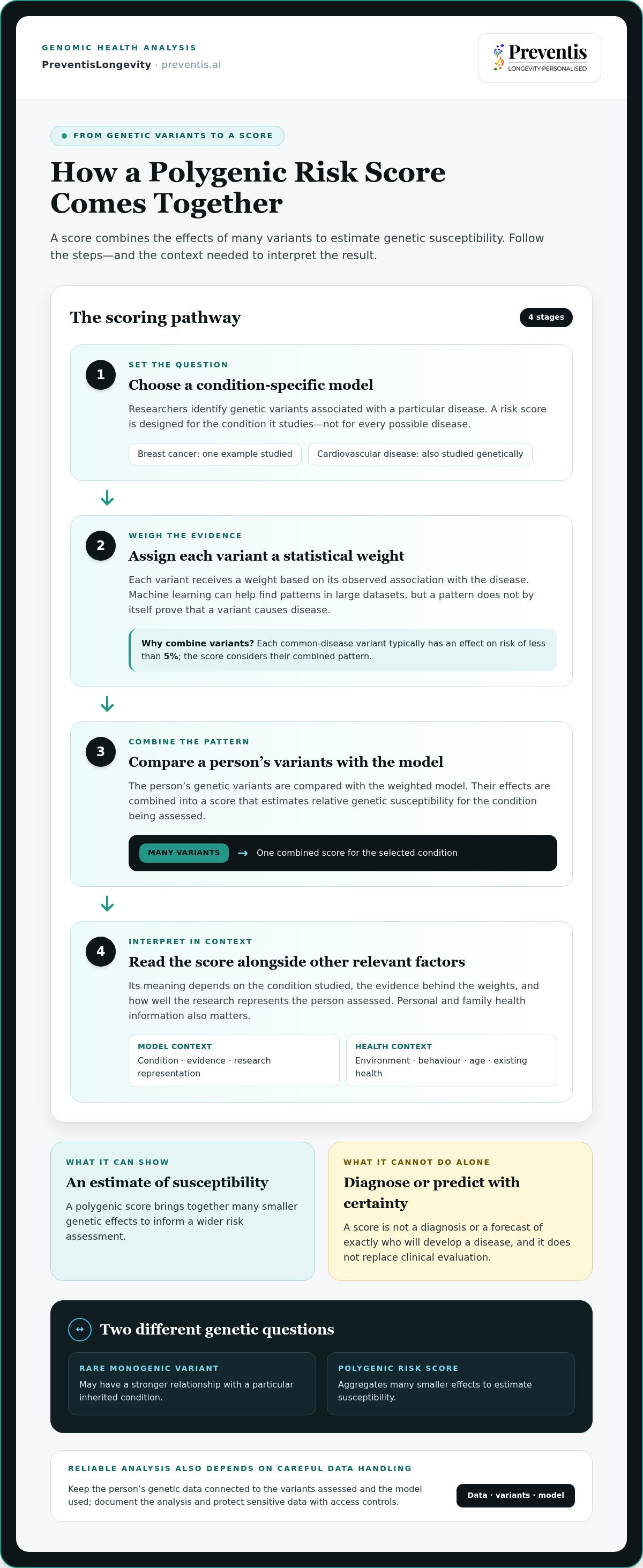
A polygenic risk score combines the effects of multiple genetic variants linked to a condition. Each common-disease risk variant typically has an effect on risk of less than 5%, so the score considers their combined pattern rather than treating one finding as a diagnosis. The result estimates genetic susceptibility, which can inform prevention discussions alongside personal and family health information.
To create a score, researchers identify variants associated with a disease and assign each a statistical weight based on its observed association. A person’s variants are then compared with that model to produce a combined score. Its meaning depends on the condition studied, the evidence behind the weights, and how well the underlying research represents the person being assessed. The number alone is not enough: its context matters.
Machine learning can help researchers analyse large genetic datasets and identify patterns linked to disease. In genetic association research, algorithms can prioritise relationships between variants and health outcomes for further study. They do not establish that a variant causes disease. Researchers still need to assess whether an association is strong and consistent, then test how reliably the model performs in relevant groups.
Polygenic scoring differs from screening for rare monogenic variants. A monogenic variant can have a stronger relationship with a particular inherited condition, while a polygenic score aggregates many smaller effects. In one study, rare monogenic variants were identified in 62 participants, representing 29.7% of participants; variants associated with cardiovascular diseases affected 1.9%. These findings describe that study group, not an individual’s likelihood of disease.
Heritability describes genetic contribution across a population; it does not tell an individual what proportion of their health is genetically determined. Environment, behaviour, age, and existing health factors also affect outcomes. A score can support risk assessment, but it does not replace diagnosis or clinical evaluation.
Data management matters throughout the scoring process. A sound workflow preserves the connection between a person’s genetic data, the variants assessed, and the model used to calculate the result. Clear documentation helps analysts interpret updated evidence without confusing a new model with an earlier score. Access controls and careful data handling also help protect sensitive genetic information during analysis and storage.
For readers considering broader genetic insights, a conversation with an online genetic counsellor can help clarify how a score differs from a diagnosis and what questions to explore next.
Comparing genotyping chips with whole-genome sequencing costs
Genotyping chips and whole-genome sequencing differ in how much genetic information they examine. A chip may suit a focused analysis, while sequencing provides a broader view of genomic data for investigating inherited conditions.
In the UK, NHS genomic services are part of NHS care, while private testing is arranged outside that pathway. The difference lies in the route and purpose of testing, so consider whether you are addressing a clinical question or seeking information for personal health planning.
Tests vary by method and target. Genotyping chips examine approximately 1 million of the 3 billion positions in the human genome, while whole-genome sequencing analyses genetic information across the genome. A targeted test examines selected genes or variants, which can be relevant to a defined condition. The method determines which changes can be assessed, not whether every result will explain a health concern.
Costs depend on the sequencing approach, laboratory processing, data interpretation, and the analysis included. When comparing services, separate the laboratory test from interpretation and reporting rather than treating the test name as the whole service.
Genomic analysis generally involves sample collection, laboratory processing, sequencing or genotyping, and computational analysis. Quality control checks whether the sample and resulting data are suitable for interpretation. Analysts then compare detected variants with the specific question being investigated before preparing the results.
Long-read sequencing analyses longer stretches of DNA than short-read approaches, which can help resolve complex genomic regions and structural changes. Because it produces a different data profile, the analysis pipeline needs to suit the method and the variant types being sought. When comparing approaches, look at the findings targeted, data quality checks, and interpretation provided.
Sequencing may identify variants unrelated to the original reason for testing, known as additional findings. Results may also be uncertain or fail to explain a condition, because analysis depends on the regions examined, data quality, and current scientific understanding. Consider how findings are interpreted and reported, particularly when they relate to inherited risk rather than an existing diagnosis.
To make an informed choice, match the test to your health question, then compare its coverage, sequencing method, quality-control process, and interpretation. This makes the difference between a genotyping chip and whole-genome sequencing clearer than comparing their labels alone.
Genomic bioinformatics and data analysis
Genomic bioinformatics converts sequencing output into findings that can be interpreted against a health question. A typical analysis pipeline checks data quality, aligns sequences to a reference genome, identifies variants, then prioritises those relevant to the requested analysis. Each step affects what appears in the report. For example, a pipeline focused on inherited variants follows a different analytical purpose from one assessing bacterial DNA.
Clinical interpretation connects genetic findings with patient information, including the reason for testing and relevant health history. Analysts consider the nature and location of a variant, and whether evidence links it to a condition. A detected change is not automatically an explanation or diagnosis. The report should clarify which findings are relevant and distinguish them from results that need further interpretation.
Genomic and healthcare data provide different kinds of context. A genetic result describes inherited information, while clinical records may contain symptoms, diagnoses, or other health observations. Considering these sources together can help assess whether a finding fits the patient’s clinical picture. National datasets can support research into population patterns, but population-level results do not replace interpretation of an individual’s genomic data.
Information security is part of responsible genomic data management because genetic information is sensitive and potentially identifying. Practical safeguards include limiting access to authorised users, separating identifying details from analysis files where appropriate, and documenting how data is stored and used. Before testing, look for clear information about data handling, retention, and sharing. These steps make the data pathway easier to understand, from sample processing through to reporting.
RNA analysis examines gene expression, showing which genes are active in a particular sample or condition. It differs from DNA analysis: DNA captures inherited sequence, while RNA reflects biological activity in the sampled tissue and context. The workflow may include quality checks, sequence processing, and comparisons of expression patterns. This adds another analytical layer, but its value depends on the research or clinical question.
Different pipelines serve different data types. GMS_16S is used for bacterial 16S analysis, a distinct workflow from human genomic analysis. Choosing the correct pipeline matters because the target sequence, reference data, and interpretation methods must match the sample. An analysis designed for bacterial 16S data cannot answer an inherited-disease question simply because both processes handle sequence data.
For a practical review, identify the data type, the question being analysed, and the steps that connect raw data to findings. Then consider how patient context informs interpretation and how genomic data access is managed. These details help show whether the analysis is designed to produce relevant, understandable insight rather than a list of unexplained variants.
Cancer panel analysis
A cancer panel examines selected genes for variants associated with inherited cancer risk. Its value depends on the genes and variant types covered, and how findings are interpreted. A focused panel can address a defined question, while whole-genome sequencing examines a much broader range of genetic information. Neither approach makes a genetic finding a cancer diagnosis.
Panel analysis typically begins by identifying relevant genes and checking sequence data for variants. Analysts then assess whether each detected change has evidence linking it to cancer risk. The significance of a result depends on the variant and the evidence supporting its interpretation. A report should distinguish a disease-associated finding from a variant whose significance remains uncertain, so readers understand what the result does and does not indicate.
The distinction between rare, higher-impact variants and common variants matters. One study reported that rare monogenic variants associated with neoplasms affected 7.7% of participants. That figure describes the study group, not an individual’s probability of developing cancer. A panel can focus on selected inherited variants, while broader approaches may assess multiple types of genetic risk.
Risk estimates can also change how inherited susceptibility is understood over time. In the research example, the 3% of women at highest genetic risk for breast cancer reached the risk level of a typical 55-year-old woman at age 45. The 3% at lowest genetic risk did not reach that same level until age 75. These comparisons illustrate risk variation, not a prediction for every individual.
Whole-genome sequencing and a cancer panel answer different questions. A panel focuses on selected cancer-related genes, making its scope easier to relate to a defined concern. Whole-genome sequencing examines a much broader span of DNA. The practical choice depends on whether you want a focused inherited-cancer assessment or broader genomic information.
To interpret a panel result, consider the genes assessed, the variant types detectable, and how the report classifies each finding. Then relate the result to the reason for testing and relevant family history. A positive inherited-risk finding indicates susceptibility, not certainty of future cancer. A result with no relevant finding does not establish that a person has no cancer risk.
Start by identifying the cancer-risk question you want the test to address, then compare it with the panel’s scope and interpretation. This keeps the result focused on useful insight rather than treating every detected variant as equally meaningful.
Explore a focused approach to inherited cancer risk and consider which panel scope best matches your health question.
PreventisLongevity: Preventis 17 Gene BRCA/Lynch
PreventisLongevity’s Preventis 17 Gene BRCA/Lynch offers a focused option for readers exploring inherited cancer risk related to BRCA and Lynch syndrome. It may suit a more specific question than broad whole-genome sequencing, where the priority is understanding this named area rather than surveying genomic data more widely.
Choosing a test starts with the health question you want to explore and the scope of analysis that fits. Preventis Max Prevention and Preventis Preventive panel offer other options for broader preventive health insights. Genetic results need to be considered alongside personal health context; they do not, by themselves, predict whether someone will develop cancer.
To discuss which approach fits your testing goals, contact PreventisLongevity or visit preventis.ai.
Make your next testing decision with clarity
Your next step is to define what you want genetic information to help you understand. A focused question about inherited cancer risk calls for a different testing discussion than a broader interest in prevention. Advanced genomic health analysis is most useful when the test and intended use of its findings are clear from the outset.
PreventisLongevity offers Preventis 17 Gene BRCA/Lynch for those exploring inherited cancer risk, alongside Preventis Max Prevention and Preventis Preventive panel for broader preventive health insights. The right starting point depends on the health question you want to explore and the kind of information you’re seeking. Taking time to frame that question can make your next decision more purposeful.
For a conversation about genomic analysis and your testing goals, contact PreventisLongevity. A considered first step can help turn complex genetic information into a clearer path forward.
Frequently Asked Questions
What does advanced genomic health analysis include?
Advanced genomic health analysis can involve sequencing or genotyping, variant interpretation, and assessment of inherited or polygenic risk. The scope depends on the test: a focused panel examines selected genes, while whole-genome sequencing assesses a much broader range of DNA. For example, a specific inherited-cancer concern calls for a different analytical focus than a broader interest in genetic health factors.
How accurate and clinically validated are advanced genomic health tests?
Accuracy depends on the test method, the genetic changes it can detect, and the evidence supporting interpretation. Analytical validity concerns whether a test identifies genetic variants correctly; clinical validity concerns how strongly those variants relate to a health condition. Ask which findings the report classifies, how it explains uncertainty, and whether the test is intended for risk assessment, diagnostic support, or another purpose.
How much does genomic health testing cost in the UK?
In the UK, genomic testing costs depend on sequencing scope, the genes or variants analysed, laboratory work, interpretation, and any reporting or counselling included. A targeted panel and whole-genome sequencing involve different levels of analysis, so compare what each service covers rather than relying on the test name alone. Check whether interpretation and follow-up support are included in the quoted fee, as these affect the overall service.
How should genomic health test results be interpreted and confirmed?
First identify whether a result describes a disease-associated variant, an uncertain finding, or an estimate of risk. These categories have different meanings and should not be treated as interchangeable. A genetic counsellor can explain how a finding relates to the reason for testing and personal or family history. If a result could affect clinical care, a healthcare professional can advise on appropriate further assessment.
What UK laws and guidance protect genetic data and govern consent for genomic testing?
Before testing in the UK, review the consent information and data-protection terms for the specific service. They should explain why the sample is collected, how genetic data is handled, who can access it, and whether it may be shared or retained. Check that you understand any choices about secondary use, such as research, and how to raise questions about consent before providing a sample.
How are genetic results used to guide treatment, screening, or prevention?
Genetic results can inform clinical conversations about care, depending on the finding and the person’s health context. An inherited cancer-risk result may prompt discussion about personalised follow-up, while pharmacogenomic information can help a prescriber consider how genetic variation relates to medication response. Risk estimates can also support prevention planning, but they do not replace clinical assessment or determine future health outcomes on their own.


