

What if a DNA result could help shape your preventive care without telling you that you have a disease? That’s the distinction at the heart of advanced dna screening for adults. Genetic findings can indicate an inherited predisposition, but they don’t confirm whether a condition is present or guarantee that it will develop.
It’s understandable to wonder what a broad genetic report covers or what you can do with the results. The Preventis Preventive Panel assesses 164 genes linked to hereditary cancers, hereditary cardiovascular diseases and other actionable conditions. It also analyses variants recommended by the American College of Medical Genetics and Genomics (ACMG) for actionable diseases. The panel assesses defined genetic risks; it is not a diagnosis and does not cover every possible genetic risk.
This guide explains what adult DNA screening can and can’t reveal, how to compare a broad panel with a focused assessment, and what to look for in a test. You’ll also learn how professional interpretation can help put findings in context and inform personalised check-ups and preventive strategies.
Key Takeaways
- Advanced dna screening for adults can provide insight into inherited risk, but a genetic finding isn’t a diagnosis or a prediction of your future health.
- Compare screening options by the genes and conditions they assess, their intended use, and how results can inform a preventive-care discussion.
- Before testing, define the health question you want to explore and consider how you’ll discuss the results with a healthcare professional.
- A genetic finding needs context. It may help inform personalised check-ups and preventive strategies rather than replace medical care.
- The Preventis Preventive Panel assesses 164 genes linked to hereditary cancers, cardiovascular diseases and other actionable conditions, including ACMG-recommended variants for actionable diseases.
What Does Advanced DNA Screening for Adults Actually Assess?
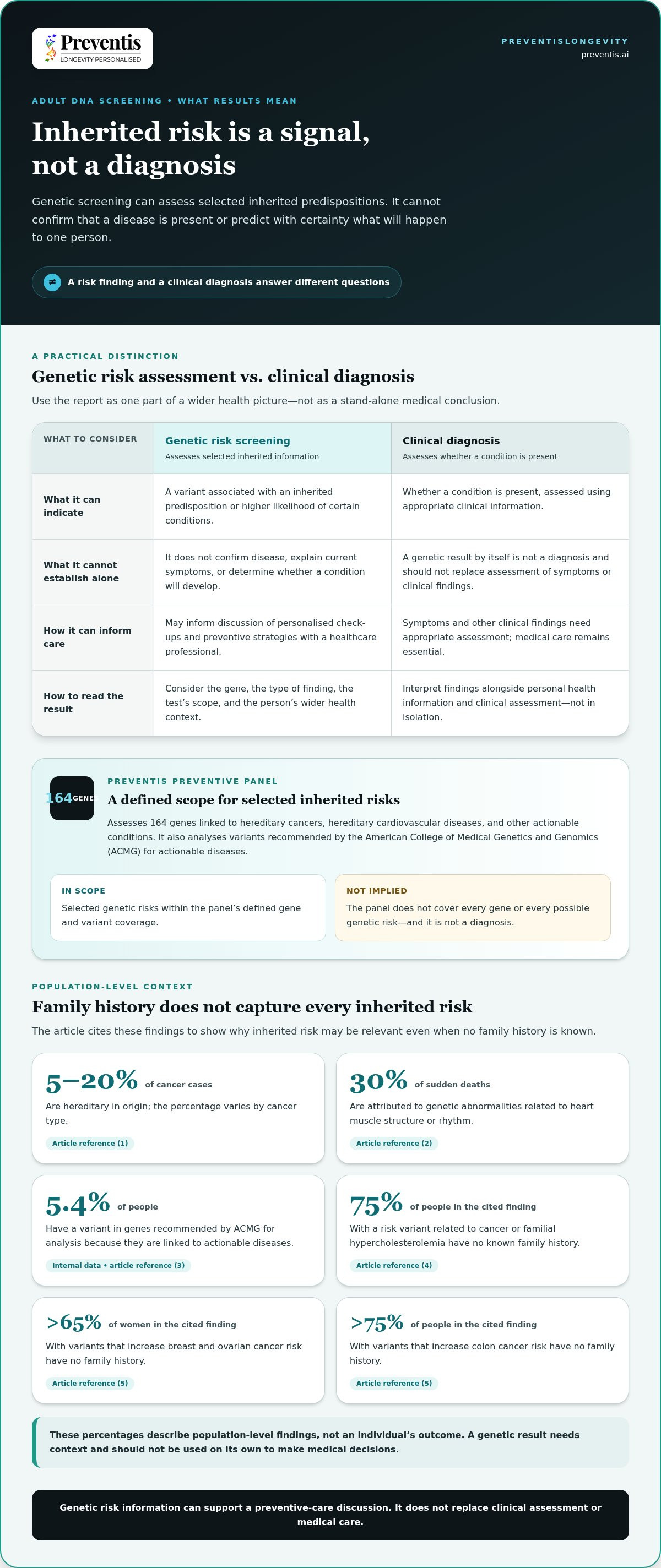
Advanced DNA screening for adults analyses selected genetic information to assess inherited risk; it does not diagnose a disease. A result may identify a genetic variant associated with a higher likelihood of certain conditions. This can inform a conversation about prevention, but it can’t establish that a condition is present or predict with certainty what will happen to one person.
Genetic testing can serve different purposes, from examining inherited traits to informing health decisions. The overview of Genetic Testing describes these varied uses. For preventive screening, focus on what a specific test examines and how its results are intended to be interpreted. A risk assessment is one part of a wider health picture, alongside personal health information and clinical findings.
How genetic risk information differs from a diagnosis
An inherited variant is a feature of someone’s genetic information, not evidence by itself that they currently have a disease. For example, a result may indicate a predisposition relevant to a particular type of cancer or cardiovascular condition. It doesn’t confirm that the condition is present, explain current symptoms, or determine whether it will develop in the future.
This distinction matters in practice. Symptoms and other clinical findings need appropriate assessment, while a genetic risk result can inform preventive-care discussions. A healthcare professional can consider the result alongside an individual’s wider health context when discussing whether personalised check-ups or preventive strategies may be relevant. Screening doesn’t replace clinical assessment or medical care, and a result should not be used on its own to make medical decisions.
What the Preventis Preventive Panel is designed to assess
The Preventis Preventive Panel analyses 164 genes linked to hereditary cancers, hereditary cardiovascular diseases and other actionable conditions. Its defined scope offers adults a structured way to assess selected inherited risks. It doesn’t examine every gene or cover every possible genetic risk, so the gene count is only one part of understanding what the panel can tell you.
The panel includes variants recommended by the American College of Medical Genetics and Genomics (ACMG) for actionable diseases. These findings may be relevant when considering prevention or follow-up with a healthcare professional. They don’t guarantee a particular outcome, and the same next steps won’t necessarily suit everyone. Interpretation matters.
The brochure provides context for why genetic risk can be relevant even without a known family history. It cites that 5-20% of cancer cases are hereditary in origin, with the percentage varying by cancer type (1); 30% of sudden deaths are due to genetic abnormalities related to heart muscle structure or rhythm (2); and 5.4% of people have a variant in genes recommended by ACMG for analysis because they are linked to actionable diseases (3, internal data). It also reports that 75% of people with a risk variant related to cancer or familial hypercholesterolemia do not have a known family history (4), and that more than 65% of women with genetic variants that increase breast and ovarian cancer risk and more than 75% of people with variants that increase colon cancer risk have no family history (5). These percentages are based on cited studies and internal data; they describe population-level findings, not an individual’s outcome.
References: (1) Nielsen FC, et al. Nat Rev Cancer. 2016 Sep;16(9):599-612. (2) Orland, et al. Current Genetic Medicine Reports 7.3;2019:145-152. (3) Internal data. (4) Grzymski JJ, et al. Nat Med. 2020;26(8):1235-1239. (5) Miller DT, et al. Genetics in Medicine. 2022 Jun. DOI: 10.1016/j.gim.2022.04.006.
In simple terms, the panel looks for selected inherited variants within its stated scope and provides risk-assessment information, not a clinical diagnosis. When reading any result, ask what it says about predisposition, what it cannot establish about present health, and how a healthcare professional may use it to inform personalised check-ups or preventive strategies.
How Adult Genetic Screening Turns DNA Findings into Health Context
A genetic panel examines selected genes for variants that may be associated with inherited health risks. The result becomes useful through interpretation: the gene involved, the type of finding and the person’s wider clinical context all matter. A report is not a complete account of someone’s health, and a finding should not be read in isolation.
Genetic risk information supports, but does not replace, clinical care. Symptoms, existing diagnoses and other clinical findings call for appropriate medical assessment. A genetic result can add another perspective to a discussion with a healthcare professional, who can consider whether it is relevant to personalised check-ups or preventive strategies.
Why the scope of a genetic panel matters
A panel’s scope sets the boundaries of its assessment: it identifies which genes are examined, not every possible inherited or health risk. The Preventis Preventive Panel analyses 164 genes linked to hereditary cancers, hereditary cardiovascular diseases and other actionable conditions. It also includes variants recommended by the American College of Medical Genetics and Genomics (ACMG) for actionable diseases.
That defined focus can make the purpose of a report clearer, but it shouldn’t be mistaken for an exhaustive assessment of all genetics. A result that identifies no relevant finding within the panel’s scope doesn’t rule out every hereditary condition or explain every health concern. The practical question is not simply how many genes a panel covers, but what its stated scope means for the health question being considered.
From a genetic finding to a preventive conversation
A healthcare professional can help put a finding into perspective and consider how it relates to a person’s health information. For instance, if a report identifies a variant associated with an actionable condition, the conversation can focus on whether that information has implications for personalised medical check-ups or preventive measures. The report alone doesn’t determine what should happen next.
Follow-up depends on professional interpretation and the individual’s clinical context. One person’s result may lead to a different discussion from another’s, even when the same broad category of risk is involved. This is why it helps to understand what a panel assesses before testing and how the result will be discussed afterwards. Advanced DNA screening for adults can offer a starting point for that discussion, rather than a fixed plan or prediction.
With this approach, a genetic finding becomes one considered part of proactive care: it can inform questions, support professional assessment and help shape a prevention conversation without creating certainty where none exists. The Preventis Preventive Panel assesses genetic risk within its defined scope, with the aim of helping specialists personalise medical check-ups and preventive strategies.
How to Compare Advanced DNA Screening Options Without Confusing Scope
Choosing a genetic test is less about finding the longest report and more about matching its purpose to the question you want to explore. A broad test may examine a wide range of genetic information, while a targeted panel focuses on selected genes or health areas. Neither is automatically more useful: relevance depends on scope, intended use and how results can inform a professional discussion.
Compare what is assessed and how findings are interpreted, not breadth alone. Use the criteria below to understand what a screening option is designed to contribute.
| Comparison point | What to consider | Preventis Preventive Panel |
|---|---|---|
| Scope | Which genes and health categories does the test assess? | Analyses 164 genes linked to hereditary cancers, hereditary cardiovascular diseases and other actionable conditions. |
| Intended use | Is the focus inherited health risk, or another type of genetic information? | Provides preventive genetic risk assessment, including variants recommended by the ACMG for actionable diseases. |
| Interpretation | How should a result be understood in relation to personal health? | Findings are intended to support professional interpretation, not independently establish a diagnosis. |
| Preventive-care connection | Can findings inform discussion of check-ups or preventive strategies? | Genetic information can help healthcare professionals incorporate genetics into check-ups and consider personalised preventive strategies. |
Compare panel scope with the question you want to explore
Start by naming your goal. Are you seeking insight into hereditary health risks, or are you interested in ancestry, personal traits or medication-related information? These are different purposes, so a high report count may reflect variety rather than deeper coverage of the health question that matters to you. For a hereditary risk assessment, examine the stated genes and condition categories, not just the number of reports.
The Preventis Preventive Panel’s documented scope is specific: 164 genes across hereditary cancer, hereditary cardiovascular disease and other actionable-condition categories. This description helps set expectations without suggesting that the panel covers every inherited condition. Compare other options by their stated scope; don’t assume that “broader” means more relevant to your personal health question.
Compare interpretation and the role of healthcare professionals
Consider what a report is intended to support after results are available. The Preventis Preventive Panel is intended for healthcare professionals incorporating genetic information into check-ups. Interpretation brings a finding into clinical context and can inform discussion of possible preventive measures. A result alone doesn’t determine diagnosis, treatment or the right follow-up for every individual.
When comparing advanced dna screening for adults, prioritise a clear path from test scope to considered interpretation and a practical preventive-care conversation. This can help you compare options without treating every extra report as extra value. The Preventis Preventive Panel offers a defined, 164-gene scope for this kind of professional risk-assessment discussion.
What Adults Should Consider Before Using Genetic Risk Information
Before using genetic risk information, get clear on what you hope it will help you understand and how you’d use the result in a preventive-care conversation. This preparation can make advanced dna screening for adults feel more purposeful while helping keep expectations realistic. Family history can provide relevant context, but it isn’t the only consideration when assessing genetic risk.
Use this reflection process to organise your questions:
- Define the health question. Consider whether you want to explore inherited risk related to hereditary cancers, hereditary cardiovascular diseases or other actionable conditions. A clear question helps you assess whether a panel’s stated focus is relevant.
- Understand the scope. Review which genes and categories the test examines, and recognise that a panel assesses its defined scope rather than every possible genetic or health risk.
- Consider interpretation. Think about how a finding could be understood alongside your personal health context. A genetic result is risk information, not a stand-alone diagnosis or certain prediction.
- Plan the discussion. Consider how you could raise relevant findings with a healthcare professional and whether they may inform personalised medical check-ups or preventive strategies.
Questions to clarify before considering a panel
Ask yourself which stated disease categories connect with the preventive-health question you have in mind. If family history is part of your concern, it can contribute useful context, but it doesn’t by itself establish what a genetic assessment will find or what follow-up may be relevant. The aim is to understand the test’s purpose, not to assume a particular result or outcome.
It can also help to note relevant personal health information and the questions you want to discuss with a healthcare professional. Their perspective can help place genetic screening within your wider care. A panel’s scope alone can’t determine what is appropriate for an individual, and considering testing doesn’t guarantee a finding or a particular clinical next step.
How to approach a result without overinterpreting it
Take time to understand what a result actually refers to. A finding may indicate an inherited predisposition within the areas assessed, but it doesn’t confirm that a disease is present or mean that it will develop. Equally, a result that doesn’t identify a relevant finding within a panel’s scope shouldn’t be taken as proof that every possible inherited risk has been ruled out.
Professional interpretation helps connect the result with personal context and consider whether it has a role in preventive-care planning. Avoid making decisions based on a genetic finding alone; discuss its meaning and any potential implications with an appropriate healthcare professional. The focus is on informed questions and proportionate next steps, not certainty.
If you’re considering a defined genetic risk assessment, explore the Preventis Preventive Panel as a way to bring genetic information into a professional discussion about personalised check-ups and preventive strategies.
How the Preventis Preventive Panel Fits into Proactive Adult Health
For adults considering genetic risk assessment, the value of a panel lies in what its findings may help inform, not in a promise of certainty. The Preventis Preventive Panel is designed to assess inherited risk, not diagnose disease. It analyses 164 genes linked to hereditary cancers, hereditary cardiovascular diseases and other actionable conditions, including variants recommended by the American College of Medical Genetics and Genomics (ACMG) for actionable diseases.
This defined scope gives healthcare professionals genetic information to consider as part of a wider health discussion. A result doesn’t establish that a condition is present or determine an individual’s future. Instead, it may offer a starting point for discussing whether genetic insights are relevant to personalised medical check-ups or preventive strategies, interpreted in the context of the person’s health.
What the panel can contribute to a preventive-health discussion
Genetic information can help specialists consider whether check-ups or preventive strategies could be personalised in light of a relevant finding. The panel is intended for healthcare professionals incorporating genetics into check-ups, where the result can be interpreted alongside other clinical context. The finding itself doesn’t prescribe a particular next step or guarantee an outcome.
That makes the panel one potential source of insight within proactive care, rather than a replacement for clinical assessment or medical support. Its 164-gene scope also matters: the results relate to the genes and categories assessed, not every possible inherited risk. Understanding this boundary can help keep follow-up conversations focused and realistic.
Where to explore related genetic health topics
If you’d like to explore the panel’s role in preventive care in more detail, the comprehensive preventive health panel guide offers broader context. For a distinct discussion of sequencing, see the whole genome sequencing guide. These topics provide further reading, but they shouldn’t be treated as additional features of the Preventis Preventive Panel.
Used thoughtfully, advanced dna screening for adults can support a more informed conversation about inherited risk and preventive care. If the Preventis Preventive Panel’s defined scope aligns with the questions you want to explore, visit PreventisLongevity or email care@preventis.ai. Genetic insight is most useful when it’s understood clearly and considered with appropriate professional guidance.
Turn Genetic Insight into a Thoughtful Next Step
The most useful next step is one that feels clear and proportionate to your health goals. Before making a decision, consider what you hope genetic information will add to your understanding and how you’d want to use it in a conversation about your care. A considered question can be more valuable than a report you’re unsure how to apply.
Advanced dna screening for adults can be part of a forward-looking approach when its purpose and relevance are clear. The aim isn’t to seek certainty from a test, but to make space for informed discussion and personalised care decisions with appropriate professional guidance.
If you’d like to take that next step, explore the Preventis Preventive Panel or email care@preventis.ai to learn more. A better-informed conversation can help you move forward with greater clarity and confidence.
Frequently Asked Questions
Can advanced DNA screening diagnose a disease?
No. The Preventis Preventive Panel is a risk-assessment test, not a diagnostic test. It assesses inherited variants within its scope, but it can’t confirm that a condition is causing symptoms. If you’re experiencing a health concern, seek appropriate clinical assessment rather than relying on a genetic report. Genetic information may add context to a care discussion, but it doesn’t replace clinical assessment or medical care.
Is genetic screening useful if I have no family history?
Family history isn’t the only context for considering inherited risk. Some people may not know their full family medical history, and a known family pattern doesn’t guarantee a particular genetic result. The Preventis Preventive Panel information notes that many people with certain risk variants have no known family history. A healthcare professional can help you consider your circumstances and the test’s scope. Don’t assume that no family history rules out risk or that family history alone determines suitability.
What does the Preventis Preventive Panel analyse?
It analyses 164 genes linked to hereditary cancers, hereditary cardiovascular diseases and other actionable conditions, including variants recommended by the ACMG for actionable diseases. Its stated cancer categories include breast, gastric, gynaecological, pancreatic, prostate, skin and colorectal cancers. Cardiovascular categories include cardiomyopathies, arrhythmias, RASopathies, vascular-involved syndromes and familial hypercholesterolemia. These examples describe the panel’s scope, not a promise to detect every inherited condition or variant.
Can genetic screening tell me exactly what will happen to my health?
No. A genetic risk result can’t predict with certainty whether or when you’ll develop a condition. It provides information about inherited risk within the test’s scope, which needs to be interpreted alongside your wider health context. A result associated with predisposition is not confirmation of current disease. Discussing what a finding can and can’t establish with a healthcare professional can help keep expectations grounded.
Should I consider genetic screening if I want to personalise my check-ups?
It may be useful to explore whether genetic information could contribute to a preventive-care discussion. Advanced dna screening for adults can provide information for specialists to consider when personalising medical check-ups, but it doesn’t prescribe a schedule or determine which checks you need. Before deciding, clarify the health question you want to address and discuss how a result might fit with your care.
Does a broader DNA report automatically make a screening test more useful?
No. A report can cover a wide range of topics without being more relevant to your specific health question. Ancestry or trait information, for example, serves a different purpose from assessing inherited risk for actionable conditions. Compare the test’s stated scope and intended use with what you want to understand, then consider how findings are interpreted. A larger report count alone doesn’t show whether the information will help inform preventive care.
Can genetic risk information replace routine medical care?
No. Genetic risk information is an additional source of context, not a substitute for medical care, clinical assessment or advice about symptoms. A result shouldn’t be used on its own to change care or dismiss a health concern. If you receive a finding, discuss its relevance with an appropriate healthcare professional, who can consider it alongside your health information and help you understand whether it has a role in future preventive-care discussions.


