

Could proactive cancer screening at home reveal whether you have cancer? No. A home sample can begin a hereditary risk assessment, but it can’t diagnose cancer or replace recommended screening. That distinction matters when you’re looking for useful answers without mistaking genetic insight for a diagnosis.
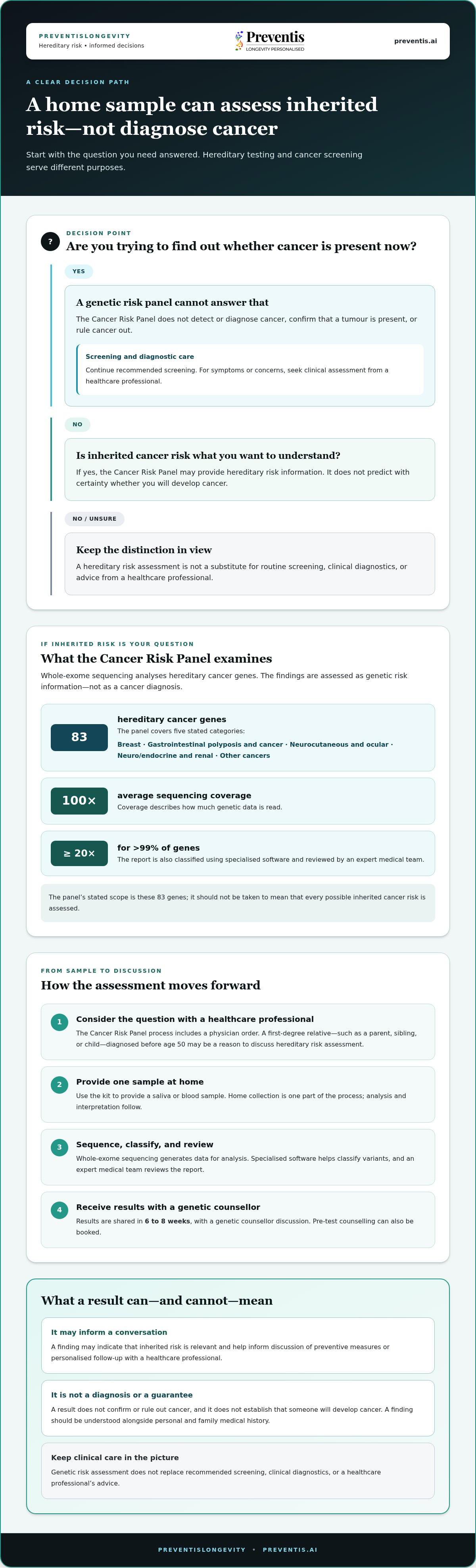
It’s understandable to look to family history for clues, yet it may not tell the whole story. The Cancer Risk Panel analyses 83 genes using whole-exome sequencing, with 100× average coverage and ≥ 20× for >99% of genes. You provide one saliva or blood sample using a kit, then receive an expert-reviewed report and results from a genetic counsellor in 6 to 8 weeks. Pre-test counselling can also be booked.
This guide explains what at-home sampling can and can’t tell you, how hereditary risk differs from cancer screening, and how counselling can help make results easier to understand. You’ll also learn what a result may mean for follow-up discussions, so you can take informed questions and next steps to a healthcare professional.
Key Takeaways
- Proactive cancer screening at home can start with a sample kit, but the Cancer Risk Panel assesses hereditary risk rather than detecting or diagnosing cancer.
- Find out what whole-exome sequencing examines: 83 genes, with 100× average coverage and ≥ 20× for >99% of genes.
- Follow the process from physician order and sample collection through expert review and a genetic counsellor discussion, with results shared in 6 to 8 weeks.
- Learn how genetic findings may inform personalised prevention and follow-up conversations with a healthcare professional.
- See how pre-test and expert genetic counselling can help put results in context, and why risk assessment does not replace clinical diagnostics.
Proactive cancer screening at home: what a genetic test can assess
Want a convenient, proactive way to understand hereditary cancer risk? It makes sense to look for clear information you can access from home. The key is knowing what a home sample can tell you, and what it can’t. With the Cancer Risk Panel, the sample is collected at home, while analysis and expert interpretation help put genetic findings into context.
The Cancer Risk Panel assesses inherited genetic risk associated with cancer; it cannot establish whether you currently have cancer or whether you will develop it. It is a risk-assessment service, not a cancer diagnosis. An at-home sample is one part of the process, not a substitute for clinical screening, diagnostic tests or follow-up with a healthcare professional.
That distinction is central to understanding proactive cancer screening at home. Genetic testing can examine inherited variations that may be relevant to health; the Genetic testing overview explains the broader range of purposes and types of testing. A hereditary risk result can inform a conversation about prevention or personalised follow-up, but it doesn’t show whether a tumour is present. Continue with recommended screening and seek clinical assessment for symptoms or concerns.
Cancer screening and inherited risk are not the same thing
Screening and diagnostic care look for signs of cancer or investigate a clinical concern. Hereditary testing asks a different question: could an inherited genetic variant affect your risk? A result may help guide discussions about preventive measures and individual follow-up. It doesn’t confirm or rule out cancer, and it doesn’t replace standard clinical diagnostics or a healthcare professional’s advice.
For example, a person may receive a finding that indicates increased hereditary risk while having no current cancer diagnosis. That information can be a reason to discuss appropriate next steps with a healthcare professional, not a reason to assume cancer is present. Genetic counselling can help explain what a result does and doesn’t mean; pre-test counselling can be booked to support an informed decision before testing.
Who may consider hereditary cancer risk assessment?
The Cancer Risk Panel is intended for people seeking hereditary risk information, including individuals with a cancer diagnosis and those with a relevant family history. A first-degree relative, such as a parent, sibling or child, diagnosed before age 50 may be a reason to discuss hereditary risk assessment with a healthcare professional. Family history is useful context, but it isn’t a diagnosis or a complete picture of inherited risk.
Think about what you hope to learn before deciding whether testing is right for you. You might want to understand whether inherited risk could be relevant to your care, or to prepare for a more informed discussion with your clinician. An expert genetic counsellor can help you interpret the report and consider possible follow-up, while your healthcare professional can advise how any result fits with your personal medical history and routine care.
How the Cancer Risk Panel analyses hereditary cancer risk
Understanding how a result is produced can make genetic information easier to interpret. The Cancer Risk Panel uses whole-exome sequencing to analyse 83 hereditary cancer genes. Sequencing coverage describes how much genetic data is read: the panel has 100× average coverage, with ≥ 20× for >99% of genes. This supports detailed analysis, while the report’s interpretation remains essential to understanding what findings may mean for hereditary risk.
Extractable summary: The Cancer Risk Panel analyses 83 hereditary cancer genes using whole-exome sequencing, with 100× average coverage and ≥ 20× for >99% of genes, followed by specialised software classification and expert medical team review of the report.
What does an 83-gene hereditary cancer panel cover?
The panel covers genes across five stated categories: breast; gastrointestinal polyposis and cancer; neurocutaneous and ocular; neuro/endocrine and renal; and other cancers. Looking across these categories provides a broader hereditary risk assessment than focusing on a single category alone. The panel’s stated scope is these 83 genes; it shouldn’t be taken to mean that every possible inherited cancer risk is assessed.
For people considering proactive cancer screening at home, the sample collection is only the starting point. PreventisLongevity supplies a saliva-collection kit, and sequencing generates data for analysis, while specialised software helps classify variants. An expert medical team reviews the report, adding professional oversight to the interpretation. This process can help distinguish information that may be relevant to hereditary risk from findings that require careful explanation.
What can variant analysis tell you?
Variant classification supports risk assessment; it does not diagnose cancer or establish that someone will develop it. A finding may suggest that inherited risk is relevant, while another result may not identify a reportable risk variant within the panel’s scope. Neither outcome is a guarantee about future health, and a result should be understood alongside personal and family medical history.
That context matters because genetic findings are not treatment instructions on their own. Depending on the result and individual circumstances, they may inform discussion of preventive measures or personalised follow-up with a healthcare professional. The National Cancer Institute Genetic Testing Fact Sheet also outlines considerations involved in inherited cancer testing. The panel cannot detect every hereditary cancer risk, predict disease with certainty or replace clinical diagnostics and recommended screening.
Expert genetic counselling can help explain the report and support informed questions about possible next steps. Pre-test counselling can be booked, so you can discuss the purpose and limits of testing before deciding whether it fits your needs. To explore the Cancer Risk Panel on the PreventisLongevity website, visit the official PreventisLongevity website or email care@preventis.ai.
At-home cancer testing: compare sample collection with clinical interpretation
A home kit can make the first step of genetic testing more convenient, but collecting a sample and interpreting genetic findings are separate parts of the process. For the Cancer Risk Panel, you provide one saliva or blood sample using an easy-to-use kit. The sample is then analysed, the report is reviewed, and genetic counselling helps put the findings into context. This distinction is important: the kit enables sample submission, it doesn’t screen for or diagnose cancer.
The stages have different roles. Seeing them side by side can clarify where home collection ends and clinical interpretation begins.
| Stage | What happens | What it means for you |
|---|---|---|
| Sample collection | You provide one saliva or blood sample with the easy-to-use kit. | This supplies a sample for laboratory analysis; it is not a cancer test result. |
| Laboratory analysis | The sample is analysed using the Cancer Risk Panel’s genetic testing process. | Analysis examines hereditary risk information within the panel’s scope. |
| Report | Specialised software supports variant classification, and an expert medical team reviews the report. | Findings are considered as risk-assessment information, not a diagnosis. |
| Clinical discussion | A genetic counsellor discusses results and helps explain their meaning. | You can consider questions about possible follow-up with your healthcare professional. |
What the sample kit does, and doesn’t do
The kit provides a way to submit a sample for laboratory analysis at home. It doesn’t examine your body for a tumour, establish whether cancer is present or determine what care you need. Those are different clinical questions. The convenience of proactive cancer screening at home should therefore be understood as convenient sample collection for hereditary risk assessment, not home-based cancer diagnosis.
For the sample step, follow the instructions provided with the kit. The important point is that collecting a sample does not itself interpret genetic information. That requires analysis and review after the sample has been submitted.
Why interpretation matters after genetic analysis
A genetic report needs context. Variant classification helps organise the findings, while expert review supports a considered interpretation of the report. Genetic counselling offers a dedicated opportunity to understand what a result may mean for hereditary risk and to discuss possible next steps. Results are discussed with a genetic counsellor in 6 to 8 weeks.
Use the discussion to note questions that matter to your circumstances, such as how findings relate to your personal or family history and what follow-up to raise with your healthcare professional. Clinical decisions remain part of personalised medical care; the report doesn’t make them for you. If you’re also exploring whole-genome sequencing and proactive health, keep in mind that different forms of genetic analysis can have different purposes and scopes.
From sample to results: the Cancer Risk Panel process
Knowing what happens between ordering a test and discussing the results can make the process feel clearer. The Cancer Risk Panel follows a sequence from physician order to laboratory analysis, expert review and a conversation with a genetic counsellor. Each stage has a distinct role: the sample provides material for analysis, while professional interpretation helps explain what the findings may mean for hereditary risk.
The sample, sequencing, and report journey
- A physician orders the test. The process begins with a physician order for the Cancer Risk Panel, a hereditary cancer risk-assessment service.
- Preventis supplies a saliva-collection kit. You provide a saliva sample using the easy-to-use kit. The kit supports sample collection; it doesn’t test for cancer itself.
- The sample is analysed. The laboratory uses whole-exome sequencing and analyses the panel’s 83 hereditary cancer genes. Specialised software supports variant classification.
- The report receives expert review. An expert medical team reviews the report before it is sent to the genetic counsellor.
- A counsellor discusses the results with you. The genetic counsellor explains the report and supports your understanding of what the findings may mean.
Results are discussed in 6 to 8 weeks; this is a stated timeframe, not an instant result or a guaranteed date.
Preparing for a results discussion
Genetic counselling gives you space to ask questions and understand the report in relation to hereditary risk. Pre-test counselling can also be booked, helping you consider the purpose and limits of testing before the process begins. Neither a result nor a counselling conversation automatically determines a particular course of care.
Before the discussion, it may help to note what you’d like clarified. For example, you could ask what a finding means in the context of your personal or family history, what the report can and can’t establish, and whether there are follow-up topics to raise with your healthcare professional. These questions keep the conversation focused on understanding your information and its relevance to you.
After the discussion, you can use the information as a basis for a personalised conversation about prevention or follow-up. Any clinical decisions remain part of your wider medical care, taking account of your circumstances and professional advice. The Cancer Risk Panel is a risk-assessment tool, not a diagnosis, and doesn’t replace clinical diagnostics or recommended screening.
If you’re considering proactive cancer screening at home, explore the Cancer Risk Panel on the Preventis website or email care@preventis.ai to learn more about the process and genetic counselling.
Turning hereditary cancer risk information into informed next steps
A genetic risk result is most useful when it helps you have a clearer conversation about your health. The Cancer Risk Panel can provide information to support discussions about preventive measures or personalised follow-up, but it doesn’t prescribe a course of action. Your personal and family history, current health and clinical guidance all matter when considering what to do next.
Keep the purpose of the report in view. It assesses hereditary cancer risk; it cannot diagnose cancer, rule it out or replace clinical diagnostics and recommended screening. A result is one part of a broader health picture, not a prediction that a particular outcome will happen. Use it as a starting point for informed questions, rather than trying to interpret it as a standalone medical decision.
Questions to discuss with a healthcare professional
Bring the report to a healthcare professional who can consider it alongside your medical context. You may find it helpful to write down questions before the appointment, so the discussion focuses on what the findings mean for you and what options may be relevant.
- How does the report’s variant interpretation relate to my personal and family medical history?
- Could any additional follow-up or preventive measures be appropriate for my circumstances?
- How should I understand the limits of this risk assessment, including what it doesn’t establish?
- What can I clarify with the expert genetic counsellor about the report and its interpretation?
These are prompts for discussion, not a checklist that determines care. Recommendations depend on individual circumstances, and a genetic finding alone doesn’t decide what follow-up is right. Genetic counselling can help you understand the report and prepare questions; pre-test counselling can also be booked if you’d like support before deciding about testing.
Explore the Cancer Risk Panel
The Cancer Risk Panel may suit people seeking information about hereditary cancer risk, whether they’re considering testing because of their own health history or want to better understand inherited risk. Home sample collection is one step in a process that includes laboratory analysis, expert review and genetic counselling. That interpretation can help make the results easier to discuss and consider in the context of personalised care.
Remember the distinction: genetic testing assesses inherited risk, while clinical screening and diagnostic assessment address different questions about cancer. The panel doesn’t diagnose cancer or replace clinical diagnostics. If symptoms or other health concerns need attention, use the appropriate clinical pathway rather than relying on a genetic risk report.
For a calm, informed next step, explore the Cancer Risk Panel and counselling support on the official Preventis website. You can also email care@preventis.ai with questions about the service.
Make your next step an informed one
Choosing proactive cancer screening at home starts with being clear about the question you want answered. If you’re considering hereditary risk assessment, take time to reflect on your medical and family history and what you’d like to discuss with a healthcare professional. Genetic information can help shape a conversation, but it isn’t a diagnosis or a prediction of what will happen.
The Cancer Risk Panel assesses 83 genes, with expert-reviewed variant interpretation to help put findings into context. Results are discussed with a genetic counsellor in 6 to 8 weeks, and pre-test counselling can be booked if you’d like support before deciding. That guidance can help you understand the report and prepare thoughtful questions about possible follow-up.
There’s no need to have every answer before you begin. A considered conversation can be a meaningful first step towards understanding your options and making decisions with confidence.
Explore the Cancer Risk Panel and take an informed next step, or email Preventis at care@preventis.ai with questions. Your next step can begin with clarity.
Frequently Asked Questions
Can you screen for cancer at home with a genetic test?
You can collect a sample at home for hereditary risk assessment, but a genetic test does not screen your body for cancer. The Cancer Risk Panel uses a home-collected sample to assess inherited genetic risk. If you have symptoms or need routine screening, discuss appropriate clinical assessment with a healthcare professional. A genetic result and a clinical screening test answer different questions, so one shouldn’t be used in place of the other.
What does an at-home hereditary cancer test actually tell you?
It can provide information about inherited variants included within the test’s scope, which may help you discuss hereditary risk with a healthcare professional. A result doesn’t show whether cancer is currently present, and it can’t predict with certainty whether you’ll develop cancer. For proactive cancer screening at home, consider what you hope to learn and whether the report’s scope addresses that question. Counselling can help you understand the findings in context.
Is a genetic cancer risk test the same as a cancer diagnosis?
No. A genetic cancer risk test assesses inherited predisposition; it doesn’t diagnose cancer or determine whether a tumour is present. If a result indicates a relevant hereditary risk, a clinician can consider it alongside your health history and discuss whether any follow-up may be appropriate. If you have symptoms or a clinical concern, seek medical advice rather than relying on a hereditary risk report to investigate it.
Who may consider hereditary cancer genetic testing?
It may be relevant to people who’ve had a cancer diagnosis, those with a family history that could suggest inherited risk, and people who want to understand their hereditary cancer risk. A first-degree relative, such as a parent, sibling or child, diagnosed with cancer before age 50 is one reason to discuss testing with a healthcare professional. Your personal circumstances and family history can help guide that conversation.
How long does the Cancer Risk Panel take to return results?
A genetic counsellor discusses the Cancer Risk Panel results with the patient in 6 to 8 weeks. This is the stated timeframe for the results discussion, not an instant result or a guaranteed date. You can use the waiting period to gather relevant personal or family health information and write down questions. That preparation may help make the counselling conversation more focused and useful.
Does the Cancer Risk Panel test for all hereditary cancers?
No. The Cancer Risk Panel assesses 83 genes related to hereditary cancer, so its findings are limited to the genes and categories included in the panel. It can’t identify every possible inherited cancer risk, and a result without a relevant finding doesn’t rule out all hereditary factors. If you have concerns about your personal or family history, discuss how the panel’s scope relates to your situation with a healthcare professional.
Can genetic counselling help explain hereditary cancer test results?
Yes. Expert genetic counselling can help explain how to interpret the report, what its findings may mean for hereditary risk, and what questions you may want to raise with a healthcare professional. It can also help clarify the limits of a result, so you don’t treat risk information as a diagnosis or a prediction. Pre-test counselling can be booked if you’d like guidance before deciding about testing.


