

What if a genetic risk result were a prompt for a better conversation with your healthcare professional, rather than a prediction of your future? That is the practical value of predictive health screening: it can highlight inherited risk, but it cannot tell you that you have a disease or that you will develop one. It is understandable to feel uncertain about what a result means or concerned that it might create anxiety without offering a clear next step.
The key is to treat genetic insight as one part of your health picture, alongside your personal and family history and clinical advice. In this article, you will learn what predictive screening can and cannot reveal, how to discuss a result with a healthcare professional, and how risk information may inform personalised preventive care. We will also look at the Preventis Preventive Panel, which analyses 164 genes linked to hereditary cancer, hereditary cardiovascular disease and other actionable conditions. Its findings are intended to support preventive-care discussions and specialist management strategies, not to diagnose disease. The aim is clarity: understand what the information means, what questions to ask and which next steps may make sense for you.
Key Takeaways
- Predictive health screening can help frame conversations about future risk, but it cannot guarantee whether or when a condition will develop.
- Risk assessment, routine screening and diagnostic testing answer different health questions.
- Bring relevant health priorities and family history to a discussion, and ask how findings could inform your preventive care.
- Genetic findings are best interpreted alongside other health information, with a healthcare professional helping you consider practical next steps.
- The Preventis Preventive Panel is one example of how genetic insight can contribute to personalised check-up discussions.
What Is Predictive Health Screening, and What Can It Tell You?
Can health risks be understood before symptoms appear? Predictive health screening explores that question by assessing information associated with the likelihood of developing certain conditions in the future. When screening includes genomic information, it can identify inherited variants linked to particular risks. The result is a risk insight, not a diagnosis, a guarantee that illness will develop or a precise prediction of when it might happen.
Different kinds of health checks answer different questions. Routine screening looks for signs that may need follow-up. Tests prompted by current symptoms help a clinician investigate what may be happening now. Genomic risk assessment considers whether inherited information may be relevant to future health. These approaches can complement one another, but they are not interchangeable. The broader concept of Predictive medicine includes using genetic and other information to estimate health risks, while recognising that estimates have limits.
Predictive screening can indicate that a person may have an increased or reduced likelihood of certain health conditions based on the information assessed. It cannot establish whether that person currently has a disease or guarantee what will happen in the future. The meaning of a result depends on what the test examines and how its findings are interpreted. Consider a result in context rather than treating it as a standalone answer about someone’s health.
Predictive screening versus diagnosis: the essential distinction
A risk estimate describes likelihood, not presence. If a screening result identifies an inherited variant associated with a health condition, it may provide a reason to discuss that risk with a healthcare professional. It does not mean the condition is present. Clinical assessment and diagnostic testing address different questions and remain important when symptoms or other concerns need investigation.
Why consider health risks before symptoms arise?
Earlier awareness can give people and healthcare professionals a starting point for discussing preventive care. A finding may help shape questions about appropriate check-ups or follow-up, but its significance should be considered alongside personal health and family history. That context can help turn a result into a thoughtful conversation without treating genetic information as certainty.
This is the practical value of predictive health screening: it can add another perspective to health planning, not replace clinical judgement. A result may be reassuring, prompt further discussion or have uncertain implications. In each case, the useful next step is to understand what the finding means in context and whether it changes any preventive-care conversations. Genetic information is one part of a person’s health picture, not the whole picture.
How Predictive Health Screening Turns Genetic Information into Risk Insight
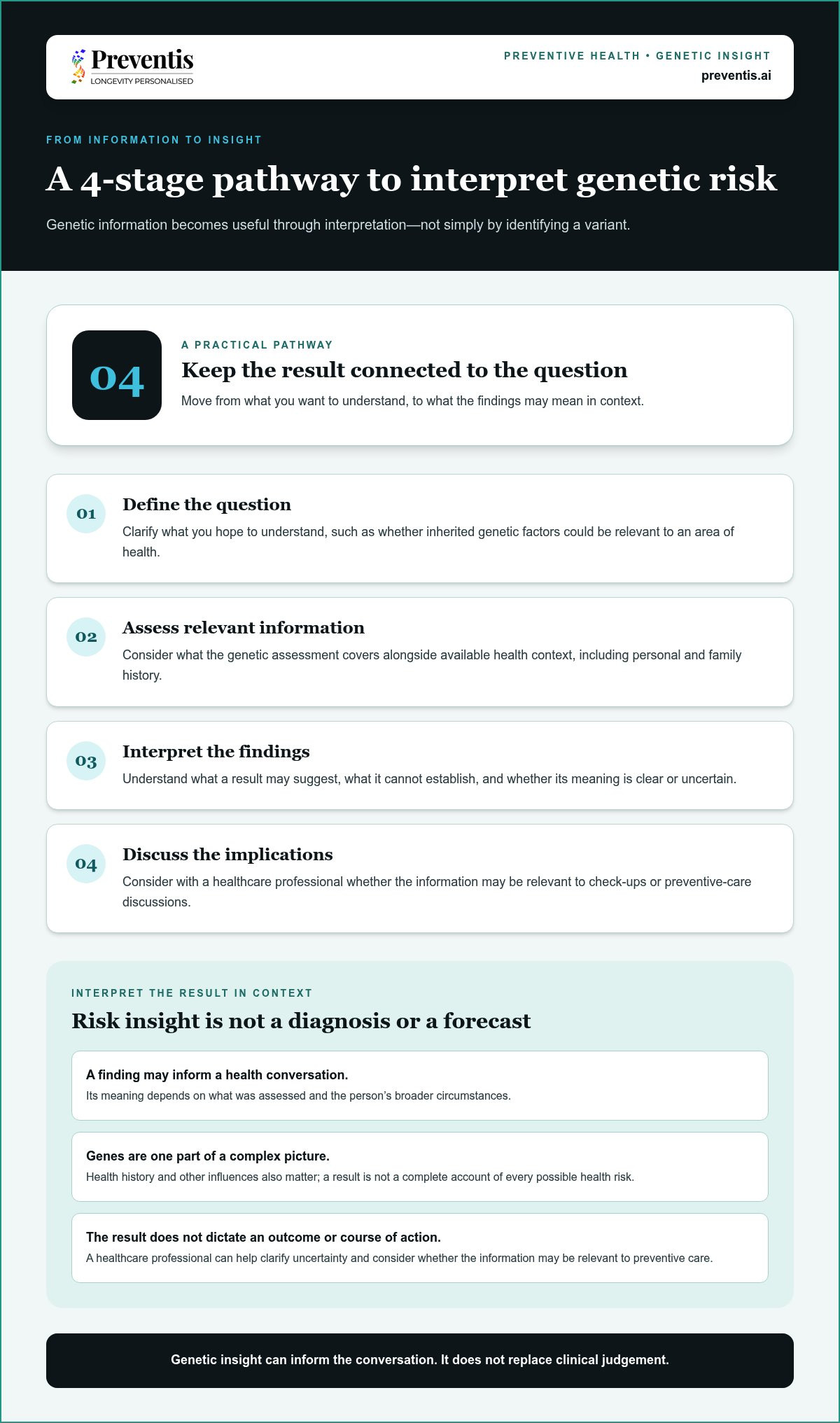
Genetic information becomes useful through interpretation, not simply by identifying a variant. A clear process keeps the result connected to the question being asked and helps prevent risk estimates from being mistaken for certainty. In predictive health screening, the aim is to consider relevant genetic findings alongside other health information, then explore whether they may inform a preventive-care conversation.
A practical pathway has four stages:
- Define the question. Clarify what you hope to understand, such as whether inherited genetic factors could be relevant to a particular area of health.
- Assess relevant information. Consider the scope of the genetic assessment and the health context available, including personal and family history.
- Interpret the findings. Understand what a result may suggest, what it cannot establish and whether its meaning is clear or uncertain.
- Discuss the implications. Consider with a healthcare professional whether the information may be relevant to check-ups or preventive-care discussions.
This sequence matters because a genetic result has meaning only in relation to what was assessed and the person’s broader circumstances. It can inform the conversation, but it does not dictate a particular outcome or course of action.
What genetic risk information contributes
People inherit genetic variations from their biological parents. Some variants may be associated with differences in health risk, but genes are only one part of a complex picture that can also involve health history and other influences. Assessments vary in the questions they address and the genetic information they examine. A result therefore reflects the test’s scope, not a complete account of every possible health risk.
One genetic assessment might focus on a defined set of genes associated with actionable conditions, while another may examine a broader range of variation. Neither approach can predict an individual’s future with certainty. The useful question is not simply “What did the test find?” but “What does this finding mean in context, and could it inform a health discussion?”
From a result to a meaningful health conversation
A healthcare professional can help explain a finding in light of personal and family history, clarify uncertainty and discuss whether it may be relevant to preventive check-ups. This interpretation helps distinguish a result that could inform further conversation from one with limited relevance to an individual’s situation. It also allows questions to be considered without assuming that a particular test or intervention is automatically needed.
Research offers examples of how health data can be combined to estimate risk. Harvard Medical School’s article, New AI Tool Predicts Risk of More Than 300 Diseases, describes an AI tool using existing patient data to predict disease risk. Such research illustrates the potential of data-led approaches, but a population-level tool and an individual genetic assessment are not the same thing, and neither makes a prediction certain.
A genetic risk assessment is one input to preventive care, to be considered alongside personal health information and clinical judgement. For an example of genetic insight within prevention, explore the Preventis Preventive Panel.
Predictive Health Screening: What It Can and Cannot Show
Predictive health screening, routine screening and diagnostic testing can all contribute to healthcare, but they answer different questions. Keeping those distinctions clear helps you interpret a result without treating a risk insight as a verdict. A genetic finding can suggest that a risk may warrant discussion; it does not confirm a condition, rule one out or replace appropriate clinical care.
| Approach | The question it addresses | What it cannot establish alone |
|---|---|---|
| Genetic risk assessment | Does the genetic information assessed indicate a possible inherited health risk? | Whether a person currently has a condition or will develop one. |
| Routine screening | Is there a sign or indicator that may need attention as part of preventive care? | A diagnosis in every case; an abnormal result may need clinical interpretation. |
| Diagnostic testing | Could a condition be present, given symptoms or other clinical concerns? | A complete account of future health or every possible risk. |
The purpose and interpretation of each test matter. A result from one category should not be used as a substitute for another. Genetic risk information does not take the place of routine care, and a risk assessment is not a diagnostic test.
Does a higher risk result mean disease is inevitable?
No. An elevated risk result describes a possible association, not certainty. It does not show that a condition is present, and it cannot establish that it will develop. A qualified healthcare professional can explain the result’s limits and consider whether it is relevant to your circumstances. This keeps the finding in perspective and supports informed discussion rather than alarm.
Can a family history alone explain someone’s risk?
Family history offers useful context, but it is only one part of the picture. A lack of known family history does not necessarily settle whether inherited risk is relevant. The Preventis Preventive Panel materials report that 75% of people with a risk variant related to cancer or familial hypercholesterolemia do not have a known family history. They also report that more than 65% of women with genetic variants that increase the risk of breast and ovarian cancer have no family history, and more than 75% of people with genetic variants that increase the risk of colon cancer have no family history. These percentages are based on cited studies and internal data (1-5).
This does not mean family history is unimportant or that these figures predict an individual’s risk. Family history can be incomplete: relatives may be few in number, health details may be unknown, or a condition may not have appeared in the family. These possibilities do not confirm that a person carries a risk variant. They reinforce why personal and family history are best considered as context for interpreting genetic information, rather than as a definitive answer on their own.
Predictive information complements clinical advice; it does not replace standard care. Continue to approach symptoms and routine health needs through appropriate clinical channels, regardless of a genetic risk result. If a finding raises questions, discuss what it means, what it cannot tell you and whether it has any bearing on your preventive-care conversations. A measured interpretation can help turn uncertainty into a clearer next step.
How to Prepare for a Predictive Health Screening Discussion
A little preparation can make a predictive health screening discussion more focused and useful. Before speaking with a healthcare professional, think about what you want to understand and how any insight might fit into your existing care. You do not need to arrive with conclusions. A clear question and relevant context are enough to get the conversation started.
Use this checklist to organise your thoughts:
- Health priorities: Note the health areas you are most interested in discussing and why.
- Relevant history: Summarise your personal health history and any known family history that may be relevant.
- Questions: Write down anything you want clarified about the test, its scope or the meaning of possible findings.
- Desired outcome: Consider what would help you feel informed, such as understanding whether a result could shape a preventive-care conversation.
For broader context on how genomic information can fit into prevention, the comprehensive preventive health panel guide explores the role of a panel-based approach.
Questions to ask before considering a genetic assessment
Useful questions focus on scope, interpretation and support. Ask which health areas and genes the assessment covers, what a result can and cannot establish, and how a risk finding differs from a diagnostic result. You can also ask who will explain the findings, how they will be considered alongside your personal and family history, and what support is available if you have questions afterwards.
It is also reasonable to ask how genetic information might relate to care you already receive. A result should not be considered in isolation or assumed to change your care automatically. If cardiovascular risk is part of your discussion, the heart health DNA screening guide offers further context on genomic insight in this area.
How to make results useful after screening
After receiving a result, note the parts you understand and the points that need clarification. Bring relevant findings to a healthcare professional and ask how they relate to your health history and existing care. Rather than drawing conclusions from complex genetic data alone, record follow-up questions, including whether the result has practical relevance to your check-up discussions.
Keep a copy of the information you are discussing, and note any explanations or agreed next steps so you can revisit them later. The aim is not to turn every finding into an immediate action. It is to understand the result’s limits, consider its relevance and make decisions through an informed conversation.
If you are ready to explore how genetic insight may support a preventive-care discussion, discover the Preventis Preventive Panel.
How the Preventis Preventive Panel Fits into a Predictive Health Approach
The Preventis Preventive Panel from PreventisLongevity is a preventive genetic test that can contribute to a broader preventive-care conversation. It assesses genetic risk, not a diagnosis. Its purpose is to help individuals and healthcare professionals consider relevant genetic findings as part of preventive health check-ups, with interpretation and any next steps discussed in context.
What the Preventis Preventive Panel is designed to assess
The panel analyses 164 genes linked to hereditary cancer, hereditary cardiovascular disease and other actionable conditions. It includes variants recommended by the American College of Medical Genetics and Genomics (ACMG) for actionable diseases. This defined scope offers information for consideration. It is not a complete account of every health risk and does not predict an individual’s future with certainty.
The panel’s preventive model centres on using genetic risk information to support personalised check-up discussions. If a finding is relevant, specialists can consider it alongside personal health information and family history when discussing medical management strategies. The result is a starting point for informed conversation, not an instruction to pursue a particular test, treatment or follow-up schedule.
To understand how the panel may fit your situation, consider asking:
- What does the panel assess, and what falls outside its scope?
- How should a genetic finding be understood alongside my health and family history?
- Who can explain the result and discuss whether it may be relevant to preventive care?
- What questions should I bring to a check-up conversation if a finding needs further explanation?
These prompts help connect the test’s defined genetic scope to the decisions that matter to you, without assuming that a result will lead to a specific change in care.
Turning genetic insight into a specialist-guided next step
A healthcare professional can help interpret findings and consider whether they are relevant to preventive check-ups or medical management discussions. The panel does not diagnose disease, replace clinical assessment or take the place of standard care. Its role is to add genetic information that may help inform a conversation, with the meaning of any result considered in context.
That distinction makes the panel most useful as part of a considered approach: understand what was assessed, discuss what a finding may mean, and decide with a healthcare professional whether it has practical relevance. Learn more about the Preventis Preventive Panel from PreventisLongevity at Explore PreventisLongevity.
Make Your Next Health Conversation More Informed
The next step does not have to be a decision about testing. Start by identifying what you want to understand, then bring those questions to a healthcare professional who can help place genetic information in the context of your health and family history. This keeps predictive health screening focused on informed choices, rather than treating a result as a conclusion in itself.
The Preventis Preventive Panel analyses 164 genes linked to hereditary cancer, hereditary cardiovascular disease and other actionable conditions. It includes variants recommended by the American College of Medical Genetics and Genomics for actionable diseases. Its findings can support personalised check-up discussions, but they are risk information, not a diagnosis.
Take time to understand what an assessment covers, what its findings can and cannot tell you, and how a healthcare professional may help interpret them. A considered conversation can turn curiosity into a clearer direction for your care. Explore the Preventis Preventive Panel.
Frequently Asked Questions
Is predictive health screening suitable if I feel healthy?
It may be considered by people who want to understand potential health risks before symptoms arise. Feeling well does not determine what an assessment will reveal, because the information depends on what the test examines and your individual context. Before deciding, identify the health question you want answered and discuss the test’s scope and limitations with a healthcare professional. This can help you judge whether it aligns with your preventive-care goals.
Can predictive health screening tell me exactly what illness I will develop?
No. Predictive health screening can indicate risk, but it cannot establish with certainty that you have or will develop a particular disease. A genetic finding is only one part of your health picture, and its relevance depends on the test and your personal circumstances. Ask a healthcare professional to explain the result’s meaning and limits, including what it does not tell you, before using it to inform health decisions.
How is predictive health screening different from a routine health check?
A routine health check may review aspects of your current health, while a genetic risk assessment examines inherited information relevant to potential risk. They serve different purposes, so one should not be used as a substitute for the other. Ask what information a specific test measures, whether it relates to current health or inherited risk, and how its results might contribute to a discussion about your care.
What happens if a predictive screening result identifies a risk variant?
A risk finding does not confirm a diagnosis. Discuss it with an appropriately qualified healthcare professional, who can explain the result and consider its relevance to your circumstances. Note which part of the report prompted questions and bring them to the conversation. Avoid changing your care based only on a genetic report; use the result as a starting point for informed discussion.
Do I need a family history of disease to consider predictive screening?
No. Family history can provide useful context, but some people with risk variants may not know of a related condition in their family. If you are unsure what history is relevant, write down what you know about relatives’ health and any details you are uncertain about. A healthcare professional can help consider that information alongside your reasons for considering an assessment and its scope.
Can predictive health screening replace regular medical care?
No. Predictive screening provides risk information; it does not replace routine healthcare, clinical assessment or diagnostic testing when needed. Continue to follow relevant medical advice, and raise symptoms or health concerns through appropriate clinical care, regardless of a screening result. If you receive genetic information, discuss how it fits with your existing care rather than treating it as a standalone plan. This keeps preventive insight connected to professional guidance.


