

What if your genetic information could help shape a clearer plan for your future health, rather than leave you with more questions? A personalized longevity roadmap connects genomic insights with screening, lifestyle choices and professional guidance to support proactive health planning.
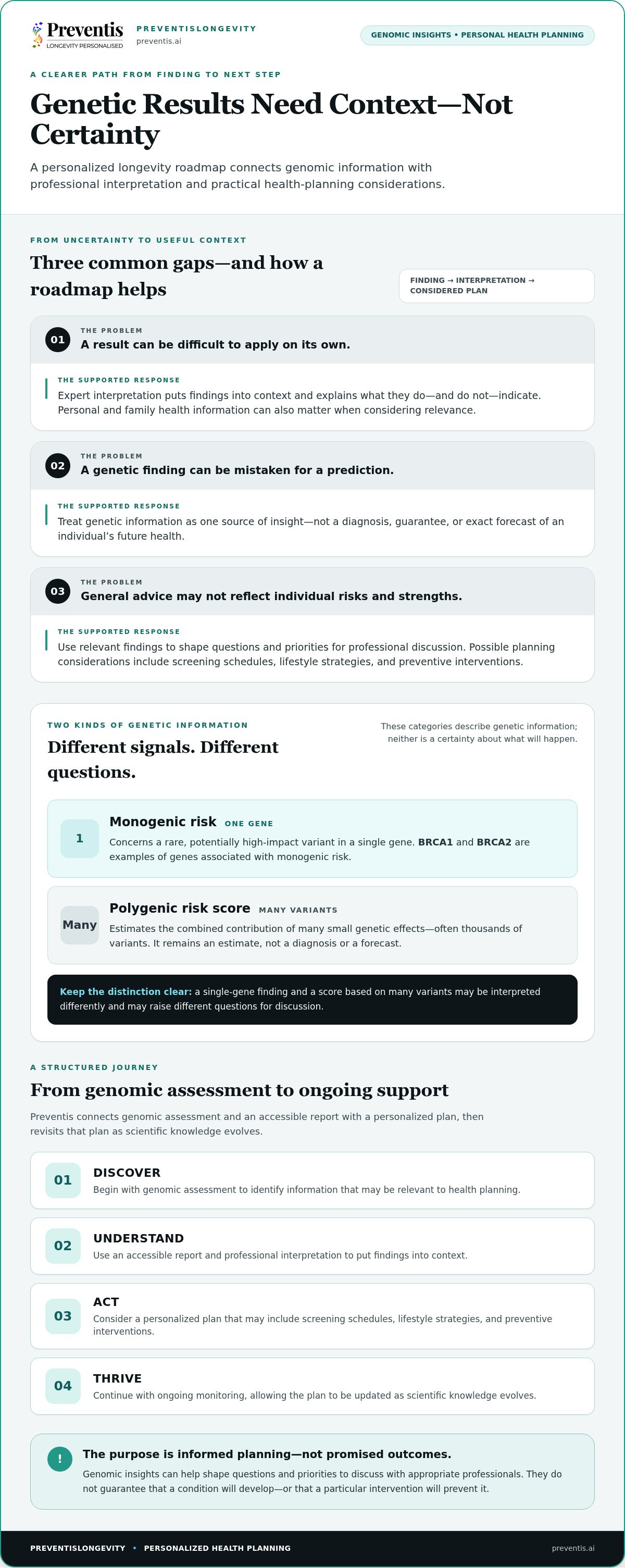
It’s understandable if genetic results feel complex or difficult to apply. A result isn’t a prediction of exactly what will happen, and general health advice may not reflect your individual risks and strengths. With expert interpretation, findings such as monogenic risks, linked to changes in a single gene, and polygenic risk scores, which reflect the combined effect of many genetic variants, can be put into context and connected to practical next steps.
PreventisLongevity guides this process through four stages: DISCOVER, UNDERSTAND, ACT and THRIVE. The stages connect genomic assessment and an accessible report with a personalized plan, which may include screening schedules, lifestyle strategies and preventive interventions. Ongoing monitoring allows the plan to be updated as scientific knowledge evolves. The aim is a professionally supported approach to long-term wellbeing, not a promise of specific health outcomes.
Key Takeaways
- A personalized longevity roadmap turns genomic findings into questions and priorities to discuss as part of proactive health planning.
- Monogenic risk relates to variants in a single gene, while polygenic risk scores reflect the combined influence of many variants.
- Genetic insights can inform planning, but they aren’t a diagnosis or a guarantee of future health outcomes.
- An explained report can help shape a personalized plan, with possible components such as screening schedules, lifestyle strategies and preventive interventions.
- Preventis guides the process through DISCOVER, UNDERSTAND, ACT and THRIVE, creating a structured path from assessment to ongoing support.
What Is a Personalized Longevity Roadmap, and What Can It Help You Do?
Long-term health planning can feel more useful when it reflects your biology, priorities and circumstances. Yet genomic information can be difficult to interpret on its own. A personalized longevity roadmap brings these elements together: it uses relevant genomic insights as one source of information for proactive health planning, with professional interpretation to put findings into context.
A personal longevity roadmap translates an individual’s genomic insights into informed health-planning considerations; a population-level longevity roadmap sets priorities for improving healthy ageing across society. The two share an interest in wellbeing over time, but serve different purposes. The National Academy of Medicine’s roadmap focuses on broader recommendations and action across sectors, while a personal plan centres on one person’s health information and aims.
Genomic findings can contribute to a wider picture, but they don’t define it. They may prompt questions about risk, screening or lifestyle strategies to explore with appropriate professional support. They cannot guarantee that a condition will develop or that a particular intervention will prevent it. The wider discussion of life extension spans scientific research and ethical questions. A personal roadmap keeps the focus on practical, considered health planning rather than promises of a longer life.
How is a personalized longevity roadmap different from general wellness advice?
General wellness guidance offers broad principles, while genomic insights can add an individual perspective. An assessment may identify information relevant to disease risk or other health considerations. Interpretation helps explain what a finding means and whether it may be relevant to planning. Possible next steps can then be considered in context, rather than treated as a universal checklist.
For example, a finding associated with a particular risk might lead to a conversation about whether screening considerations are relevant. It doesn’t, by itself, determine a diagnosis or dictate a course of action. A roadmap connects assessment, explanation and possible actions while recognising that personal and family history, existing health and professional judgement also matter.
Who might find a proactive health roadmap useful?
A proactive approach may appeal to people who feel well and want to plan ahead, as well as those managing an existing condition who want to understand how genomic information could contribute to wider health discussions. People with a family history of chronic or hereditary conditions may also value having findings explained in a considered, personal context. The purpose is to support understanding, not to suggest that family history or a test result makes a particular outcome certain.
This approach may suit anyone seeking clearer insight into health planning. It isn’t a promise of benefit or a replacement for care related to current symptoms. It offers a structured way to consider what genomic information may add, identify questions for professional discussion and decide which possibilities are relevant to the individual.
How Genomic Insights Add Context to a Longevity Plan
Genomic assessment can offer a more individual lens on health planning. Depending on the assessment, findings may relate to disease risk or point to biological characteristics that could be relevant when considering health priorities. Their value lies not in telling someone exactly what will happen, but in adding information that can be interpreted alongside personal circumstances and used to inform a considered plan.
Genomics is one part of personalised medicine, an approach that uses individual information to help shape prevention or treatment decisions. The National Human Genome Research Institute explains this in its overview of Personalized Medicine and Genomics. For a longevity plan, understanding what kind of genomic result is being discussed is a useful first step.
What is the difference between monogenic and polygenic risk?
Monogenic risk concerns a rare, potentially high-impact variant in one gene; a polygenic risk score estimates the combined contribution of many small variants, often thousands. These are distinct ways of describing genetic information, not interchangeable measures of certainty.
BRCA1 and BRCA2 are examples of genes associated with monogenic risk. A relevant variant may warrant careful interpretation, but it does not establish that a person will develop a condition. Polygenic risk scores take a broader view: they combine the effects of numerous variants, each of which may contribute only a small amount to an estimated risk. A score is still an estimate, not a diagnosis or a forecast of an individual’s future.
Keeping these categories separate helps make a report easier to understand. A finding involving one gene and a score based on many variants may be interpreted differently and may raise different questions for discussion. Expert interpretation can explain what a result does and doesn’t indicate, and whether it adds useful context to personal or family health information. That clarity can help a reader consider possible next steps without treating a genetic result as a decision in itself.
Where can pharmacogenomics fit into personal health planning?
Pharmacogenomics looks at how genetic variants may affect the way the body processes certain medicines. Insights may relate to medicines such as statins, clopidogrel, antidepressants, antipsychotics or cancer therapies. This information can add another consideration to a health discussion, particularly when reviewing whether genetic findings may be relevant to medication choices.
It isn’t a prescription, a reason to start or stop a medicine, or a guarantee that a particular treatment will work in a specific way. Medication decisions require appropriate clinical judgement and a full view of the person’s circumstances. A genomic result can contribute context to that conversation, while keeping the distinction clear between information and medical advice.
Preventis’ genomic health consultations connect assessment with an interpreted report and personal planning. Information about the service is available at Preventis genomic health consultations and through care@preventis.ai.
What Genomic Insights Can, and Cannot, Tell You About Longevity
A genetic report can raise important questions, but it isn’t a diagnosis or a precise forecast of your health or lifespan. Genomic findings are information to interpret in context, alongside your health history and other relevant factors. A personalized longevity roadmap uses that information to support planning, not to promise a particular outcome.
The distinction matters: a result may help identify topics for professional discussion, but it can’t determine with certainty what will happen to you. The table shows how to think about findings as potential planning inputs rather than definitive answers.
| Genomic insight | What it may inform | What it does not promise |
|---|---|---|
| A finding related to a particular health risk | Questions to discuss when considering personal health planning | That a condition will develop or that a specific action will prevent it |
| A polygenic risk score | Further interpretation of information drawn from many genetic variants | A certain prediction of future disease or lifespan |
| A pharmacogenomic finding | A conversation about whether genetic information may be relevant to medication choices | A prescription or a guaranteed response to a medicine |
Can a roadmap predict an individual's future health with certainty?
No. Risk information is not certainty about future disease, and genomic insight cannot guarantee how long someone will live. A roadmap translates relevant findings into planning opportunities that can be considered with professional support. That may help clarify which questions deserve attention while leaving room for personal circumstances and clinical judgement. It’s a guide for informed consideration, not a fixed script for the future.
If you’re comparing approaches to personal risk assessment, the DNA health score test guide offers a related overview. Any score or finding still needs to be understood for what it measures and what it can’t establish.
Why can interpretation change when DNA stays the same?
Your inherited DNA sequence doesn’t change over time. What can evolve is scientific understanding of how particular findings should be interpreted. As research develops, evidence may clarify the significance of a result or how it relates to health planning. A change in interpretation is not a change in your genes; it reflects a changing body of knowledge.
This is why ongoing monitoring can matter. Preventis’ programme includes continued monitoring as scientific knowledge evolves, with plan updates where appropriate. An updated interpretation can help keep planning aligned with current understanding, without suggesting that the original result was a diagnosis or that future outcomes are certain.
Read a report as a starting point for informed discussion. Ask what a finding describes, what it may help you consider and what remains uncertain. This approach keeps genomic information useful and proportionate, supporting thoughtful decisions rather than anxiety or false reassurance.
How to Turn Personal Health Insights into Practical Next Steps
An explained genomic report is a starting point, not a set of instructions. First, understand what each finding may mean in the context of your health and identify which questions are worth discussing with a health professional. This creates a bridge from information to a relevant, manageable plan, without treating a result as a diagnosis or deciding in advance what action is right for you.
A practical approach is to separate what the report says from what you might do with that information. Note the findings you understand, flag anything that needs clarification, then discuss their potential relevance and possible next steps with an appropriate professional. Your personalized longevity roadmap can provide a structure for that conversation while leaving clinical decisions to the people supporting your care.
What can a personalized health plan include?
Depending on the findings and individual context, a plan may bring together several types of consideration. These are possible components, not automatic recommendations:
- Screening schedules can help organise discussions about what follow-up may be relevant and when.
- Lifestyle strategies can connect health goals with everyday choices in a way that’s personal and realistic.
- Preventive interventions may be considered as part of a wider conversation about proactive health.
The value is in understanding why an element might be included and how it relates to your circumstances. A report doesn’t prescribe these steps, and their inclusion can’t guarantee a particular outcome. For broader context on genomic panels and prevention, the comprehensive preventive health panel guide explores how panel-based insights can contribute to planning.
How can readers keep the roadmap useful over time?
Keep a clear record of the findings discussed, questions that remain and next steps agreed with your health professional. This makes it easier to revisit decisions and distinguish confirmed plans from ideas that still need discussion. Bring the record to relevant appointments so genomic information can be considered alongside other details of your health, rather than in isolation.
A roadmap can also be revisited as scientific knowledge evolves. The underlying DNA remains the same, but interpretation may develop, so a plan may need to be reviewed or updated. Preventis’ approach includes ongoing monitoring and a personalized plan. Information about data handling is set out in the existing privacy policy.
Preventis provides professionally supported genomic planning. More information is available through Preventis consultations or by emailing care@preventis.ai.
How Preventis Guides the Journey from Genomic Insight to Action
Turning genomic information into a useful plan takes more than receiving a report. Preventis structures the journey in four connected stages: DISCOVER, UNDERSTAND, ACT and THRIVE. Each stage has a distinct purpose, moving from assessment to interpretation, practical planning and continued support. Together, they provide a clear process for developing a personalized longevity roadmap without presenting genetic findings as guaranteed health outcomes.
What happens in DISCOVER, UNDERSTAND and ACT?
DISCOVER begins with a genomic assessment using a saliva sample, cheek swab or blood draw. The assessment provides information for interpretation in the next stage.
In UNDERSTAND, an accessible report helps explain complex genomic data, including insights relevant to risk, strengths and opportunities. Professional interpretation can put findings into context, clarify what they may mean and distinguish useful planning information from conclusions the data cannot support.
ACT translates that understanding into a personalized plan. Depending on the individual findings and circumstances, it may include screening schedules, lifestyle strategies and preventive interventions. These are possible components for consideration, not automatic instructions. The plan offers a structured basis for discussion with health professionals, who can consider what is appropriate in the wider context of a person’s health.
The sequence matters: first gather information, then make sense of it, then consider possible actions. This helps prevent a complex result from becoming an isolated instruction or a source of unnecessary worry. Instead, each step builds on the previous one and supports a more informed conversation about personal health priorities.
How does THRIVE support an evolving longevity journey?
THRIVE focuses on ongoing monitoring and plan updates as scientific knowledge evolves. Continued support can help keep a plan responsive to new understanding. The process is not about changing a person’s DNA; it is about maintaining an informed interpretation of genomic insights over time.
Preventis’ programme is supported by four consultant geneticists, who bring a combined 175 years of experience across cancer, cardiac, general and paediatric genetics. Their expertise supports the interpretation that connects genomic assessment with personal planning, helping make a complex process more accessible while keeping the focus on each individual’s understanding and choices.
A supported journey can make it easier to move from questions about a report to a considered plan, then revisit that plan as knowledge develops. Further information is available at Explore Preventis's personalized approach or through care@preventis.ai.
Take the Next Step Towards More Personal Health Planning
Your next step doesn’t need to be a major change. Start with one question you’d like your health information to help you explore, then consider what context or professional discussion could make that question clearer. A personalized longevity roadmap is most useful when it supports thoughtful choices that fit your priorities, rather than adding pressure to optimise everything at once.
Keep curiosity at the centre. As your needs and scientific understanding evolve, you can revisit what matters and adjust your plans with appropriate support. The aim isn’t to control every outcome, but to approach your future health with greater understanding and intention.
Explore Preventis’ approach to proactive health and take a considered first step towards planning for your wellbeing.
Frequently Asked Questions
Is a personalized longevity roadmap only for people who are already unwell?
No. It can be relevant to someone who feels well and wants to make health planning more personal, as well as someone managing an existing condition. For example, a symptom-free person might want to understand what genomic findings could add to a future health discussion. The roadmap supports informed planning; it doesn’t assume you’re ill or guarantee that taking part will improve your health.
Can a genetic roadmap tell me exactly how long I will live?
No. Genomic information can’t tell you your exact lifespan or determine precisely what will happen to your health. It can contribute information for planning, but it should be understood in context rather than treated as a countdown or certainty. If a result worries you, discuss what it does and doesn’t mean with a qualified health professional before making decisions based on it.
Does my DNA change as I get older?
Your inherited DNA sequence stays the same as you age. What may change is how researchers understand the significance of particular genetic findings as scientific knowledge develops. If a report’s interpretation is reviewed later, that doesn’t mean your genes have changed. It reflects evolving understanding, which can help keep health discussions informed by current knowledge.
Can a longevity roadmap include information about how I respond to medicines?
It may include pharmacogenomic information, which considers how genetic variants can affect drug metabolism. Findings may relate to medicines such as statins, clopidogrel, antidepressants, antipsychotics or cancer therapies. This information can be a useful subject to raise with a health professional, but it isn’t a prescription or a reason to change medication without clinical guidance. Individual treatment decisions require professional judgement.
What sample can be used for a genomic assessment?
For the Preventis genomic assessment, the sample options are saliva, a cheek swab or a blood draw. The appropriate option is part of the DISCOVER stage. Follow the instructions provided for your chosen sample method, as collection requirements can differ. The sample provides material for genomic analysis; it doesn’t itself explain what any result means for your health.
Will a personalized longevity plan stay the same over time?
Not necessarily. A plan may be revisited as scientific understanding develops or as your health priorities change. Keeping a copy of your report, noting questions and recording discussions with your health professional can make reviews more useful. Updates are about keeping interpretation and planning relevant, not changing your DNA. Information about how personal data is handled is described in the existing privacy policy.
Can I use a personalized longevity roadmap if I have a family history of disease?
Yes, family history can be useful context to discuss alongside genomic findings, whether the concern relates to a chronic or hereditary condition. Before a consultation, you might note which relatives were affected and any details you already know, then share that information with the professional interpreting your results. Family history alone doesn’t establish your personal risk, and a genomic result should be considered in context.
To explore professionally supported genomic planning, visit Preventis or email care@preventis.ai.


