

What if a genetic result were a starting point for a more informed health conversation, rather than a verdict about your future? It’s understandable to find terms like whole genome sequencing and genetic screening difficult to distinguish, or to worry that a result could be mistaken for a diagnosis. Full body genetic screening is a broad, informal term for examining genetic information. It can provide insights into inherited risks, but it needs careful interpretation.
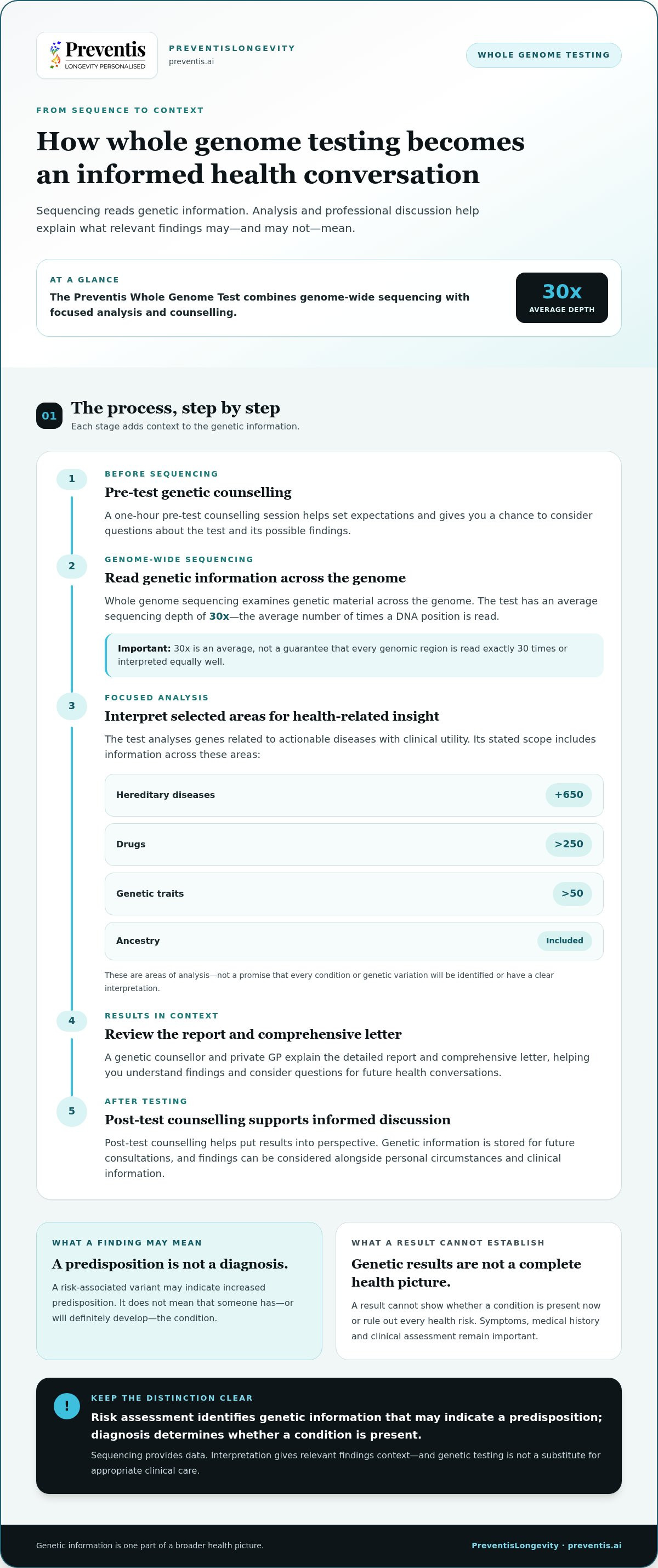
This guide explains what whole genome testing examines, how it differs from a targeted genetic panel and what its findings can and can’t tell you. The PreventisLongevity Whole Genome Test uses whole genome sequencing at an average depth of 30x. It analyses genes related to actionable diseases with clinical utility and provides information on +650 hereditary diseases, >250 drugs, >50 genetic traits and ancestry.
A finding may indicate a predisposition, but it does not mean you have or will develop a condition. The PreventisLongevity Whole Genome Test includes a one-hour pre-test genetic counselling session and post-test counselling. A genetic counsellor and private GP explain the detailed report and comprehensive letter, helping you understand the information and consider questions for future health conversations.
Key Takeaways
- Full body genetic screening refers to analysing genetic information, not physically scanning every part of the body.
- Whole genome sequencing differs from a targeted panel in the breadth of genetic material sequenced, while analysis focuses on interpreting findings relevant to health.
- A genetic finding may indicate predisposition, but it is not a diagnosis or a certain prediction.
- Pre-test counselling, report review and post-test discussion help you understand the results and consider informed next steps.
- The Preventis Whole Genome Test stores genetic information for future consultations.
What does full body genetic screening actually mean?
The phrase can sound like a scan of every organ, tissue and system in the body. It isn’t. Full body genetic screening is a broad, informal term for examining genetic information, often through whole genome sequencing (WGS). Rather than creating images of the body, WGS sequences DNA for analysis of genetic differences that may be relevant to health.
A genome is the complete set of genetic instructions in a person’s DNA. Whole genome sequencing reads across that genetic material, while analysis interprets findings that may be relevant to health. The What is Whole Genome Sequencing? overview explains the method and its applications. The breadth of sequencing does not mean every genetic change has a clear health meaning or that every condition can be assessed.
How is genome-wide testing different from a physical body scan?
A physical scan uses imaging to look at structures inside the body. Genetic testing examines DNA for variations that may be associated with inherited conditions or other traits. These approaches answer different questions: imaging can help assess a physical concern, while genetic analysis provides information about inherited susceptibility.
A genetic finding might indicate an increased predisposition to a condition, but it cannot show whether that condition is present now. Symptoms, medical history and clinical assessment remain important. Genetic sequencing also cannot reveal every present or future health condition. Some conditions are influenced by factors beyond the genetic information assessed, and not every finding can be interpreted with certainty.
What does genetic risk information tell you?
A result may inform conversations about personal or family health history, prevention, further assessment or other appropriate next steps. Its relevance depends on the specific finding and the person’s wider circumstances. Consider a result alongside clinical information, rather than using it on its own to make decisions about symptoms or treatment.
Risk assessment identifies genetic information that may indicate a predisposition; diagnosis determines whether a condition is present. A risk-associated variant does not mean someone will definitely develop a condition. Equally, a result without a reported finding cannot rule out every health risk.
This distinction is central to using full body genetic screening responsibly. Sequencing generates data, but interpretation gives that data context. A genetic counsellor can explain what a finding may and may not mean, discuss uncertainty and help identify whether it warrants further conversation. This can be especially important when results relate to inherited conditions or may have implications for family members.
Genetic information is one part of a broader health picture, not a substitute for clinical care. If you have symptoms, seek appropriate medical assessment rather than relying on a genetic result to explain them. With realistic expectations and professional discussion, genome-wide testing can provide information without being mistaken for a complete picture of your health.
What can whole genome sequencing analyse?
Whole genome sequencing examines genetic information across the genome, but its practical value depends on what is analysed and how findings are interpreted. The Preventis Whole Genome Test sequences the genome at an average depth of 30x and analyses genes related to actionable diseases with clinical utility. Its scope includes information on +650 hereditary diseases, >250 drugs and >50 genetic traits, as well as ancestry information. These are areas of analysis, not a promise that every condition or genetic variation will be identified or have a clear interpretation.
This broad approach differs from a test focused on a smaller, specific set of genes. For more context on how sequencing fits into proactive health, explore this whole genome sequencing guide. The CDC’s Understanding Genetic Testing resource also outlines different uses of genetic tests. When considering a result, focus on what was analysed and what question the information may help address.
What does 30x average sequencing depth mean?
Sequencing depth describes how many times, on average, a position in the DNA sequence is read during sequencing. Think of checking a line of text more than once to help build a reading. For the Preventis Whole Genome Test, the average depth is 30x. “Average” matters: it describes overall sequencing depth, not a guarantee that every genomic region is read exactly 30 times or interpreted equally well.
Depth is a technical measure of sequencing, not a measure of someone’s health or the certainty of a result. It does not, by itself, tell you whether a genetic finding is medically meaningful. That depends on analysis and interpretation. In full body genetic screening, sequencing provides the basis for assessment, while professional review helps put relevant findings into context.
Which kinds of information are included?
The Preventis Whole Genome Test provides information in several areas. Each may contribute a different kind of insight for discussion, rather than a standalone conclusion about health or treatment.
- Hereditary disease information: Analysis covers genes related to actionable diseases, with information on +650 hereditary diseases.
- Medication information: The scope includes insights on >250 drugs across the listed categories, which may inform conversations about how genetic factors relate to medicines.
- Genetic traits: The test includes information on >50 genetic traits related to areas such as metabolism, nutrition and diet, physical appearance, sensory perception, athleticism and behaviour.
- Ancestry: Ancestry information is also provided.
These categories are not interchangeable. Hereditary disease information may raise questions about personal or family risk; medication information may be relevant to a prescribing discussion; and a trait result may describe a genetic characteristic. The meaning of a finding depends on its specific context. Read the report as structured information, not as a list of definite predictions.
The Preventis Whole Genome Test pairs sequencing with genetic counselling and professional explanation, helping you consider how findings relate to your questions. Explore the Preventis Whole Genome Test to learn about this supported approach to genome-wide analysis.
What full body genetic screening cannot tell you
A broad genetic analysis can reveal information relevant to health, but it cannot tell you exactly what will happen. A result linked with a condition does not mean you will develop it, and a result with no reported finding does not guarantee that you are free from genetic or other health risks. Full body genetic screening is best understood as one source of information, not a complete forecast of your health.
Risk information is not a diagnosis or certainty
Genetic findings need to be considered alongside symptoms, personal and family medical history, and clinical assessment. A test result alone cannot establish that a disease is present, explain every symptom or predict with certainty whether a condition will develop. Likewise, no finding in the areas assessed cannot rule out every possible genetic or non-genetic cause of illness.
What a test can report depends on what it analyses and what is known about the genetic variations it finds. Some findings may be relevant to health; others may not have a clear interpretation. Scientific understanding can also evolve, so a result is not an all-encompassing answer about present or future health. MedlinePlus discusses these boundaries in its overview of the limitations of genetic testing.
Why professional interpretation matters
Professional discussion helps connect a result to the person behind it. A genetic counsellor can explain what a finding may mean, clarify uncertainty and consider its relevance alongside family and health history. A clinician can discuss whether the information warrants follow-up in the context of the individual’s circumstances. The appropriate conversation depends on the finding and the wider clinical picture.
Genetic results are most useful when a professional explains what they may mean, what they cannot establish and whether further discussion is appropriate. This helps avoid treating a risk-associated result as a diagnosis or making decisions from a report without context. The Preventis Whole Genome Test includes pre-test and post-test genetic counselling; a genetic counsellor and private GP explain its detailed report and comprehensive letter.
For readers considering different approaches to prevention, the comprehensive preventive health panel guide offers related context. A panel and whole genome sequencing are distinct approaches, so information about one should not be assumed to describe the scope or specifications of the other.
After receiving results, useful questions to discuss with a professional include:
- What does this finding mean, and what does it not tell me?
- How does it relate to my personal or family health history?
- Is follow-up discussion appropriate for my circumstances?
These questions keep the focus on informed next steps rather than certainty. Genetic information can support prevention and medical conversations, but it does not replace care. If you have symptoms or a health concern, seek clinical assessment regardless of a screening result.
Prepare for testing and move from curiosity to clarity
A supported testing process gives you space to understand the purpose of genome-wide analysis before considering what the results might mean. The Preventis Whole Genome Test includes pre-test counselling, testing, report review and post-test discussion. Each stage has a distinct role, from setting expectations to helping you make sense of the information.
- Pre-test counselling: Discuss the test’s scope, purpose and limitations before proceeding.
- Testing: Whole genome sequencing is carried out as part of the test.
- Report review: A genetic counsellor and private GP explain the detailed report and comprehensive letter.
- Post-test discussion: Use the included counselling to talk through findings and possible next conversations.
What the one-hour pre-test session is for
The included pre-test genetic counselling session lasts one hour. It is an opportunity to understand what the test examines and what its results can and cannot establish. Use the conversation to clarify your reasons for considering full body genetic screening, ask about the information it may provide and discuss your expectations before deciding how to proceed.
You do not need to arrive with a fixed list of questions. You might ask how findings are interpreted, what a result could mean for your health discussions, or how uncertainty is explained. The aim is to approach testing with a clear understanding of its scope, rather than treating sequencing as an answer to every health question.
What to expect when the report is discussed
A genetic counsellor and private GP explain the report and comprehensive letter once they are available. The discussion connects the information to your questions and gives you a chance to ask what a finding may mean in context. Post-test genetic counselling is included, so you are not left to interpret complex information alone.
Not every result will lead to the same questions or next steps. You might want to clarify the meaning of a finding, understand what it cannot tell you, or discuss whether it is relevant to a wider health conversation. If a rare finding is identified, referral to consultant geneticists is available. This supports further discussion without implying that a result is a diagnosis or that a particular outcome is assured.
Before the report review, note which parts you would like explained and any questions that have come up since testing. Afterwards, focus on what the findings mean for you, what remains uncertain and whether further conversation is appropriate. A result should not replace clinical assessment if you have symptoms or a specific health concern.
If you are considering a clinician-supported route from testing to interpretation, explore the Preventis Whole Genome Test and its included counselling support.
How the Preventis Whole Genome Test supports informed next steps
Genomic information becomes more useful when it is interpreted and discussed, rather than left as a sequence of technical findings. The Preventis Whole Genome Test combines whole genome sequencing with a detailed report, a comprehensive letter and professional discussion. This gives you a supported way to understand key points and consider how they might inform conversations about preventive health.
The report is not a diagnosis or a ready-made prevention plan. Its findings need to be considered in context, and decisions about care remain with the relevant healthcare professionals. Instead, the information can help you frame questions, understand areas that may merit discussion and bring relevant genetic insights into a future consultation.
From genomic findings to a considered health conversation
A genetic counsellor and private GP explain the detailed report and comprehensive letter, helping you understand what the findings may mean and where interpretation has limits. Use the discussion to clarify unfamiliar terms, ask how a result relates to your health questions and identify points to raise in future consultations. The aim is informed dialogue, not a prescribed course of action.
The test’s genetic information is stored for future consultations. This provides a reference point if you return to discuss your results or have new questions over time. The information is intended to be available as context for later conversations.
After reviewing a finding, distinguish what the report says from what you still want to understand. For example, note which result you would like explained, how it relates to your family or health history, and whether a clinician should discuss its relevance to your circumstances. These questions can help keep a consultation focused without treating a genetic result as a decision in itself.
When a rare finding needs specialist input
If a rare finding is identified, referral to consultant geneticists is available. Specialist input can support further interpretation and discussion of the finding in context. A referral does not mean a disease has been diagnosed or that a particular outcome is expected; it creates an opportunity for appropriate specialist follow-up based on the information available.
This distinction matters because full body genetic screening can contribute to a broader health conversation, but it cannot determine every clinical decision. A finding may prompt questions for a healthcare professional, while other information may simply add context. The appropriate next step depends on the individual result and wider circumstances, not on the sequence alone.
With pre-test and post-test genetic counselling included, the Preventis Whole Genome Test is designed to support understanding before and after testing. To learn more, visit preventis.ai or email care@preventis.ai.
Make your next step an informed one
Genetic insight is most valuable when it helps you ask better questions and make considered choices, not when it is treated as a fixed prediction. If full body genetic screening fits your goals, reflect on what you hope to learn and how you might use the information in future health conversations.
The Preventis Whole Genome Test brings sequencing together with interpretation and professional discussion, including an average sequencing depth of 30x, a one-hour pre-test counselling session and post-test genetic counselling. A genetic counsellor and private GP explain the report and comprehensive letter, so you can explore what the findings may mean in context.
Curiosity can be a thoughtful first step. Explore the Preventis Whole Genome Test and consider whether supported genomic insight is right for your proactive health goals.
Frequently Asked Questions
Is full body genetic screening suitable for healthy adults?
Healthy individuals may consider full body genetic screening as a way to explore genetic information relevant to preventive health, even if they have no symptoms. Whether it suits you depends on your goals and how you feel about receiving uncertain or unexpected findings. Before deciding, consider what questions you hope testing will help you discuss and whether you are comfortable interpreting results with professional support.
Does the Preventis Whole Genome Test include ancestry information?
Yes. The Preventis Whole Genome Test includes ancestry information alongside its health-related analysis. This may be of interest if you are curious about genetic heritage, but it is one aspect of the test rather than a complete account of family history or personal identity. If you are unsure what the ancestry information represents, include that question in your counselling discussion.
What happens if whole genome analysis identifies a rare finding?
If a rare finding is identified, referral to consultant geneticists is available for specialist follow-up. This creates an opportunity to explore the finding in more depth; it does not mean a condition has been diagnosed or that a particular outcome is certain. Note any questions about the result, its interpretation and its relevance to your circumstances for discussion with the professionals involved.
Can whole genome testing provide information for couples planning to have children?
It may provide genetic information relevant to a discussion about inherited disease and family planning, but a result alone should not be treated as a couple-specific assessment of reproductive risk. The Preventis Whole Genome Test information states that around 3% of couples planning to have children have a 25% risk of having a child affected by a genetic disease. Discuss individual questions with a genetic counsellor.
Does the Preventis Whole Genome Test include genetic counselling?
Yes. It includes pre-test and post-test genetic counselling, with a one-hour pre-test session. Use the pre-test conversation to discuss what you hope to learn, raise concerns about possible findings and clarify the test’s scope. After testing, counselling offers space to ask questions about your results and consider what, if anything, you would like to discuss with a healthcare professional.
Can whole genome testing tell me exactly which condition I will develop?
No. Whole genome testing cannot predict with certainty which condition you will develop. A genetic finding may indicate a predisposition, but it does not establish that a condition is present or guarantee it will occur. Equally, a result without a reported finding does not rule out every health condition. Treat the information as one part of a broader health conversation, not a personal forecast.


