

What if your health score isn’t a grade for your overall health? The same phrase can describe very different things, from a general wellness or biomarker score to a genetic estimate of risk for specific conditions. If you’re focused on understanding my health score, the first step is knowing what kind of score you’re looking at.
A genetic risk estimate isn’t a diagnosis or a prediction that you’ll develop a condition. PreventisLongevity MyHealthScore, also called the PreventisLongevity Polygenic Risk Test, estimates lifetime polygenic risk for cardiovascular disease, type 2 diabetes, breast cancer and prostate cancer compared with the general population. It’s intended for adults, is performed once in a lifetime, and uses a saliva sample, next-generation sequencing (NGS) and CE-marked analysis software. A basic ancestry analysis helps adjust the risk analysis, and results include information relevant to medical care.
This guide explains what a genetic health score can and can’t tell you, how it differs from other health scores, and how to discuss its insights with a healthcare specialist. With the right context, risk information can support thoughtful preventive care, without being mistaken for certainty.
Key Takeaways
- For understanding my health score, first identify whether it’s a genetic risk estimate, a clinical measure or a general wellness score.
- Learn how many genetic variants contribute to a polygenic risk estimate, and why it complements rather than replaces traditional risk factors.
- See how to interpret risk insights as a starting point for a conversation with a healthcare specialist, not as a prescription for a specific action.
- Explore which disease areas the Preventis Polygenic Risk Test assesses and how its variant counts differ by condition.
- Understand why results are intended for adults and why the test is performed once in a lifetime.
What does understanding my health score actually mean?
It’s understandable to feel unsure when you see the words “health score”. They can refer to different kinds of information, not one universal measure of how healthy you are. A genetic risk score, a result from a health check and a wellness rating may all use numbers or categories, but they assess different things.
myHealthScore is a genetic assessment that estimates a person’s lifetime polygenic risk for specified diseases; it is not a diagnosis, a prediction of certainty or a universal grade of overall health. It estimates risk for cardiovascular disease, type 2 diabetes, breast cancer and prostate cancer compared with the general population. The result relates to the conditions assessed, not every aspect of a person’s current or future health.
In practice, understanding my health score starts with asking what it measures and what information it draws on. A genetic estimate can add a distinct perspective, but it doesn’t replace current clinical measurements or explain someone’s whole health picture.
Is a health score the same as a diagnosis?
No. myHealthScore assesses polygenic risk. It does not diagnose disease, confirm that a condition is present or determine that someone will develop it. A risk estimate describes a likelihood in context, not a certainty or a timetable. Someone with a higher estimated genetic risk may never develop the condition, while someone with a lower estimate may still do so.
That distinction matters: a score is one piece of information, not a definitive statement about an individual’s health. It should not be read as a diagnosis or as a decision about treatment.
Why can different health scores mean different things?
The name “health score” doesn’t tell you what data sits behind it. A genetic score draws on inherited variants. Other scores may summarise biomarkers, such as measurements from a clinical assessment, or combine lifestyle information. A wearable-based rating may use data gathered by a device. These categories aren’t interchangeable, so comparing their numbers directly can be misleading.
An NHS Health Check result is also distinct: it reflects information collected during that check, rather than a polygenic estimate of lifetime risk. The two may offer different perspectives; neither should be mistaken for the other.
A polygenic risk score uses information from many genetic variants to estimate risk for a particular condition. For myHealthScore, the genetic estimate is independent of and complementary to traditional risk factors. It isn’t a summary of current biomarkers, daily habits or wearable readings.
- Identify the data: Is the score based on genetic variants, clinical measurements, lifestyle information or device data?
- Check its purpose: Does it estimate risk for specific conditions, report current measurements or summarise general wellness?
- Keep the context: A number only has meaning within the method and purpose for which it was created.
These questions make it easier to interpret what a score can reasonably tell you, and what it leaves outside its scope.
How does myHealthScore estimate lifetime genetic risk?
Polygenic risk is based on the combined information from many genetic variants. Rather than treating one variant as a verdict, the analysis considers a broad pattern of inherited differences associated with a particular disease. The National Human Genome Research Institute’s explanation of polygenic risk scores also highlights that these scores estimate risk; they don’t establish what will happen to any one person.
For the Preventis Polygenic Risk Test, a saliva sample is analysed using next-generation sequencing (NGS) and CE-marked software. The result estimates lifetime risk in comparison with the general population. It isn’t an exact personal forecast: it doesn’t say whether or when someone will develop a condition.
A genetic risk estimate describes how inherited variation relates to the likelihood of a specified disease; it is not a diagnosis or confirmation that the disease is present. Understanding my health score means keeping that distinction in view and treating the estimate as one source of information, not a conclusion about your future health.
Which disease risks can the test assess?
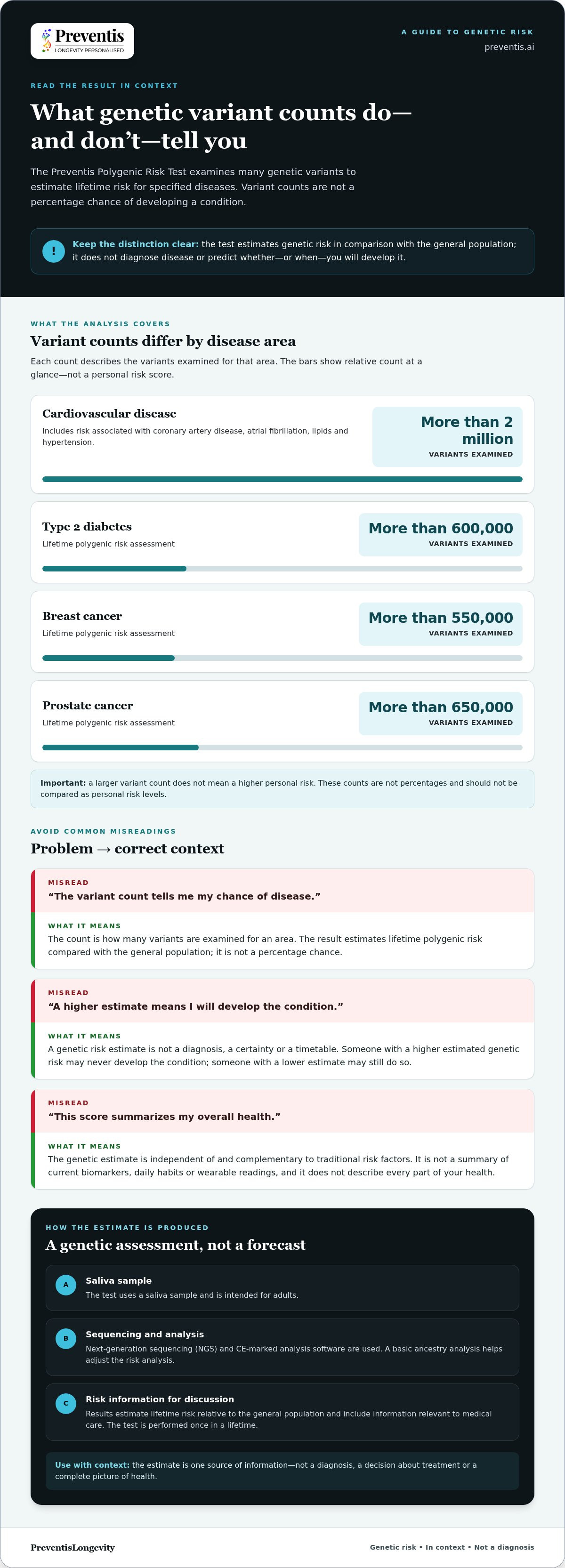
The test assesses lifetime polygenic risk across four disease areas. For cardiovascular disease, the analysis covers risk associated with coronary artery disease, atrial fibrillation, lipids and hypertension. The other areas are type 2 diabetes, breast cancer and prostate cancer. The number of variants examined differs by area:
- Cardiovascular disease: more than 2 million variants
- Type 2 diabetes: more than 600,000 variants
- Breast cancer: more than 550,000 variants
- Prostate cancer: more than 650,000 variants
These figures describe the variants examined for each area. They aren’t a percentage chance of developing a disease, and they shouldn’t be compared with one another as if a larger count meant a higher personal risk.
What information accompanies the genetic risk estimate?
A basic ancestry analysis is included to help adjust the risk analysis. The results also provide content relevant to medical care, giving adults and healthcare specialists information to consider when discussing preventive strategies. The test is intended for adults, is performed once in a lifetime, and is independent of and complementary to traditional risk factors.
That context matters. A genetic estimate doesn’t account for every factor that shapes health, and it doesn’t dictate a particular lifestyle change or clinical decision. It can contribute to a broader, informed conversation with a healthcare specialist, who can consider the result alongside other relevant information.
If you’d like to understand how the assessment works and what its results are designed to communicate, explore the Preventis Polygenic Risk Test information.
What a genetic health score can, and cannot, tell you
A genetic health score offers one perspective on risk, not a verdict on your health. myHealthScore estimates lifetime polygenic risk for specific conditions. Its result is independent of and complementary to traditional risk factors, which means it adds a different kind of information rather than replacing other measures. A higher estimate isn’t a diagnosis, and it doesn’t mean you’re certain to develop a condition.
Understanding my health score means keeping the purpose of each result clear. A genetic estimate concerns inherited variation. A clinical measurement reflects information gathered about your health at a particular time. A general wellness score may summarise lifestyle or device data. The figures aren’t interchangeable, so a higher number in one system can’t automatically be compared with a number in another.
| Type of information | What it reflects | What it cannot establish on its own |
|---|---|---|
| Genetic risk estimate | Polygenic risk for specified conditions, considered over a lifetime and compared with the general population | Whether or when an individual will develop a condition |
| Current clinical measures | Measurements such as blood pressure or cholesterol, captured as part of a clinical assessment | A person’s full genetic risk or overall future health |
| General wellness score | A summary based on the particular lifestyle, activity or wearable data used by that scoring system | A diagnosis or a complete account of health |
Does a higher genetic risk mean you will develop a disease?
No. A higher estimate indicates a different level of relative genetic risk, not a certain outcome. It doesn’t provide an exact personal probability or age of onset, and it shouldn’t be treated as proof that a condition is present. A healthcare specialist can help interpret the result alongside relevant health information and care context.
How should you compare genetic risk with other health information?
Consider what each measure assesses rather than trying to rank the results. An NHS Health Check reading and a polygenic estimate answer different questions: one reports clinical measures, while the other estimates inherited risk for specified diseases. Discussing them together with a healthcare specialist can put each in context. Neither a genetic score nor a check-up result alone replaces diagnosis or treatment decisions.
Traditional risk factors and genetic information can inform the same broader health conversation, but they are not substitutes for one another. Lifestyle changes don’t remove inherited genetic risk or guarantee a different score. They may be relevant to preventive strategies for other reasons, which is why any next steps should be considered in context with a healthcare specialist rather than inferred from a score alone.
How to use a health score as a starting point for prevention
A genetic risk result can raise useful questions, but it doesn’t decide what you should do next. A steady approach helps turn information into a considered conversation: first understand what the result refers to, then discuss its meaning with a healthcare specialist, and only then consider whether any preventive strategies are appropriate to your circumstances.
Use genetic risk information to guide an informed discussion with a healthcare specialist, not to self-diagnose or choose a course of action on your own. This keeps the result in perspective and allows it to be considered alongside your existing health information.
- Understand the result. Identify the disease area covered and what the risk estimate represents. Note any questions or terms in the report that you’d like explained.
- Discuss the context. Share the result with a healthcare specialist and consider how it relates to your clinical information and wider health picture.
- Consider next steps together. If appropriate, discuss preventive strategies or lifestyle considerations. The score itself doesn’t prescribe a specific action.
What should you discuss with a healthcare specialist?
Start by clarifying which disease area the result refers to and how to interpret the estimate. You can then ask how the genetic information relates to your existing clinical information and what context may matter when considering prevention. These questions support a focused conversation without treating the result as a diagnosis or assuming it calls for a particular test, treatment or screening schedule.
- Which condition does this estimate relate to, and what does the comparison mean?
- How should I consider this information alongside my existing clinical measures and health history?
- Are there preventive strategies that are appropriate to discuss in my circumstances?
How can you keep the result in perspective?
Use the report’s medical-care-relevant content as context for discussion, rather than as a complete account of your present health. myHealthScore is a genetic test performed once in a lifetime, not a score designed for repeated tracking over time. Your health and clinical information may change, but the genetic estimate isn’t a routine progress measure. Understanding my health score means recognising what it can contribute while leaving broader interpretation to a conversation with a healthcare specialist.
A clear conversation can help you distinguish inherited risk from current health findings and consider whether any next steps make sense. If you’d like to explore how Preventis MyHealthScore can support a more informed health discussion, learn about the Preventis Polygenic Risk Test.
How Preventis myHealthScore supports a more informed health conversation
Once you understand that a genetic risk score is specific to certain diseases and isn’t a diagnosis, it becomes easier to see its role: it can provide an additional perspective to discuss with a healthcare specialist. Preventis myHealthScore, also called the Preventis Polygenic Risk Test, estimates lifetime risk compared with the general population. It’s designed for adults and is performed once in a lifetime, rather than used to track changes in health over time.
What makes the Preventis Polygenic Risk Test distinct?
The test focuses on polygenic risk for cardiovascular disease, type 2 diabetes, breast cancer and prostate cancer. It uses a saliva sample, next-generation sequencing (NGS) and CE-marked analysis software. A basic ancestry analysis is included to adjust the risk analysis, and results provide content relevant to medical care.
For each disease area, the test examines:
- More than 2 million variants for cardiovascular disease
- More than 600,000 variants for type 2 diabetes
- More than 550,000 variants for breast cancer
- More than 650,000 variants for prostate cancer
These counts describe the variants assessed, not an individual’s probability of developing a condition. The result is independent of and complementary to traditional risk factors. It doesn’t diagnose disease, guarantee an outcome or replace clinical judgement. A health advisor explains the test and answers patient questions, helping make the information easier to understand before discussing its relevance to preventive strategies with a healthcare specialist.
What is a sensible next step after understanding your score?
Choose further reading based on the questions you want to explore. The DNA health score test guide offers related context for comparing genetic health scores. For a closer look at cardiovascular genetics, see the heart health DNA screening guide. If you’re interested in broader preventive genomic information, the comprehensive preventive health panel guide explores that wider context.
Understanding my health score is a useful first step, but the result is most meaningful when considered alongside other relevant health information. If you’d like to learn more about the assessment, explore the Preventis Polygenic Risk Test. For enquiries, Preventis can be reached at preventis.ai or care@preventis.ai.
Make your next health conversation more informed
Understanding my health score can be the beginning of a more focused conversation about your long-term health, rather than a search for a single definitive answer. Before speaking with a healthcare specialist, consider writing down what you hope to clarify and which questions matter most to you. This can help keep the discussion centred on your priorities and the wider context of your care.
Genetic information is most useful when it supports thoughtful decisions, not when it creates pressure to act on a result alone. Take the time to understand the purpose of any assessment and how its insights may fit into a personalised preventive care discussion.
If you’re ready to explore whether this type of genetic risk assessment aligns with your interests, explore the Preventis Polygenic Risk Test. A considered next step can bring greater clarity to your health journey, with your questions and wellbeing at the centre.
Frequently Asked Questions
Can myHealthScore diagnose cardiovascular disease, type 2 diabetes, breast cancer or prostate cancer?
No. myHealthScore estimates genetic risk for these disease areas; it can’t confirm whether you currently have any of them. If you have symptoms or concerns about your health, a genetic risk result isn’t a substitute for an appropriate clinical assessment. For example, a result related to cardiovascular risk shouldn’t be read as evidence that you have cardiovascular disease. A healthcare specialist can help explain what the result does and doesn’t indicate.
Is myHealthScore the same as a general health or wellness score?
No. myHealthScore is focused on lifetime genetic risk for specified diseases, rather than giving an all-purpose rating of your wellbeing. A general wellness score might draw on activity or lifestyle information, while a clinical measure reflects a particular assessment. The label “health score” alone doesn’t identify the method. If you’re understanding my health score, check which conditions it covers and what information the result is based on before interpreting it.
How many genetic variants does the Preventis Polygenic Risk Test examine?
The counts differ by disease area: more than 2 million variants for cardiovascular disease, more than 600,000 for type 2 diabetes, more than 550,000 for breast cancer and more than 650,000 for prostate cancer. These figures indicate the number of variants examined for each assessment, not a risk percentage. They also aren’t a measure of how severe a condition might be or whether it will occur.
What sample is needed for the Preventis Polygenic Risk Test?
A saliva sample is needed. The genetic analysis uses next-generation sequencing, with CE-marked analysis software. A basic ancestry analysis is also included to adjust the risk analysis. If you’re preparing to take the test, follow the sample collection instructions provided with it so the sample can be submitted as directed. The result is intended to contribute information relevant to medical care, rather than provide a standalone clinical assessment.
Can I request a risk assessment for one disease area or several together?
Yes. The test can be requested for cardiovascular disease, type 2 diabetes or cancer risk, separately or together. This lets the assessment focus on one area of interest or consider multiple offered areas. “Cancer risk” in this test refers to the specified breast and prostate cancer assessments, not every type of cancer. A health advisor can explain the test and answer questions about its scope.
Does myHealthScore include ancestry analysis?
Yes. A basic ancestry analysis is included and used to adjust the risk analysis. It forms part of the context for interpreting the genetic assessment; it isn’t a separate overall health grade or a diagnosis. If you’re reviewing a result, you can ask how this included analysis relates to the risk information in your report and how the information should be considered in a healthcare discussion.
Is the Preventis Polygenic Risk Test intended for children?
No. The Preventis Polygenic Risk Test is intended for adults, not children. Its purpose is to estimate lifetime polygenic risk in adults and provide information for use by healthcare specialists when informing preventive strategies. If you’re considering genetic information for a family member who is under 18, don’t assume this adult test is appropriate for them. The intended age group is an important part of understanding the test’s scope.
Can genetic risk results replace traditional risk factors or clinical care?
No. Genetic risk results are independent of and complementary to traditional risk factors; they don’t replace clinical care, diagnosis or treatment decisions. For example, a genetic estimate and a blood pressure reading describe different aspects of health, so neither should be treated as a substitute for the other. Discussing results with a healthcare specialist can help place them alongside relevant clinical information and avoid drawing conclusions from one measure alone.


