

The most convenient test isn’t automatically the most useful one. In the choice of Bluecrest health screening vs at-home test, the right fit depends less on where a sample is taken and more on the health question you want to answer.
It’s understandable to wonder whether a home-collected result carries the same meaning as a provider-led screening, or whether a broad panel is better than a focused test. The answer depends on what’s measured, how the sample is collected and how the result is interpreted. Neither type of screening can diagnose every condition or replace advice from a healthcare professional.
This guide compares Bluecrest screenings and at-home tests by scope, sample collection and limitations. It also explains what to do with an unexpected result and when to seek clinical advice. If your question relates to inherited risk or preventive health, genomic testing can offer a different kind of information, but it is not a diagnosis.
Key Takeaways
- In the Bluecrest health screening vs at-home test comparison, start with the health question you want answered, not where the sample is collected.
- Check which markers or measures a test covers. A screening result is not a diagnosis or a complete clinical assessment.
- Compare sample method, test scope, result interpretation, convenience and follow-up to find an option that fits your circumstances.
- Use a five-step checklist to clarify your question, consider your health context and plan what to do with the result.
- For questions about genomic or preventive health, compare your goals with the scope of a PreventisLongevity testing option.
Bluecrest health screening vs at-home test: what is actually different?
A screening appointment and an at-home kit can answer different health questions. Health screening checks selected indicators in people who may not have symptoms. It can flag something worth discussing, but it isn’t a diagnosis. The purpose and limits depend on what’s measured, so understanding the medical screening strategy behind a test matters as much as where it takes place.
“At-home” describes where some steps happen, not a standard method or level of clinical value. A kit might involve sending a sample for laboratory analysis, completing a questionnaire or providing information for a genetic test. The sample, analysis and result depend on the specific test.
Does at-home testing mean the same thing as a home health check?
No. A home health check may refer to a broad panel, while another kit may focus on one measure or use a different assessment approach. Some tests use a biological sample; others may rely on questionnaires or genetic analysis. Check the test’s stated scope and method rather than assuming every kit measures blood biomarkers or follows the same steps.
What does a Bluecrest health screening involve?
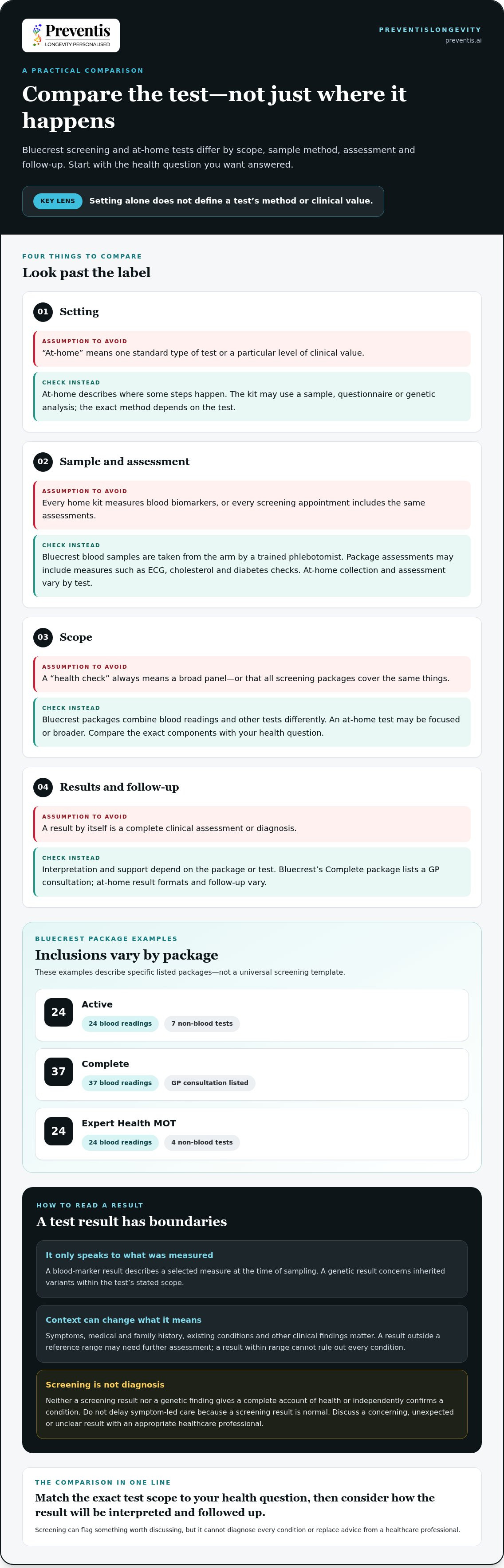
Bluecrest’s screening packages are provider-led appointments that include blood readings, with some packages also including non-blood tests. For example, its Active package lists 24 blood readings and seven non-blood tests, while Complete lists 37 blood readings and a GP consultation. Bluecrest also lists an Expert Health MOT with 24 blood readings and four non-blood tests. Inclusions vary by package, so these figures are not a universal screening template.
Bluecrest blood samples are taken from the arm by a trained phlebotomist, and assessments may include measures such as ECG, cholesterol and diabetes checks. That differs from a home kit, where collection and assessment depend on the individual test. To compare options fairly, look at the components of the particular Bluecrest package and at-home test you’re considering rather than treating either category as uniform.
| Factor | Bluecrest screening | At-home test |
|---|---|---|
| Setting | Appointment-based screening | Some steps take place at home |
| Sample or assessment | Blood draw and package-dependent assessments | Varies by test; may involve a sample, questionnaire or another method |
| Scope | Package-dependent combination of blood readings and other tests | May be focused or broader, depending on what the test includes |
| Results and follow-up | Interpretation and support depend on the package; Complete lists a GP consultation | Result format and follow-up vary by test |
For the Bluecrest health screening vs at-home test decision, match the exact test scope to your health question first. The setting is only one part of the comparison.
What can health screening and at-home tests reveal, and what can they not?
A result can only speak to the markers, genetic variants or other measures included in that particular test. A cholesterol reading, for example, describes a measured level at the time of sampling. A genetic result may indicate whether specific inherited variants were detected within the test’s stated scope. Neither result, on its own, gives a complete account of someone’s health.
Screening is a targeted check of selected health indicators, not a complete account of your health or a diagnosis. It may identify a signal that merits further assessment, but screening, risk prediction and diagnosis are different. A risk estimate describes likelihood in a defined context; diagnosis requires appropriate clinical assessment of the person and their findings.
How do blood-marker and genomic tests differ?
Blood-marker tests measure selected characteristics in a sample at a particular point in time. Results can be influenced by context, such as recent illness or other individual factors. Genetic testing examines inherited information, but only within the variants and conditions the test is designed to assess. A finding may inform risk; it doesn’t establish that a person has, or will develop, a condition. For more detail, read this comprehensive preventive health panel guide.
Why do results need context and follow-up?
Interpretation depends on more than the number or result shown. Symptoms, medical and family history, existing conditions and other clinical findings can change what a result means and what action is appropriate. A result outside a reference range may need further assessment, while a result within range can’t rule out every condition.
A normal screening result shouldn’t delay symptom-led care. If you have symptoms or a result that’s concerning, unexpected or unclear, discuss it with an appropriate healthcare professional. A consumer test can inform that conversation, but it doesn’t independently confirm a diagnosis or determine treatment.
For background on how a regulator discusses direct-to-consumer tests, the US Food and Drug Administration explains the regulation of direct-to-consumer tests in the United States. This is a US reference, not UK regulatory guidance, so keep the jurisdiction in mind when interpreting it.
In the Bluecrest health screening vs at-home test comparison, usefulness depends on whether the test’s scope fits your question and whether you understand its limits. If you’re exploring inherited risk or preventive health, consider whether Preventis genomic and preventive testing matches the information you’re seeking. Results are most valuable when considered in context and followed by appropriate next steps.
Bluecrest screening or an at-home test: compare the factors that matter
Start with your health question, then check whether each option measures something relevant to it. A broad package can offer a wider snapshot, but more measurements don’t automatically make it the best answer to a specific concern. In the Bluecrest health screening vs at-home test decision, relevance matters more than test count or location alone.
| Factor | Bluecrest screening | At-home test |
|---|---|---|
| Health question | May suit someone seeking a general overview through a selected package of checks. | May suit a focused question if the kit specifically measures the relevant marker or information. |
| Scope | Package-dependent; review the included readings and assessment components. | Varies from a specific measure to a broader panel, depending on the individual test. |
| Method | Appointment-based, with methods determined by the package. | Some steps happen at home; sample and process depend on the test. |
| Interpretation | Consider the result in light of its stated reference ranges and any support included. | Check how results are presented and what guidance accompanies them. |
| Convenience and follow-up | Requires attending an appointment, which some people prefer for an in-person assessment. | Can avoid an appointment for sample collection, though follow-up arrangements differ by test. |
Is an in-person screening always more comprehensive?
No. Breadth comes from what is measured, not simply from being assessed at an appointment. Bluecrest’s package inclusions vary, while an at-home test may be designed around one clearly defined question. Compare the actual components and intended use. A longer list of results may provide more information, but it won’t necessarily give a more relevant or definitive answer about your concern.
Validity also depends on the specific test and the processes used to collect, handle and analyse its sample. For laboratory-based tests, laboratory accreditation is one relevant quality consideration; Bluecrest uses UKAS-accredited laboratories. Accreditation alone, however, doesn’t show that a test covers your question or guarantees a particular result.
When might a preventive or genetic test be more relevant?
If you want to understand selected current health markers, a blood-marker panel may fit better. If your question concerns inherited risk, a genetic test may be more pertinent within its stated scope. These approaches provide different kinds of information, and neither replaces assessment of symptoms. For a related overview, explore this heart health DNA screening guide.
The CDC outlines examples of recommended health screenings, but this is US guidance, not a UK screening recommendation. For UK decisions, use guidance relevant to your circumstances and discuss personal concerns with a healthcare professional. If inherited or preventive health is what you’re exploring, Preventis genomic and preventive testing offers a way to consider those questions through testing, with results interpreted in context.
How to choose: a five-step checklist for your health question
A clear question makes the comparison more useful. Before choosing between a screening appointment and a home kit, consider whether you have symptoms, a relevant family history, existing conditions or advice from a clinician. If you have urgent symptoms, seek appropriate medical attention rather than relying on a consumer screening kit.
- Define the question. Are you looking for information about a current health marker, inherited risk or a general preventive overview? If symptoms are driving your concern, focus on getting medical advice rather than treating screening as a substitute.
- Check the scope. Read the test’s stated measures, variants or assessment components. Make sure it explicitly covers the question you want answered; a broad package isn’t automatically more relevant.
- Understand the method. Find out what sample or information the test uses and what that method can and can’t assess. Follow the instructions carefully, since collection and analysis depend on the specific test.
- Plan interpretation. Look at how results are presented and what guidance or follow-up is available. Consider how your health history and any clinician advice could affect their meaning.
- Decide next steps. Before testing, know what you’ll do with an unexpected or unclear result. Afterward, keep the report and note relevant symptoms, family history and existing conditions to support a discussion with an appropriate healthcare professional.
In brief: define your health question, match it to the test’s stated scope and method, then decide how you’ll interpret the result and act on it. Convenience can help you choose between suitable options, but it shouldn’t be the only reason to select a test.
How can Preventis testing fit into a preventive plan?
If your question relates to inherited risk, a Preventis genetic testing option may be relevant. For broader preventive health questions, compare your goals with the scope of a preventive panel. Preventis offers options including Preventis 17 Gene BRCA/Lynch, Preventis Whole Genome, Preventis Max Prevention and Preventis Preventive panel. Whole-genome testing is a broader genomic route, not a replacement for symptom-led care or clinical advice. Explore this Preventis preventive health panel guide as a related resource. The right next step depends on the question and the test’s defined scope, not on a promised outcome.
Once you’ve clarified what you want to understand, explore Preventis health testing to compare genomic and preventive testing options with your question in mind.
Choosing your next step: use screening results as a starting point
The practical rule is simple: begin with the question you want answered, then match it to a test’s stated scope, method and follow-up. A Bluecrest screening package and an at-home test may provide different kinds of information, so compare what each actually assesses rather than choosing by breadth or convenience alone. If symptoms are the reason you’re looking for a test, seek appropriate medical advice instead of relying on screening as a substitute for care.
Which Preventis testing category could match your question?
Preventis offers direct-to-consumer genomic and preventive health testing kits. The relevant category depends on what you want to explore. Cancer panels and cardiovascular panels address distinct areas; preventive testing offers another route for questions focused on prevention. MyHealthscore is a separate option, while Preventis Whole Genome may be relevant when your question concerns broader inherited information. These categories are not interchangeable, and no result should be treated as a diagnosis or a guaranteed prediction.
Choose by subject, not by the most expansive-sounding option. If you’re considering genetic testing, first clarify whether inherited information is relevant to your concern. If you’re comparing a panel with general screening, check the stated scope and how its findings could inform a wider health discussion.
How can you move from insight to action?
Keep any report alongside the context that may help explain it: symptoms, health history, family history, existing conditions and advice you’ve already received. If a result is concerning, unexpected or unclear, discuss it with an appropriate healthcare professional. A screening or genomic result can contribute information, but it doesn’t independently confirm a condition or determine treatment.
Preventis testing can be one part of a broader preventive health conversation when its scope aligns with your question. The value lies in understanding what the result can tell you, recognising its limits and considering suitable next steps with relevant professional advice. That approach turns information into a more considered plan without asking a test to answer questions it wasn’t designed to address.
For a health question that aligns with genomic or preventive testing, explore Preventis testing options. Screening is a starting point for informed conversations, not a replacement for diagnosis or medical care.
Make your next health decision with greater clarity
The right choice in the Bluecrest health screening vs at-home test comparison depends on the question you want answered, the test’s stated scope and how you’ll interpret the result. A broader package isn’t automatically more relevant, and a convenient kit is only useful when it measures something that fits your needs.
Screening results offer information about selected measures, not a complete picture or a diagnosis. Consider your symptoms, health history and family history, and discuss concerning or unclear findings with an appropriate healthcare professional. If your question relates to preventive or inherited health, Preventis offers genomic and preventive testing options, including cancer and cardiovascular panels. These can contribute information to a wider health discussion, but they don’t replace professional care.
Start with your question, match it to the test, then plan a considered next step. Explore Preventis health testing to compare genomic and preventive options with what you want to understand. A thoughtful choice can help turn health information into a clearer path forward.
Frequently Asked Questions
Is Bluecrest health screening better than an at-home test?
Neither is automatically better; the right choice depends on what you want to learn. In the Bluecrest health screening vs at-home test comparison, check whether the specific tests cover your question, how assessment and results work, and what follow-up is included. A provider-led screening and a consumer kit may assess different things, so compare their stated scope rather than the setting alone. Seek professional advice for symptoms or concerning results.
Can an at-home health test be as accurate as a clinic-based screening?
Accuracy depends on the individual test, not simply on whether it’s used at home or at an appointment. The sample or assessment method, collection and handling, laboratory processes, and interpretation can all matter. Compare tests that measure the same thing and review their stated limitations. A result is not automatically a diagnosis, and a negative finding can’t rule out every health condition. Discuss questions or unexpected findings with an appropriate healthcare professional.
What does a Bluecrest health screening include?
Inclusions vary by screening option, so use the package description when comparing checks. Bluecrest’s Active package lists 24 blood readings and seven non-blood tests; its Complete package lists 37 blood readings and includes a GP consultation. These are package-specific details, not a description of every Bluecrest screening. Read the listed components carefully, and distinguish measured readings from broader conclusions about your health.
Are at-home health tests reliable?
They can provide useful information when the test is appropriate for your question and used as directed, but reliability depends on its specific method, sample handling, analysis and limitations. “At-home test” describes where some steps take place, not one uniform technology. Check exactly what the test measures and how results are explained. If a finding is unexpected, concerning or unclear, discuss it with an appropriate healthcare professional rather than relying on the result alone.
Can an at-home test diagnose a health condition?
Don’t assume a consumer test can diagnose a condition. Many tests measure selected markers or genetic information within a defined scope, and a result may indicate that further assessment is worth discussing. Diagnosis depends on appropriate clinical assessment and context. If you have symptoms, seek medical advice rather than waiting for a kit result. Treat screening information as a starting point for a conversation, not as confirmation of a condition or a treatment decision.
Should I choose genetic testing or a general health screening?
Start with the question you want answered. General screening checks selected health indicators, while genetic testing examines inherited information within the test’s defined scope. They aren’t interchangeable: one may relate to measured markers, the other to inherited risk. Consider your health and family history, existing conditions and any clinician advice. Then compare the exact scope and limitations to decide which information may be relevant to your situation.
What should I do if my health screening result is abnormal?
Read the report’s explanation and follow its stated guidance, but remember that an abnormal screening result isn’t a diagnosis. Keep the report and discuss the finding with an appropriate healthcare professional, especially if you have symptoms or relevant medical history. They can consider it alongside your circumstances and advise on suitable next steps. If symptoms are urgent or severe, seek urgent medical attention rather than waiting for another test.


