

What if a higher genetic risk estimate were a prompt for a more informed conversation, not a diagnosis? A future health risk assessment can help you understand how inherited factors may relate to lifetime risk, but the result is only one part of your health picture. It’s natural to wonder what a higher estimate means and how it fits alongside factors such as family history and other health information.
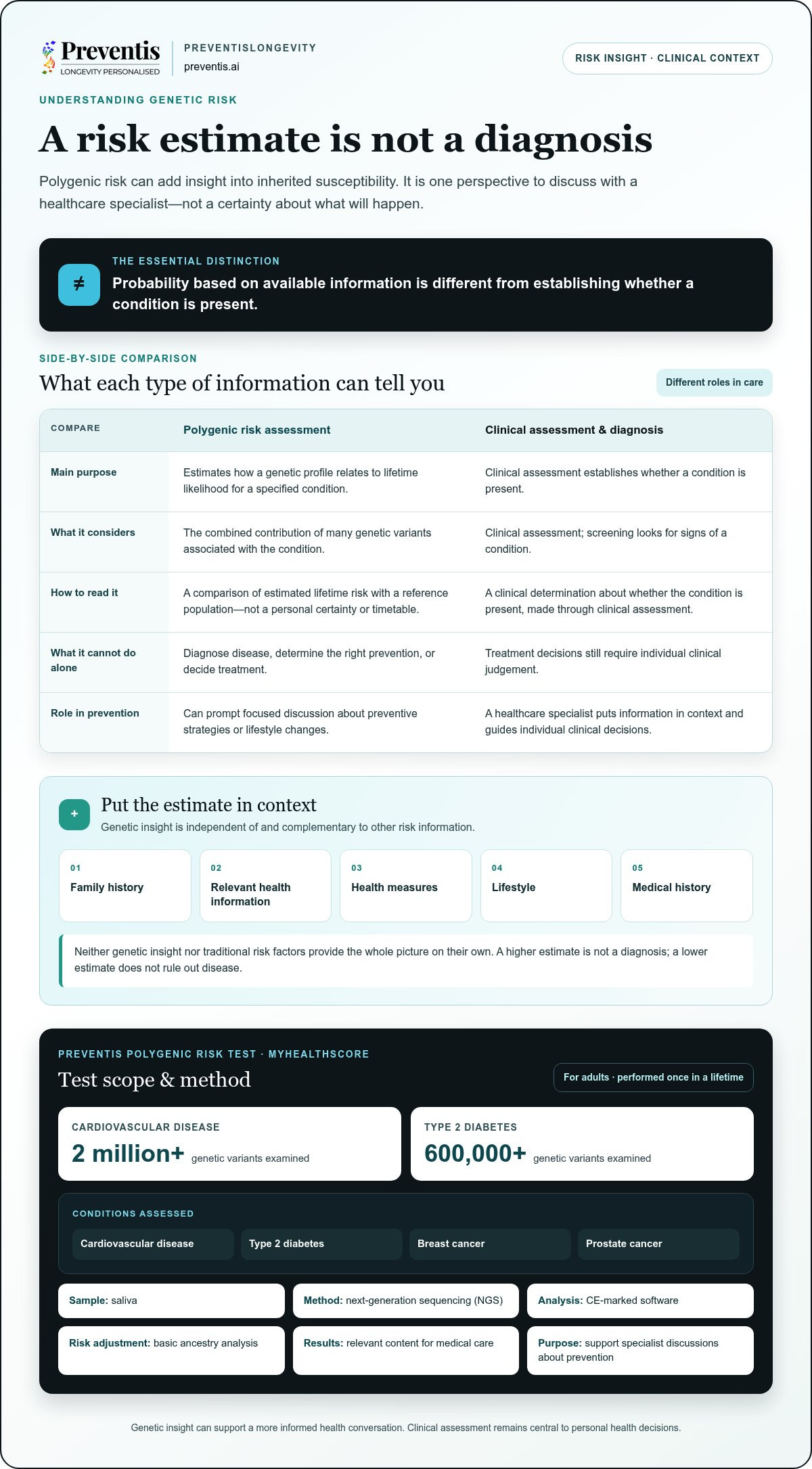
This guide explains what polygenic risk assessment can reveal, where its limits lie, and how to discuss genetic insight with a healthcare specialist. The PreventisLongevity Polygenic Risk Test, also known as myHealthScore, assesses lifetime polygenic risk for cardiovascular disease, type 2 diabetes, breast cancer or prostate cancer. It is intended for adults, uses a saliva sample and next-generation sequencing (NGS), and includes CE-marked analysis software and a basic ancestry analysis to adjust the risk analysis. The test is performed once in a lifetime, and results include relevant content for medical care. You’ll learn how to put the estimate in context and prepare for a productive conversation about prevention, without mistaking probability for certainty.
Key Takeaways
- A future health risk assessment estimates susceptibility. It doesn’t diagnose disease or predict with certainty who will develop it.
- Polygenic risk reflects the combined effect of many genetic variants. Interpret it alongside traditional risk factors, not in isolation.
- Use your results to prepare focused questions for a healthcare specialist rather than drawing clinical conclusions on your own.
- The Preventis Polygenic Risk Test examines more than 2 million genetic variants for cardiovascular disease and more than 600,000 for type 2 diabetes.
- The results are intended to support healthcare specialists as they consider preventive strategies and lifestyle changes.
What a future health risk assessment can tell you about tomorrow
What can an assessment reveal about future health? It can estimate how your genetic profile relates to the likelihood of developing certain conditions over a lifetime. A future health risk assessment is not a forecast of exactly what will happen. It offers one perspective that you and a healthcare specialist can consider when discussing prevention.
Genetic insight may highlight a predisposition before symptoms arise. That information can help guide a conversation about preventive strategies or lifestyle changes. It doesn’t determine which choices are right for you, and it shouldn’t be interpreted on its own. Using information about possible future disease to guide prevention is often described as predictive medicine.
A risk estimate describes a probability based on the available information. A medical diagnosis establishes whether a condition is present through clinical assessment. Keeping that distinction clear can help you treat a result as a useful starting point, rather than a cause for alarm or unwarranted reassurance.
How genetic risk differs from a diagnosis
An increased genetic risk estimate doesn’t mean you have a disease, and it doesn’t make that disease inevitable. Risk information is different from clinical screening, which looks for signs of a condition, and from diagnosis, which establishes whether it is present. Treatment decisions require individual clinical judgement. A genetic result may inform these discussions, but it cannot make those decisions on its own.
Why risk estimates need context
Genetic risk assessment is independent of and complementary to traditional risk factors. A healthcare specialist may consider genetic information alongside your family history and other relevant health information. Neither genetic insight nor traditional factors provide the whole picture on their own. A lifetime estimate compared with the general population is a reference point, not a personal certainty. A specialist can help interpret it in light of your circumstances.
For example, an estimate suggesting higher-than-average inherited susceptibility may be a reason to ask whether preventive strategies are relevant to you. It isn’t a reason to assume you have the condition or to change treatment without clinical advice. A lower estimate also doesn’t rule out disease or remove the value of ongoing care and attention to established risk factors.
Rather than asking only, “Am I at risk?”, consider what the estimate compares, which condition it relates to and what other information a specialist may need to interpret it. This keeps genetic findings in their proper role: one source of information that can support thoughtful prevention, while clinical assessment remains central to decisions about your health.
How genetic and polygenic risk assessment builds a health estimate
Polygenic risk assessment looks at the combined contribution of many genetic variants, rather than treating one variant as a complete explanation of future health. Each variant contributes to an estimate for a specified condition. Taken together, these signals can indicate whether estimated lifetime risk is higher or lower than that of the general population.
Polygenic risk is an estimate shaped by the combined effect of many genetic differences. It is not a prediction that a particular person will or won’t develop a condition. That is the central idea behind a future health risk assessment based on polygenic information: it adds a perspective on inherited susceptibility without claiming to map out an individual’s future with certainty.
What a polygenic risk estimate represents
A polygenic assessment examines variants associated with the health condition being assessed and combines their contribution into a risk estimate. The National Human Genome Research Institute’s overview of polygenic risk scores explains the general approach. The result compares estimated lifetime risk with a reference population. It is not a timetable for when a disease might appear or proof that it will develop.
That distinction matters. A result can identify a potential subject for a more informed health discussion, but it can’t establish whether a disease is present. Nor does it show, by itself, what prevention or treatment is appropriate. Its meaning depends on the assessment’s scope and the wider clinical picture.
How genetic information complements traditional risk factors
Genetic risk assessment is independent of and complementary to traditional risk factors. A healthcare specialist may consider genetic information alongside relevant health measures, family history, lifestyle and other details from your medical history. Each offers a different kind of information, and none should be treated as enough on its own to determine an individual’s health outcome.
For example, an estimate indicating higher inherited susceptibility could prompt a discussion about which preventive strategies or lifestyle changes may be suitable for you. It doesn’t automatically mean that more intensive screening is needed or that existing clinical guidance should change. A healthcare specialist can put the estimate in context and help you understand whether it adds useful information to the conversation.
The comparison with the general population is a reference point, not a complete personal forecast. Your health profile includes many considerations beyond that comparison, and those details can affect how a result is understood. The practical value lies in considering the genetic estimate with other relevant information, then using that fuller picture to guide an appropriate discussion.
If you’re exploring how genetic insight could contribute to preventive planning, the Preventis Polygenic Risk Test assesses polygenic risk to support conversations with healthcare specialists. Results provide relevant content for medical care; they don’t make clinical decisions on their own.
What a future health risk assessment can and cannot tell you
A genetic risk result can be useful, but its meaning depends on understanding its limits. A future health risk assessment based on polygenic information estimates susceptibility for specified conditions. It doesn’t reveal with certainty who will develop a disease, when it might happen or whether it is present now.
A risk estimate is not a diagnosis or a guarantee. It’s one source of information to discuss with a healthcare specialist. The CDC’s guide to Genetic Testing provides further context on what genetic tests can tell people about health. Use results to support a considered conversation, not as a standalone basis for medical decisions.
Risk estimate versus diagnosis
A polygenic risk test assesses the combined effect of many genetic variants associated with a condition. It doesn’t test whether that condition is currently present, and it doesn’t replace clinical diagnosis or treatment decisions. If you have symptoms or a health concern, a genetic risk estimate isn’t a substitute for appropriate clinical assessment. A result indicating lower estimated risk can’t guarantee that you won’t develop the condition.
| What a risk estimate can indicate | What it cannot establish |
|---|---|
| How estimated lifetime genetic risk compares with a general population reference. | Whether you currently have a disease. |
| That inherited factors may be relevant to a preventive health discussion. | Whether, or at what age, you will develop a condition. |
| Information a healthcare specialist may consider alongside your wider health context. | Which screening, treatment or lifestyle plan is right for you on its own. |
Why results should be read alongside other information
Genetic risk assessment is independent of and complementary to traditional risk factors. Family history, health measurements, lifestyle and other clinical information can all contribute to a fuller understanding of your circumstances. A genetic estimate adds a distinct perspective, but it doesn’t outweigh or replace the rest of that picture.
Consider a result that suggests higher estimated lifetime risk. It may give you a useful reason to ask a healthcare specialist whether preventive strategies are relevant to your circumstances. It doesn’t automatically mean additional screening or treatment is appropriate. A specialist can weigh the result alongside other relevant information and explain what, if anything, it changes.
Approach the report with questions rather than conclusions: What is being estimated? What population is the comparison based on? How might this information fit with my health history? These questions help keep the result in perspective and make the discussion more productive. The purpose is not to label your future, but to offer information that may support informed, professionally guided prevention.
How to use a future health risk assessment in a health conversation
A genetic result is more useful when you approach it as the start of a discussion, not a decision in itself. Take time to understand what the report measures, note what you’re unsure about, and bring those questions to a healthcare specialist. The results are intended to support specialists as they consider preventive strategies and lifestyle changes in the context of your health.
Use this sequence to prepare:
- Read the report carefully. Identify which condition the estimate relates to and how the result is presented. Note any terms or comparisons you’d like explained.
- Separate the estimate from your health history. Record relevant context, such as family history, existing health information and lifestyle factors. Don’t use a genetic result to diagnose yourself.
- Prepare specific questions. Ask how the estimate relates to your wider health picture and which traditional risk factors may also matter.
- Discuss possible next steps. Explore whether preventive strategies, lifestyle changes or further clinical discussions are appropriate for your circumstances.
Questions to take into a specialist discussion
Clear questions can help you move from uncertainty to a more informed conversation. You might ask:
- What does this estimate mean in relation to my health history and traditional risk factors?
- How should I understand the comparison with the general population?
- Could any preventive strategies or lifestyle changes be relevant to me?
- Does this result change what we should discuss about my ongoing care?
These questions invite interpretation without assuming that the result dictates a medical plan. A specialist can consider the genetic information alongside other relevant details and explain what it may, or may not, add to your care. The article on the comprehensive preventive health panel offers another perspective on how genetic information may support health planning.
How to keep risk information in perspective
Treat the result as information for discussion, not a fixed forecast. The Preventis Polygenic Risk Test is intended for adults and provides results to support healthcare specialists. It doesn’t diagnose disease or replace clinical judgement. You don’t need to reach a conclusion on your own. Focus on understanding what the report says, what it can’t establish and which questions matter for your circumstances.
Prepared questions can make a specialist conversation more focused and help turn genetic insight into considered, professionally informed prevention. If you’re exploring genetic risk assessment, learn about Preventis myHealthScore.
How the Preventis Polygenic Risk Test assesses future health risk
The Preventis Polygenic Risk Test estimates lifetime polygenic risk for cardiovascular disease, type 2 diabetes, breast cancer or prostate cancer. Intended for adults, it is performed once in a lifetime. The assessment uses a saliva sample, next-generation sequencing (NGS) and CE-marked analysis software to examine genetic variants associated with the selected health area or areas.
The number of variants assessed depends on the selected area:
- >2 million genetic variants for cardiovascular disease
- >600 000 genetic variants for type 2 diabetes
- >550 000 genetic variants for breast cancer
- >650 000 genetic variants for prostate cancer
Conditions and information included in the assessment
The cardiovascular disease assessment includes coronary artery disease, atrial fibrillation, lipid profile, including triglycerides, LDL and HDL cholesterol, and hypertension. You can request assessment of cardiovascular disease, type 2 diabetes or cancer risk separately or together. The cancer risk assessment covers breast cancer and prostate cancer. The selected areas determine which genetic information is included.
A basic ancestry analysis is also included and used to adjust the risk analysis. This provides context for interpreting the genetic data. The estimate remains a measure of lifetime risk compared with the general population, not a prediction of whether or when an individual will develop a condition.
The test also provides risk calculators that improve predictive power for cardiovascular disease and breast cancer. This information complements traditional risk factors; it does not replace clinical assessment or establish a diagnosis.
What the test provides after analysis
Results include relevant content for medical care and are intended to support healthcare specialists as they consider preventive strategies and lifestyle changes. A health advisor explains the test and answers patient questions. Genetic risk is independent of and complementary to traditional risk factors, so the findings are most useful when considered alongside a person’s wider health context.
This can make the result a practical starting point for a health conversation. A specialist can help explore whether the estimate adds useful information to discussions about prevention, while taking other individual factors into account. The result doesn’t replace clinical assessment or determine a medical plan on its own.
For adults considering a genetic perspective on future health, the Preventis Polygenic Risk Test brings variant analysis, ancestry adjustment and information for medical care into one assessment. Its role is to inform a conversation, not define an individual’s future.
Explore the Preventis Polygenic Risk Test to learn more.
Make your next health conversation more informed
Genetic insight is most valuable when it helps you ask better questions and take considered steps with a healthcare specialist. Rather than treating a result as a fixed forecast, use it to discuss what matters for your individual health and which preventive choices may be appropriate. That’s how a future health risk assessment can support a more proactive approach without replacing clinical judgement.
Take time to explore how genetic risk information may fit into your approach to prevention, and bring questions about your results to a healthcare specialist. The aim isn’t to control every uncertainty, but to make thoughtful decisions with the information available to you.
Explore the Preventis Polygenic Risk Test and consider how genetic insight could inform your health conversations.
Frequently Asked Questions
Can a future health risk assessment tell me whether I will develop a disease?
No. A future health risk assessment estimates lifetime risk; it can’t say whether you’ll develop a condition or when it might happen. The Preventis Polygenic Risk Test compares estimated risk with the general population, and its findings are independent of and complementary to traditional risk factors. You could ask a healthcare specialist how a result fits with your family history and other health information. It doesn’t replace diagnosis or treatment decisions.
Is a genetic risk assessment the same as a medical diagnosis?
No. The assessment estimates risk for specified conditions; it doesn’t confirm that a condition is present. If you have symptoms, don’t use a genetic result to decide what they mean. Seek appropriate clinical advice. The results provide relevant content for medical care and are intended to inform healthcare specialists, who can interpret the information alongside your circumstances and traditional risk factors.
What sample is needed for the Preventis Polygenic Risk Test?
The test uses a saliva sample provided by the patient. It is analysed using next-generation sequencing (NGS) and CE-marked analysis software. The test is intended for adults, and results relate to the selected disease area or areas. They provide relevant content for medical care, but don’t establish whether a condition is present. A health advisor can explain the test and answer your questions.
How many times can the Preventis Polygenic Risk Test be taken?
The Preventis Polygenic Risk Test is performed once in a lifetime. This genetic estimate isn’t a substitute for ongoing conversations about your health. If your circumstances change, a healthcare specialist can consider those developments through appropriate clinical care. The result can inform preventive strategies, but it doesn’t determine a medical plan or remove the role of traditional risk factors.
Does a higher polygenic risk mean I will definitely develop the condition?
No. A higher estimate isn’t a guarantee that a condition will develop, just as a lower estimate can’t rule it out. Treat the result as one piece of information, not a personal prediction. Ask a healthcare specialist what the comparison means for your circumstances and which other factors should be considered. Don’t change treatment or make health decisions based solely on the estimate.
Does the Preventis Polygenic Risk Test include ancestry analysis?
Yes. The assessment includes a basic ancestry analysis, which is used to adjust the risk analysis. It contributes to the interpretation of the genetic risk estimate, but it doesn’t turn the result into a diagnosis or determine what care is appropriate. Results include relevant content for medical care, and a healthcare specialist can help explain how to consider the estimate alongside other information about your health.
Who should interpret the results of a future health risk assessment?
Healthcare specialists are intended to use the results to inform preventive strategies and lifestyle changes. A health advisor explains the test and answers patient questions, while the results provide relevant content for medical care. Before a discussion, note what you’d like clarified, such as how the estimate relates to your health history. Don’t use it alone to diagnose a condition or decide whether to start, stop or change treatment.


