

What if a genetic result showed a higher risk of chronic disease but couldn’t tell you whether you’d ever develop it? That’s the distinction at the heart of genetic markers for chronic disease: inherited variants can offer useful clues, but they aren’t a verdict. Genes are neither everything nor irrelevant. Risk can reflect genetic factors alongside environment, lifestyle and other influences.
This article explains what genetic testing can reveal, what it can’t, and how to use a result as a starting point for an informed conversation with a healthcare professional. You’ll learn the difference between monogenic risk, linked to a variant in a single gene, and polygenic risk, shaped by many variants, and why neither should be interpreted in isolation.
Hereditary-risk testing can support prevention without diagnosing disease. For example, the PreventisLongevity Preventive Panel analyses 164 genes linked to hereditary cancer, hereditary cardiovascular disease and other actionable conditions. It assesses risk and can support specialists as they personalise medical management. The aim is clarity, not certainty: useful information to help guide thoughtful next steps.
Key Takeaways
- Genetic markers for chronic disease can inform risk assessment without confirming that you’ll develop a condition.
- Single-gene findings and polygenic scores address different questions, so they need different interpretation.
- Genetic associations, risk predictions and causes aren’t interchangeable. Exposures can also shape risk.
- A practical approach is to understand what was tested, review the result’s limitations and discuss its implications with a healthcare professional.
- The Preventis Preventive Panel analyses 164 genes linked to hereditary cancer, hereditary cardiovascular disease and other actionable conditions. It is a risk-assessment tool, not a diagnostic test.
What genetic markers for chronic disease can, and cannot, tell you
A genetic marker is a DNA variation studied for its association with a particular health trait or disease risk. Markers can provide different kinds of genetic information, but they are not a single type of test and cannot guarantee what will happen to an individual. For a foundational overview of the term and its uses, see What are Genetic Markers?
An association means a variant is linked with a trait or risk in a studied group. That link may contribute to risk assessment, but it doesn’t prove that the variant caused a condition or that a particular person will develop it. The strength and usefulness of an association depend on the evidence, the health question being asked and how well the findings apply to the person being assessed.
Genetic risk is one input to health decisions, not a forecast of an individual’s future. Genetic markers for chronic disease may add information, but they don’t replace a person’s medical history, symptoms or clinical assessment.
Genetic predisposition is not the same as disease
Carrying a variant associated with a condition may indicate an inherited predisposition. It doesn’t mean the condition is present, that symptoms will appear or that disease is inevitable. A genetic result is one piece of risk information; diagnosis depends on clinical evaluation and relevant evidence about the individual.
For example, someone may learn they carry a variant associated with a particular heart condition. That finding may be relevant to a discussion with a healthcare professional, but it doesn’t establish that they have the condition. Their symptoms, health history and any appropriate clinical assessments remain important.
Why genes are only part of the picture
Health develops over time, and inherited biology is only one influence. Lifetime exposures and circumstances, including diet, tobacco smoke, physical activity and other environmental factors, may also shape risk. Gene and environment interactions describe how a genetic difference and an exposure can work together in ways that affect health. The influence of any one factor can vary by condition and individual.
A PLOS article argues that exposures and interactions deserve substantial attention when considering chronic disease, rather than treating genetic factors as the whole explanation. This is a useful reminder, not a rule that applies equally to every condition. The relative contribution of genes and exposures can differ, so a broad claim about one disease shouldn’t automatically be applied to another.
Interpret a result alongside the question the test was designed to answer, the evidence supporting its findings and relevant personal health information. A marker alone can’t capture every influence on health. Putting it in context helps turn a result into a balanced conversation about possible next steps, rather than a conclusion about what will happen.
How monogenic and polygenic markers relate to chronic disease risk
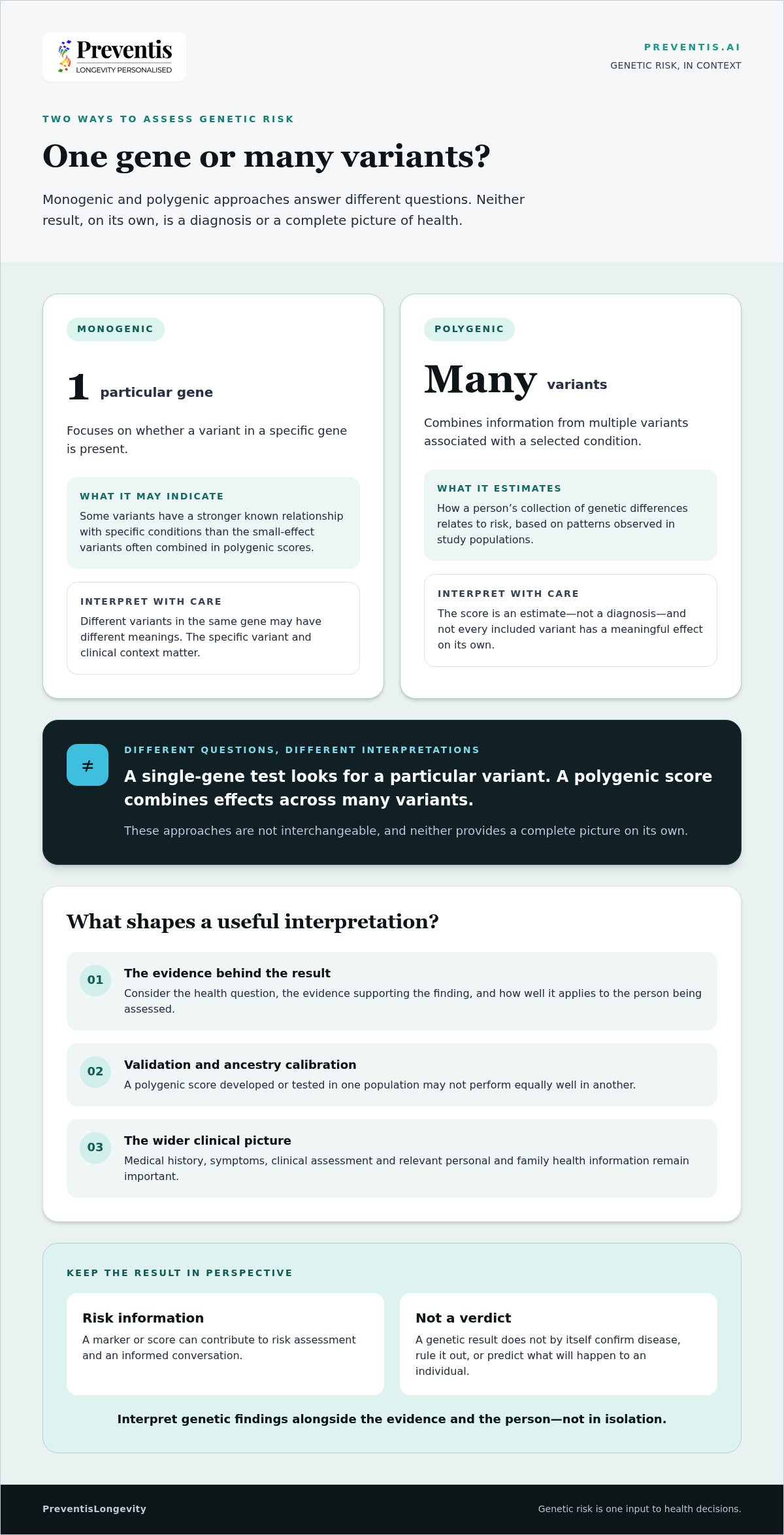
Genetic risk can be assessed in different ways. A monogenic approach focuses on a variant in one particular gene, while a polygenic risk score combines information from many variants. These approaches are not interchangeable: one looks for a specific gene-related risk, while the other estimates how a collection of genetic differences may contribute to a condition.
A high-impact single-gene variant can carry a distinct risk signal; a polygenic score adds together the smaller effects of many variants. Neither approach offers a complete picture on its own. The right interpretation depends on the health question, the evidence behind the result and the individual’s wider clinical context.
What single-gene markers can indicate
Monogenic risk is associated with a variant in a particular gene. Some variants have a stronger known relationship with specific conditions than the small-effect variants commonly combined in polygenic scores. But the gene name alone isn’t enough to interpret a result: different variants in the same gene may have different meanings, and the significance of a finding depends on the specific variant and clinical context.
A result can help inform further assessment or a conversation about personal and family health history. It doesn’t, by itself, confirm that someone has a disease or rule one out. Symptoms and clinical evaluation remain separate parts of understanding a person’s health.
How polygenic risk scores combine many variants
A polygenic risk score combines the effects of multiple genetic variants associated with a selected condition. Researchers use patterns observed in study populations to estimate how a person’s collection of variants relates to risk. The result is an estimate, not a diagnosis, and it doesn’t mean that every variant included has a meaningful effect on its own.
The Broad Institute discusses important challenges in making these scores useful, including validating them and calibrating them across ancestry groups. A score developed or tested in one population may not perform equally well in another. This matters because an estimate is only as useful as the evidence supporting its application to the person receiving it. Polygenic scoring continues to develop, so research use shouldn’t be confused with universal clinical practice.
Consider the contrast: a single-gene test asks whether a particular variant is present, while a polygenic score combines many variants to estimate their cumulative contribution. The first can focus attention on one gene-specific finding; the second summarises a broader pattern. Both depend on sound interpretation, but they answer different questions and should not be used as substitutes for one another.
For a result to become useful, it must be linked to the right question and interpreted with its limitations in view. If you’re considering how a genetic finding fits into your personal health context, an online genetic counsellor service can support a more informed discussion of what the result may mean.
What the evidence says about genes, exposures, and risk prediction
Research on genetic markers for chronic disease doesn’t produce one universal answer about how much genes matter. Their contribution can differ by condition, the population studied and the methods researchers use. A finding about one disease or one group of people shouldn’t automatically be treated as a rule for every individual.
It also helps to separate three terms that can sound similar:
- Association means a genetic variant and a health outcome are linked in the data studied. That link may point to a relationship, but doesn’t show by itself that the variant causes the outcome.
- Prediction means using information to estimate the likelihood of an outcome. A model’s usefulness depends on how accurately it performs in the people and setting where it’s applied.
- Causation means a factor contributes to producing an outcome. Establishing it requires evidence beyond observing that two things occur together.
A risk estimate is meaningful only within the evidence that supports it and the context in which it’s used.
Why research findings can appear to disagree
Studies may ask different questions, recruit different populations, use different methods or measure different outcomes. One might examine whether a genetic pattern is associated with a condition; another might assess whether that pattern improves risk prediction. Even studies of the same condition may define outcomes or follow-up periods differently, making their conclusions difficult to compare directly.
A PLOS article emphasises exposures and interactions when considering chronic disease. That perspective is a useful counterweight to claims that genes explain everything, but it shouldn’t be stretched into a conclusion that genetic variation is unimportant for every condition. Equally, a genetic association shouldn’t eclipse the roles of environment, behaviour and other influences. Read each finding in light of the question the study actually examined.
What validation and ancestry calibration mean
Before a risk model is relied on beyond its original research setting, its performance needs to be evaluated in relevant populations. Validation tests whether the model’s estimates remain useful in new data. Calibration asks whether estimated levels of risk correspond appropriately with observed outcomes in the population being considered.
The Broad Institute has discussed validation and ancestry calibration as challenges for polygenic scores. Genetic patterns and the data used to build a model may differ across ancestry groups, so a score’s performance in one group can’t simply be assumed to transfer unchanged to another. This is a research consideration, not a claim about any particular test.
For readers, the practical question is not just whether a study reports a genetic link. Consider what population was studied, what outcome was measured and whether the model was tested for the intended use. A score that performs well in research may still have limits in a different clinical context. Evidence, population fit and purpose all shape how responsibly a result can inform decisions.
How to interpret genetic markers for chronic disease responsibly
A genetic result is most useful when you know what question it was designed to address. Before treating a finding as a personal health instruction, work through what was tested, what the result means and where its limits lie. This makes genetic information a clearer starting point for discussion, rather than a reason to self-diagnose or make changes to your care on your own.
- Identify the test question. Is the result about a variant in one gene, a polygenic score or another type of marker? Note which condition the test assesses and what it was designed to tell you.
- Understand the result. Ask what the finding means in plain language and whether it describes an association, an estimated risk or something else. A risk estimate is not a diagnosis, and it isn’t automatically a recommendation for treatment or screening.
- Review the limitations. Find out what evidence supports the interpretation, which population the test or model was studied in and what it can’t tell you. Consider whether the result addresses your specific question.
- Discuss the implications. Bring the report and relevant health information to an appropriate healthcare professional. Together, you can consider whether further assessment or personalised medical check-ups are relevant.
Questions to ask when reviewing a genetic result
Useful questions include: What type of marker or score does this report describe, and which condition does it concern? What evidence supports the interpretation, and what are its limitations? How should I understand it alongside my personal health information and family history? These questions help distinguish what the report actually says from assumptions that may arise from technical language or a risk label.
Turning insight into a clinician-led conversation
Genetic information can provide context for a professional discussion, but it shouldn’t replace clinical evaluation. A healthcare professional can consider the result alongside symptoms, medical history and family history, then discuss whether follow-up or personalised check-ups make sense for you. The aim is a proportionate next step, not an automatic change to treatment or screening based on a result alone.
If the finding relates to cardiovascular risk, the heart health DNA screening guide offers more context on genomic insights in this area. For a wider view of how genetic information may contribute to prevention, explore the comprehensive preventive health panel guide.
The Preventis Preventive Panel analyses 164 genes linked to hereditary cancer, hereditary cardiovascular disease and other actionable conditions. It is a risk-assessment tool, not a diagnostic test, and can support specialists in personalising medical management. Explore genetic risk assessment as a starting point for informed, specialist-led prevention.
How the Preventis Preventive Panel applies genetic risk assessment
The Preventis Preventive Panel is a hereditary-risk assessment tool designed to support preventive care. It analyses 164 genes linked to hereditary cancer, hereditary cardiovascular disease and other actionable conditions. It is not a diagnostic test: its findings provide information for risk assessment and specialist discussion, rather than confirming whether someone has a disease.
What the Preventis Preventive Panel is designed to assess
The panel examines genetic variants across its stated gene scope, including variants recommended by the American College of Medical Genetics and Genomics (ACMG) for actionable diseases. Its focus is hereditary risk in the specified disease areas. It is distinct from a polygenic risk score, which combines many variants to estimate risk, and it should not be understood as covering conditions beyond its stated scope.
In practice, a relevant finding may give a specialist additional information to consider alongside a person’s health history and other clinical context. That information can help inform personalised medical check-ups and preventive strategies. The panel doesn’t determine by itself which checks an individual needs; a result should be interpreted as part of a wider assessment rather than in isolation.
Genetic testing can refer to different approaches and levels of analysis. For context on how broader genomic testing relates to preventive health, see this whole genome sequencing prevention guide. The Preventis Preventive Panel has a defined focus on 164 genes associated with its stated hereditary and actionable disease areas; that scope shouldn’t be mistaken for whole-genome analysis.
A supported next step for preventive health
The value of risk information lies in how it is interpreted and used. Specialists can consider panel findings with relevant clinical information to inform medical management and decide whether personalised preventive strategies or check-ups may be appropriate. The result doesn’t promise a particular health outcome, and it doesn’t replace clinical assessment or dictate a treatment plan.
For people exploring genetic markers for chronic disease, a hereditary-risk panel is one way to bring inherited information into a prevention-focused conversation. The findings can help frame questions for a specialist: what does this result mean in my circumstances, and could it affect my preventive care? Clear interpretation keeps the focus on informed decisions, not assumptions based on a test result alone.
If you’re ready to explore how hereditary genetic risk can inform specialist-led prevention, learn about the Preventis Preventive Panel.
Make your next health decision with greater clarity
Genetic information is most valuable when it helps you ask a better question about your health, not when it’s treated as a prediction set in stone. If you’re considering genetic markers for chronic disease, focus on what you want to understand and how a result could contribute to a thoughtful conversation about prevention.
The Preventis Preventive Panel is designed to support specialist-led preventive strategies and personalised medical check-ups. Its findings are intended to inform medical management, not replace professional judgement or guarantee a particular outcome. This measured approach keeps the emphasis on interpreting information in your individual context and considering proportionate next steps with a specialist.
A clear conversation about your health priorities can help you decide whether genetic risk assessment is relevant to your plans. Explore the Preventis Preventive Panel as a starting point for specialist-led preventive health.
Frequently Asked Questions
Can genetic markers tell me whether I will develop a chronic disease?
No. Genetic markers for chronic disease can contribute to an estimate of risk, but they can’t determine with certainty whether you’ll develop a condition. A higher-risk result isn’t a prediction that disease is inevitable, and a lower-risk result doesn’t mean risk is absent. If a finding concerns you, write down what you’d like clarified and discuss its relevance to your health with a healthcare professional.
What is the difference between monogenic and polygenic risk?
Monogenic risk concerns a variant in a specific gene, while polygenic risk combines information from many genetic variants. A report may describe a finding in one gene or give a score based on a broader pattern of variants. These results answer different questions, so they shouldn’t be compared as if they were the same kind of measurement or interpreted using identical assumptions.
Do genetic markers explain all of a person’s chronic disease risk?
No. Genetic information is one part of a person’s health picture. Exposures over time, lifestyle, medical history and other influences may also matter, and their relative importance varies by condition. A result related to inherited risk shouldn’t be used to overlook symptoms or other health information. Consider it alongside the broader context of your wellbeing, rather than as a complete explanation on its own.
Can a genetic risk result diagnose a chronic disease?
No. A risk result provides information about genetic findings or estimated susceptibility; it doesn’t establish that a disease is present. Diagnosis relies on appropriate clinical evaluation, which may consider symptoms and other relevant evidence. If you have symptoms, seek medical advice based on those symptoms rather than waiting for or relying on a genetic test. A risk report can be shared with your healthcare professional as additional context.
How should I discuss genetic risk information with a healthcare professional?
Bring the report, note which result you’re unsure about and share relevant personal and family health information. You could ask what the finding means for you, what the test can’t establish and whether it changes any aspect of your care. If the report uses unfamiliar terms, ask for them to be explained plainly. This can help keep the conversation focused on appropriate, individual next steps.
Can polygenic risk scores be used equally across all populations?
No. A score’s performance may vary between populations, so it shouldn’t be assumed to provide equally reliable estimates for everyone. Researchers assess whether a model has been validated in relevant groups and whether its estimates are appropriately calibrated. If you’re reviewing a score, ask what population evidence supports its use and whether the result is suitable for the context in which it’s being interpreted.
What does the Preventis Preventive Panel assess?
The Preventis Preventive Panel analyses 164 genes linked to hereditary cancer, hereditary cardiovascular disease and other actionable conditions. It includes variants recommended by the American College of Medical Genetics and Genomics for actionable diseases. The panel is intended for risk assessment, not diagnosis, and can support specialists in personalising medical management. Its findings should be interpreted in context by a healthcare professional.


