

Can your DNA help you live longer, or does it only show which risks deserve attention? If you’re exploring how to live longer through genetics, the distinction matters: genes can influence health and ageing, but they can’t set a fixed lifespan or guarantee disease. Lifestyle, environment and chance also shape the years you live and how well you live them.
It’s understandable to want a clear answer from a genetic test. The more useful question is how to turn a result into informed prevention, without treating a risk association as a prediction. This article explains the difference between lifespan and healthspan, how to read longevity research with care, and where genetic insights may support more personalised health conversations. PreventisLongevity Whole Genome Test includes a one-hour pre-test counselling session and post-test genetic counselling, helping put findings into context. The aim is not a promise of extra years, but a clearer, more thoughtful starting point for decisions about your future health.
Key Takeaways
- Genes can influence longevity, but they don’t determine an individual lifespan. Distinguish years lived from years spent in good health.
- Genetic variants may contribute to differences in ageing, but no single variant acts as a longevity switch.
- Learn how to live longer through genetics by treating DNA results as information for prevention, not a guarantee or an exact lifespan prediction.
- Turn a genetic insight into a considered next step by reviewing the evidence and discussing relevant findings with a qualified clinician.
- The Preventis Whole Genome Test analyses +650 hereditary diseases, >250 drugs and >50 genetic traits, with pre-test and post-test genetic counselling included.
How much does genetics really influence how long you live?
Genes can influence longevity, but they don’t determine an individual’s lifespan. How long you live reflects a combination of inherited biology, lifestyle, environmental conditions and events across your life. DNA is one part of that picture, not a personal countdown or a guarantee of what will happen.
Genetic influence is a contribution to the likelihood of certain outcomes, not a fixed prediction of an individual’s future. This distinction matters when considering how to live longer through genetics: genetic information may help frame questions about health, but it can’t promise extra years. It also helps to separate living longer from living well for longer.
What is the difference between lifespan and healthspan?
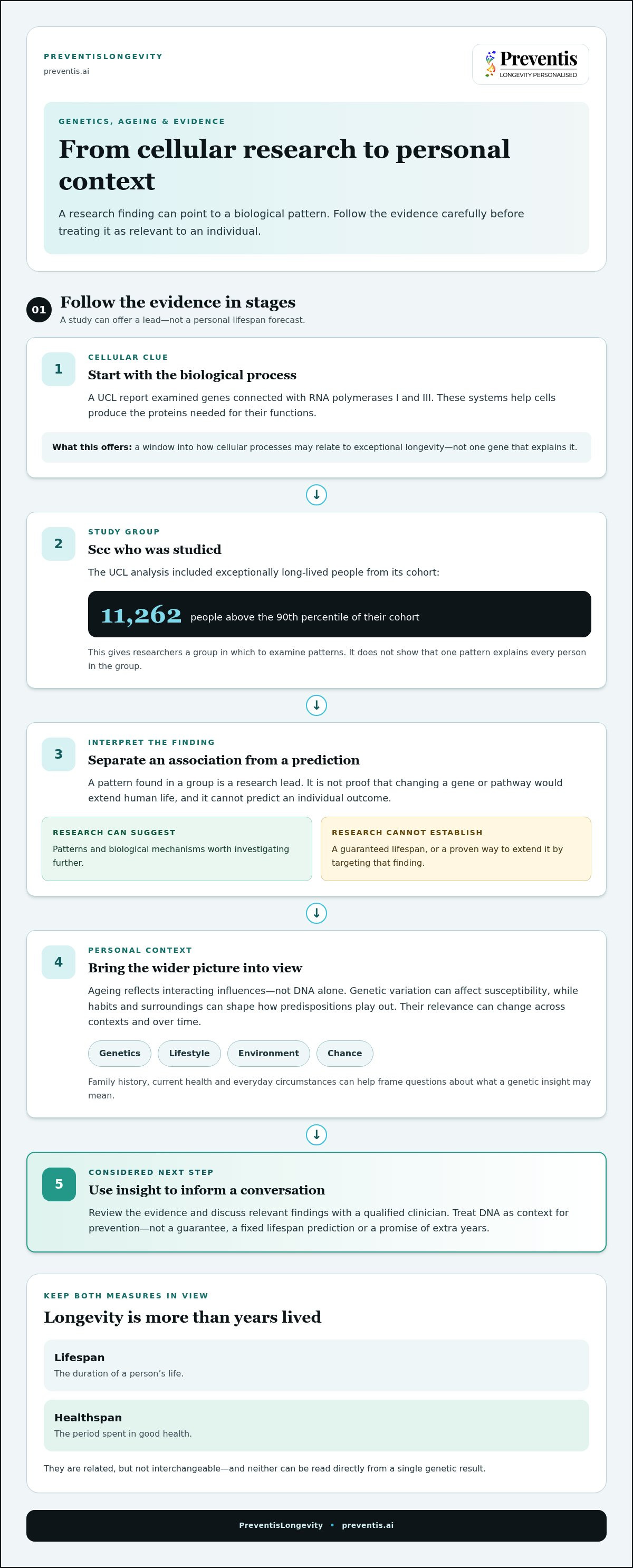
Lifespan is the duration of a person’s life. Healthspan is the period spent in good health. They’re related, but they aren’t interchangeable: two people may live for a similar length of time while experiencing very different levels of health and independence.
Considering both measures gives a fuller view of longevity. A discussion focused only on lifespan can miss the quality of those years, while healthspan alone doesn’t describe how long life lasts. Neither measure can be read directly from a single genetic result.
Are genes the main factor in how long you live?
There isn’t one factor that explains longevity. Genetic variation can affect biological processes and susceptibility to particular conditions, while habits and surroundings can shape how those predispositions play out. These influences also change over time and interact: the same genetic variant may have different relevance in different contexts.
MedlinePlus describes longevity as shaped by genetics, environment and lifestyle, and points to public-health improvements as part of the broader context for changes in how long populations live. That’s a population-level view, not a way to predict an individual’s lifespan. Changes in healthcare and living conditions can influence outcomes across a population without telling any one person exactly what their DNA means.
For a broader overview of genetics and longevity, it’s useful to consider how inherited and external factors contribute together. Research into exceptionally long-lived people can reveal associations worth studying, but a finding in a group doesn’t establish a simple rule for everyone. It also doesn’t make a genetic result a personal forecast.
A practical starting point is to treat genetic information as context. It may suggest questions to explore alongside family history, current health and everyday circumstances. It cannot, on its own, account for every influence on ageing or tell you which outcome is inevitable. That balanced view makes it easier to approach the science with curiosity rather than certainty, and to focus on decisions that can be discussed and reviewed over time.
How can genetic variation shape ageing and longevity?
Genetic variation can influence how cells function over time, but there’s no single “longevity switch” that determines how long someone will live. A variant may affect a biological process, yet its relevance depends on how that process works across the body and alongside other genetic, environmental and lifestyle factors.
This is why how to live longer through genetics is not a question with a simple DNA-based answer. Research can identify patterns and suggest mechanisms worth investigating. It can’t, by itself, show that changing a particular gene would extend a person’s life, or predict an individual outcome.
What does longevity research suggest about biological pathways?
A UCL report examined genes connected with cellular protein-production machinery, including RNA polymerases I and III. These systems help cells produce the proteins needed for their functions. The finding offers a window into how cellular processes may relate to exceptional longevity, rather than pointing to one gene that explains it.
Any reported relationship needs careful interpretation. Biological processes operate in different tissues and contexts, so an association observed in one setting may not apply uniformly throughout the body. The result is a research lead, not evidence that targeting a particular pathway is a proven way to extend human life.
A research association can point to a biological pattern, but it doesn’t prove a personal outcome. Nor does it establish that deliberately changing the associated gene or process would reproduce the pattern in people. That distinction separates an intriguing scientific observation from clinical advice.
Why do researchers study families and exceptionally long-lived people?
Studying relatives and people who live to unusually old ages can help researchers look for inherited patterns that might be harder to detect across a general population. If certain variants or biological features appear more often in a group, they can become useful subjects for further study. Family patterns may also help researchers consider how shared genes and shared circumstances overlap.
The UCL analysis included 11,262 people above the 90th percentile of their cohort. This gives researchers a way to examine genetic patterns among exceptionally long-lived people, but it doesn’t mean those patterns explain every person in the group or apply to everyone else. A cohort finding describes evidence in the people studied; it isn’t a lifespan forecast for an individual.
For readers, the practical value is knowing what kind of question a study can answer. It may suggest that a cellular process deserves more investigation, but it can’t establish whether a particular variant will affect your health or longevity. MedlinePlus explains how genes and other factors relate to lifespan, providing useful context for interpreting this evolving research without treating an association as certainty.
If you’re considering what genetic information could contribute to prevention, exploring the Preventis Whole Genome Test can be one way to understand the kind of genomic insights that may be discussed with genetic counselling. Results need interpretation in context; they don’t promise a longer life.
Can genetic testing help you live longer, or only inform your choices?
A DNA test can’t guarantee a longer life or calculate how many years you’ll live. Its value is more measured: it can identify genetic variations that may be relevant to health, giving you information to interpret alongside your family history, current health and other clinical context. Used thoughtfully, it can help you ask more focused questions, but it can’t decide what will happen or what action is right for you.
Think of a result as one piece of evidence, not a verdict. The distinction is central to understanding how to live longer through genetics: testing may inform prevention conversations, but it doesn’t itself prevent, diagnose or treat disease.
Genetic information
Possible relevance
What it cannot establish
A variant associated with a health condition
May help frame questions about personal or family health history.
That you have, or will develop, the condition.
A variation linked to a biological trait
May contribute context when considering health and ageing.
An exact lifespan or guaranteed exceptional longevity.
A result relevant to health risk
May support a discussion about whether further clinical assessment is appropriate.
A diagnosis, treatment plan, or proof that a particular action will extend your life.
What can a genetic result tell you about longevity?
A result describes genetic information identified through testing, such as a variation that research has linked with a trait or health risk. That link may help you prepare a useful question for a health professional: does this finding matter given my history and current circumstances? Its significance depends on the specific finding and the evidence behind it.
Interpretation helps distinguish a finding that may warrant discussion from one with limited relevance to your situation. No single result guarantees disease or exceptional longevity. The value lies in understanding what the evidence supports, what remains uncertain and whether the information changes a health conversation.
What can genetic testing not tell you?
A test can’t tell you exactly how long you’ll live. It also can’t prove that a particular diet, exercise routine or other lifestyle choice will extend your individual lifespan. Such choices may matter to health, but a genetic result alone can’t establish a guaranteed outcome for any one person.
Most importantly, risk insight is not a diagnosis, treatment or substitute for clinical care. Don’t treat a result as a reason to start, stop or change care without appropriate clinical guidance. Instead, take the finding, its explanation and your relevant health context into a conversation with a qualified health professional. This turns genetic data into a more grounded starting point for decisions, while keeping its limits clear.
How can you turn genetic insight into a practical longevity plan?
A genetic result becomes useful when it helps you ask a better question, not when it’s treated as a set of instructions. A steady process can help you separate meaningful evidence from uncertainty and decide what, if anything, deserves a conversation with a health professional.
Use this sequence to keep the next steps clear:
- Understand the question. Identify what you want to learn, such as whether a result may be relevant to your family history or health.
- Review the evidence. Find out whether the interpretation is well established, emerging or uncertain, and what the result can and can’t show.
- Interpret the finding in context. Consider it alongside your health history and other relevant clinical information, rather than in isolation.
- Discuss possible next steps. Take focused questions to an appropriate health professional before changing care or treatment.
How should you interpret genetic information responsibly?
Start by separating an established finding from an association still being studied. Ask what evidence supports the interpretation and whether it applies to the question you’re asking. Then consider the result alongside your personal and family health history. These steps can help you prepare focused questions for a health professional, rather than trying to diagnose yourself from a report.
For example, you might ask whether a finding is relevant to your circumstances, what its limitations are and whether it changes any existing health discussion. You don’t need to reach a conclusion alone. Clear interpretation is part of using genetic information responsibly.
How can insight support long-term health decisions?
Use a genetic finding as context for prevention conversations, not as an instruction to start, stop or change treatment. Personal circumstances and scientific interpretation can evolve, so it may be useful to revisit questions with a clinician over time. For a related planning perspective, explore DNA insights for long-term health.
Genetic information is only one part of a broader health picture. MedlinePlus describes observations among some long-lived people, including not smoking, avoiding obesity and coping well with stress. These are population-level observations, not personalised prescriptions or guarantees that a particular choice will extend your life. They can, however, prompt a balanced conversation about health habits alongside genetic findings.
Before a discussion, write down what you want clarified: what the result means, how certain the interpretation is, and whether it has any relevance to your current care. This turns “how to live longer through genetics” from a search for a guaranteed formula into a practical question about informed decisions. You can also read about genetic markers for longevity to explore how markers are discussed in the context of healthier ageing.
If you’re considering genomic information as part of that process, the Preventis Whole Genome Test includes a one-hour pre-test counselling session and post-test genetic counselling. Explore the Preventis Whole Genome Test as an option for gaining information to discuss in context, not as a promise of a longer life.
How the Preventis Whole Genome Test can support informed prevention
The Preventis Whole Genome Test offers genomic information that can contribute to a prevention discussion. It doesn’t promise a longer life, prevent disease or predict an exact lifespan. Its purpose is to provide findings that can be explained and considered alongside personal health context, so you can approach questions about ageing with more information and support.
What does the Preventis Whole Genome Test include?
The test uses whole genome sequencing at an average depth of 30x. Its scope includes analysis of genes related to actionable diseases, with coverage of +650 hereditary diseases, insights on >250 drugs and >50 genetic traits, including longevity-related traits. These findings can help inform discussions, but their relevance depends on the specific result and individual circumstances.
Variant classification uses internal and external databases, including ClinVar and HGMD. Genetic information is also stored for future consultations, offering a reference point for later conversations without determining what a person’s health outcomes will be. The service includes a one-hour pre-test genetic counselling session and post-test genetic counselling, so there is support both before testing and when considering the results.
How are results explained and supported?
Results are presented in a detailed report and comprehensive letter, explained by a genetic counsellor and private GP. This can help make complex information easier to understand and put findings into context. If a rare finding is identified, referral to consultant geneticists is available.
That explanation matters because a genetic finding is not automatically a diagnosis or an instruction to change care. The report can help frame questions for a health professional, who can consider the result alongside relevant clinical information. It can’t establish that a particular action will prevent disease or extend life.
For anyone exploring how to live longer through genetics, the most constructive approach is to treat genomic information as a starting point for informed discussion, not a shortcut to a guaranteed outcome. You can explore whole genome sequencing for proactive health to understand how sequencing may contribute to a broader prevention conversation.
If you’d like to consider this kind of information with professional support, explore the Preventis Whole Genome Test. Pre-test and post-test counselling are included, helping you approach results with context and a clear sense of what they can, and cannot, tell you.
Take a thoughtful next step towards healthier ageing
The most useful question isn’t whether DNA can guarantee more years. It’s whether better-understood information can help you make health decisions with greater clarity. Keep curiosity at the centre: identify what you want to understand, consider how it relates to your life, and bring questions into a considered conversation with a health professional.
That perspective keeps how to live longer through genetics grounded in possibility rather than promise. A genetic insight may help shape what you explore next, while your health journey remains broader than any one result. You’re not looking for certainty from a test; you’re building a more informed basis for decisions over time.
If you’d like to explore genomic information as part of a supported prevention approach, explore the Preventis Whole Genome Test. A considered first step can bring useful questions into focus and help you move forward with confidence.
Frequently Asked Questions
Can genetics predict how long I will live?
No. Genetic testing can’t calculate an exact lifespan or tell you the age you’ll reach. A result may highlight a variant relevant to a health risk, but it can’t account for every influence on your future, such as other health conditions or life events. For questions about how to live longer through genetics, use results as information to discuss, not as a personal forecast or a reason to assume a particular outcome is inevitable.
Can lifestyle affect longevity if I have inherited genetic risks?
Yes, lifestyle and health care still matter, although no specific habit can guarantee a longer life or cancel an inherited risk. If a result raises a concern, ask a health professional how it fits with your health history and what general health measures are appropriate for you. For example, a discussion might cover activity, smoking or weight management, without assuming these actions will remove the risk indicated by your genes.
Do longevity-related genetic findings change as I get older?
Your inherited DNA generally stays the same throughout life, but the interpretation of a genetic finding can change as scientific evidence develops. A variant once considered uncertain may later be understood differently, for example. Age and new health information can also change the relevance of a result to a clinical discussion. Keep the report available and raise it again if your health circumstances or family history changes.
Can a genetic test show which health risks to discuss with a clinician?
It can identify findings that may be relevant to a health conversation, depending on the test and the result. Take the report and any questions it raises to a clinician, and include relevant family history. You might ask what the finding means, how certain the interpretation is, and whether it affects your care. A genetic result alone doesn’t diagnose a condition or determine what medical action you need.
Does whole genome sequencing examine genes related to actionable diseases?
Yes. The Preventis Whole Genome Test analyses genes related to actionable diseases with clinical utility. Its stated scope includes +650 hereditary diseases, alongside insights on >250 drugs and >50 genetic traits. The findings are information for interpretation and discussion, rather than a diagnosis. A clinician or genetic counsellor can help clarify what a particular result means in the context of your health.
What does an average sequencing depth of 30x mean?
An average depth of 30x means that, across the sequenced genome, each position is read about 30 times on average. Repeated reads provide data for analysing the sequence, but the average doesn’t mean every position is read exactly 30 times, nor does it guarantee a particular result. It’s a technical measure of sequencing depth, not a measure of your health, risk level or predicted lifespan.
Who explains the results of the Preventis Whole Genome Test?
A genetic counsellor and private GP explain the detailed report and comprehensive letter, helping place the findings in context. The service includes a one-hour pre-test counselling session and post-test genetic counselling. If a rare finding is identified, referral to consultant geneticists is available. Use the discussion to clarify what a result can support and what questions should be directed to your usual clinical care team.


