

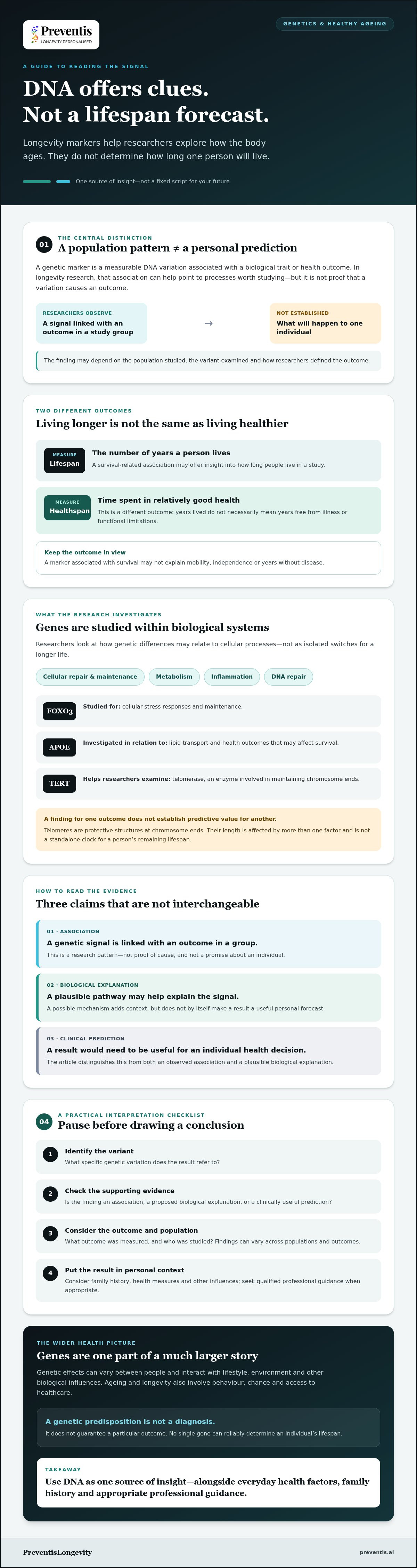
What if genetic markers for longevity reveal more about how the body ages than how long any one person will live? That’s the key distinction. Researchers study genetic signals linked to cellular repair, metabolism and other ageing pathways, but an association found in a population isn’t a personal lifespan forecast.
Findings about longevity genes can seem contradictory because genes are only part of a much larger picture. Their effects can vary between people and interact with lifestyle, environment and other biological influences. A genetic predisposition isn’t a diagnosis, and it doesn’t guarantee a particular outcome.
This article explains which kinds of genetic signals researchers investigate, what they may suggest about healthy ageing, and why their predictive value for individuals remains limited. You’ll also learn how to consider genetic information alongside everyday health factors and what to ask before using test results in health planning. The aim is a clearer way to interpret DNA: as one source of insight, not a fixed script for your future.
Key Takeaways
- Learn how researchers define genetic markers for longevity and why lifespan and healthspan are distinct measures.
- Explore how genes such as FOXO3 and APOE are studied in ageing research, while recognising that associations can vary across populations and outcomes.
- See why a genetic association, a plausible biological explanation and a clinically useful prediction are not the same thing.
- Use a four-step checklist to assess a DNA result, including the variant, supporting evidence and your personal context.
- Consider genomic information alongside family history, health measures and qualified professional guidance when thinking about prevention.
What Genetic Markers for Longevity Actually Tell Us
A genetic marker is a measurable variation in DNA that researchers associate with a biological trait or health outcome. In longevity research, genetic markers for longevity are signals linked to outcomes such as survival or aspects of ageing. They can help researchers investigate biological processes, including those described by the hallmarks of aging. But an association is a research finding, not proof that a DNA variation causes an outcome.
That distinction matters when interpreting a result. A marker may be more common among people in a particular study group, but it can’t tell you with certainty what will happen to one person. The finding may also depend on which population researchers studied and how they defined the outcome. A longevity-associated marker is not an individual lifespan prediction.
What is the difference between lifespan and healthspan?
Lifespan is the number of years a person lives. Healthspan is the period spent in relatively good health. The two are related, but describe different outcomes: living longer doesn’t necessarily mean spending more years free from illness or functional limitations.
A marker associated with survival may offer insight into how long people live in a study, but it may not explain their mobility, independence or years without disease. This is why genetic information is best considered alongside broader health measures. The DNA health score test guide explores how health-related genetic information fits into a wider picture, rather than serving as a standalone verdict.
Can a gene tell you how long you will live?
No single gene can reliably determine an individual’s lifespan. Ageing and longevity reflect the combined influence of many biological factors, as well as environment, behaviour, chance and access to healthcare. A genetic result may point to a predisposition or pathway worth understanding, but it doesn’t set a fixed outcome.
For example, a result linked with a particular health tendency doesn’t account for a person’s full medical history or circumstances. Nor does it establish that someone will develop a condition. Genetic information can help frame useful questions, but it should be interpreted in context and, where appropriate, discussed with a qualified health professional. Its practical value lies in contributing to informed health planning, not in treating DNA as destiny.
How Longevity-Related Genes Influence Ageing Pathways
Researchers study genes not as isolated switches for a longer life, but as parts of biological systems. These include pathways that help maintain cells, regulate metabolism, manage inflammation and repair DNA. A genetic difference could influence how one of these systems functions, but its effects depend on the wider biological context. A signal found in one group therefore doesn’t automatically apply in the same way to every person.
The research also reflects the complexity of ageing itself. The genetics and lifestyle in longevity overview from MedlinePlus describes longevity as involving both inherited and non-genetic influences. Together, these factors help explain why genetic markers for longevity are clues to investigate, not personal forecasts.
What do FOXO3, APOE, and TERT research findings suggest?
FOXO3 is studied for its role in cellular stress responses and maintenance. APOE is investigated in relation to lipid transport and health outcomes that may affect survival. TERT helps researchers examine telomerase, an enzyme involved in maintaining chromosome ends. These genes raise different research questions. Evidence for an association with one outcome doesn’t establish usefulness for predicting another.
Findings can vary with the population studied, the genetic variant examined and the outcome measured. A group-level association describes a pattern across participants. It doesn’t show that a particular result will determine an individual’s ageing trajectory, or establish a simple cause-and-effect prediction of lifespan.
Why do telomeres and cellular pathways matter in ageing research?
Telomeres are protective structures at the ends of chromosomes. They help protect genetic material as cells divide, and their biology is relevant to ageing research. But telomere length is affected by more than one factor and cannot serve as a standalone clock for someone’s remaining lifespan. A measurement needs careful interpretation, not a simple conclusion that “longer means younger.”
Researchers also investigate insulin-like growth factor and mTOR pathways, which are involved in growth, nutrient sensing and cellular activity. These systems coordinate essential functions, so changes in their activity can have complex effects rather than one predictable benefit. The same principle applies to pathways involved in inflammation, DNA repair and cellular maintenance: biological plausibility can guide research, but it isn’t proof of a personal outcome.
If you’re exploring genetic information as one part of a broader preventive health picture, you can learn about broader genomic analysis without treating it as a lifespan forecast.
How Strong Is the Evidence Behind Longevity Genetic Markers?
A finding about one gene can be easier to study than the combined influence of many genetic variants. But longevity is complex: researchers also examine polygenic influences, where numerous variants may each contribute a small effect. Combining those signals into a useful score is challenging. The variants, their weighting and the population used to develop the score all shape what it can tell us.
Three questions help separate evidence from interpretation. Is there a statistical association? Is there a plausible biological explanation? Does the information improve a health decision? A positive answer to one doesn’t automatically answer the others. The MedlinePlus overview of genetics and life span offers accessible context on this evolving research, including studies of genes such as APOE and FOXO3.
What is the difference between a genetic association and a prediction?
An association is a pattern observed across a study group. It may mean that a variant occurred more often among participants who reached a particular age or experienced a defined health outcome. It doesn’t predict an individual’s future. To interpret a result, consider both its effect size and the person’s baseline risk: even a statistically detectable association may make little difference to an individual estimate.
Before relying on a reported figure, check the original study, the outcome measured and the population examined. Don’t repeat study statistics without a verifiable source and the context needed to interpret them.
| Evidence question | What it can show | What it doesn’t establish |
|---|---|---|
| Research association | A pattern between a variant and an outcome in a study group. | That the variant caused the outcome. |
| Individual prediction | An estimate for a person, if a model has been developed and validated for relevant people and outcomes. | A certain lifespan or personal destiny. |
| Actionable clinical relevance | Whether the result can usefully inform a health decision. | That every research finding should change care or behaviour. |
Why can genetic risk findings differ between studies?
Studies may differ in sample size, ancestry representation, participants’ ages and environmental exposures. They may also define outcomes differently: reaching an advanced age, living longer overall, avoiding a particular disease and maintaining good health are not interchangeable measures. A result identified in one population may not transfer neatly to another, especially when some groups are under-represented.
Variation between studies doesn’t make genetic research meaningless. It shows why evidence needs careful appraisal. For genetic markers for longevity, look for replication across relevant populations, a clearly defined outcome and evidence that adds value beyond established health information. These checks turn a striking headline into a more useful question: how strong is the finding, and does it apply to me?
How to Interpret Longevity DNA Results Responsibly
A result is most useful when you know what was tested, how strong the evidence is and what it can reasonably inform. Use this four-step checklist to turn a report into better questions, rather than a fixed conclusion about your future:
- Identify the variant. Find out which specific DNA change was assessed and what trait or health outcome the report connects it with.
- Check the evidence. Ask whether the finding comes from a replicated study, how the result was interpreted and whether it reflects an association in a group or an established clinical risk.
- Consider your context. Check whether the research applies to people with a similar ancestry and whether family history, age or other personal factors affect its relevance.
- Decide what question remains. Is there a practical next step, or would the result benefit from clarification by a qualified healthcare professional?
What questions should you ask about a longevity result?
Ask what the report can and can’t establish. Which variant or marker was assessed? What evidence supports the interpretation, and does it describe a population-level association or a clinically established risk? Also ask about uncertainty, ancestry limitations and appropriate follow-up. A result’s presence alone may not explain its significance for you.
If a finding seems clinically significant or concerning, discuss it with an appropriately qualified healthcare professional, such as your GP, who can consider it alongside your circumstances and advise whether further assessment is appropriate. Don’t make health decisions based on a headline or isolated result.
Consumer genetic information is not a diagnosis and shouldn’t replace professional care. It may prompt useful questions, but it can’t substitute for assessment of symptoms, medical history or established health measures.
How can genetic information fit into a wider health picture?
DNA is one part of the picture. Family history, routine health measures and personal circumstances can add context, as can considerations such as sleep, physical activity, nutrition, smoking and routine care. These factors matter to health, but they don’t erase a genetic predisposition or guarantee a particular lifespan. Instead, they can help you and your healthcare professional consider what’s relevant and what actions are appropriate.
Different genetic tests address different questions. A broader analysis doesn’t automatically provide a more accurate lifespan estimate. If you’re exploring wider genomic information, read the whole genome sequencing guide to understand the approach. You can also explore PreventisLongevity Whole Genome as an option for broader genomic analysis, while keeping any results in their proper context.
Using Longevity Genetics as One Part of Preventive Health
Genetic information is most useful when considered alongside health history, current measurements and guidance from a qualified professional. It may add context to a preventive health picture, but it can’t replace those other inputs or forecast how long you’ll live. Even a broad genomic result needs to be interpreted in light of the specific question being asked.
Tests also differ in scope. A targeted panel examines selected genes or variants relevant to its stated purpose, while broader sequencing analyses a wider range of genetic information. More data doesn’t automatically mean a more useful answer, and neither approach should be assumed to assess every longevity-related marker. For an overview of how panel scope fits into preventive health, see the comprehensive preventive health panel guide.
When might broader genomic testing be worth exploring?
Broader genomic testing may be worth exploring if your questions extend beyond a specific set of genes or variants. Before choosing a test, clarify what you hope to learn, how you intend to use the information and what interpretation is available. Ask which areas are covered, what findings may be reported and where uncertainty remains.
Preventis Whole Genome is an option for people exploring broader genomic analysis. Its name alone doesn’t establish which longevity markers are assessed or what a result can tell you about lifespan. For technical background on sequencing, consult the whole genome sequencing guide.
What should a responsible next step look like?
Before deciding, review the test’s scope, consent information, reporting approach and available support. Consider whether the information is relevant to your health question and how you’ll respond to results that are uncertain or potentially concerning. If a finding could affect a health decision, discuss it with an appropriately qualified healthcare professional.
Preventis provides testing and analysis, not in-person clinical procedures or prescriptions. Its genetic testing can contribute information to a broader preventive health picture, but genetic markers for longevity don’t establish an individual lifespan or guarantee a health outcome. If you’d like to compare options with those limits in mind, explore Preventis testing options.
Turn Genetic Insight Into Informed Health Planning
Genetic markers for longevity can point researchers towards biological pathways linked with ageing, but they can’t tell you how long you’ll live. Their meaning depends on the strength and limits of the evidence, the outcome studied and your individual context. A genetic association is a clue, not a diagnosis or a guaranteed prediction.
The most useful approach is to consider DNA alongside family history, current health measures and guidance from a qualified professional. Before choosing a test, be clear about the question you want answered and what the results can realistically contribute. Broader genomic analysis doesn’t automatically provide a lifespan forecast.
Preventis offers genomic and preventive health testing panels, including Preventis Whole Genome as an option for broader genomic analysis. The right choice depends on your goals and the scope and interpretation of the test. Explore Preventis genetic testing options to consider what may fit your preventive health planning.
With a clear question and a balanced view of the evidence, genetic information can support informed decisions while leaving room for what matters most: your health choices and circumstances over time.
Frequently Asked Questions
What are genetic markers for longevity?
Genetic markers for longevity are DNA features associated in research with biological traits or outcomes related to ageing or survival. They can help researchers investigate how biological pathways may relate to health over time, but they don’t reveal a fixed lifespan. The meaning of a finding depends on the evidence, the population studied and non-genetic influences. Treat a reported association as a research clue, not a personal forecast or diagnosis.
Can a DNA test tell me how long I will live?
No DNA test can reliably tell you how long you will live. Genetic findings may indicate an association or predisposition, but they can’t account for every influence on health, including environment, behaviour, chance and future healthcare. A result isn’t a personal countdown or guarantee. If a report raises a health question, consider its evidence and limitations, and discuss clinically concerning findings with an appropriately qualified healthcare professional.
Which genes are associated with longevity?
FOXO3, APOE and TERT are among the genes studied in ageing and longevity research. Researchers investigate different questions for each, and findings can vary according to the specific variant, population and outcome measured. An association observed in a study group doesn’t establish what will happen to an individual. Before relying on a claim about a particular gene, check that it’s supported by current evidence and interpreted with its limitations in view.
Are longevity genes more important than lifestyle?
No. Genes are one part of a complex picture and don’t act in isolation. Lifestyle, environment, health history, chance and access to care can also influence health over time. A genetic result shouldn’t be used to dismiss healthy behaviours, nor does research support promising that a particular habit will overcome inherited risk. Consider genetic information alongside your circumstances and established health guidance, rather than treating either genes or lifestyle as the sole determinant.
Can telomere length predict lifespan?
No, telomere length isn’t a dependable standalone forecast of an individual’s lifespan. Telomeres are protective structures at the ends of chromosomes, and researchers study their biology in relation to ageing. A measurement needs to be interpreted in context, including how it was obtained and what the test can establish. Don’t treat a single telomere result as a definitive biological age or a prediction of future health or lifespan.
What happens if a genetic test finds a longevity-related variant?
Start by checking which variant was assessed and what the report says about supporting evidence, uncertainty and limitations. A research association may not have established clinical meaning for you. Don’t change treatment or care based only on a consumer report. If the finding suggests a health concern or you’re unsure what it means, take the report to an appropriately qualified healthcare professional to discuss it in the context of your health history.
Is genetic testing useful for preventive health?
It may help some people ask more informed questions, but its usefulness depends on what the test analyses, the strength of the evidence and how results are interpreted. Genetic information doesn’t replace established screening, diagnosis or professional advice. Before choosing a test, clarify what it covers, what kinds of findings may be reported and what support is available to understand them. Use results as one input to preventive health planning, not as a complete assessment.


