

What if a DNA result that sounds like a warning is better understood as a prompt for a conversation, not a verdict? It’s understandable to feel unsettled when a report uses terms such as “variant,” “risk” or “significance” without explaining what they mean. Learning how to interpret DNA health results starts with separating what the test found from what that finding can, and can’t, say about your health.
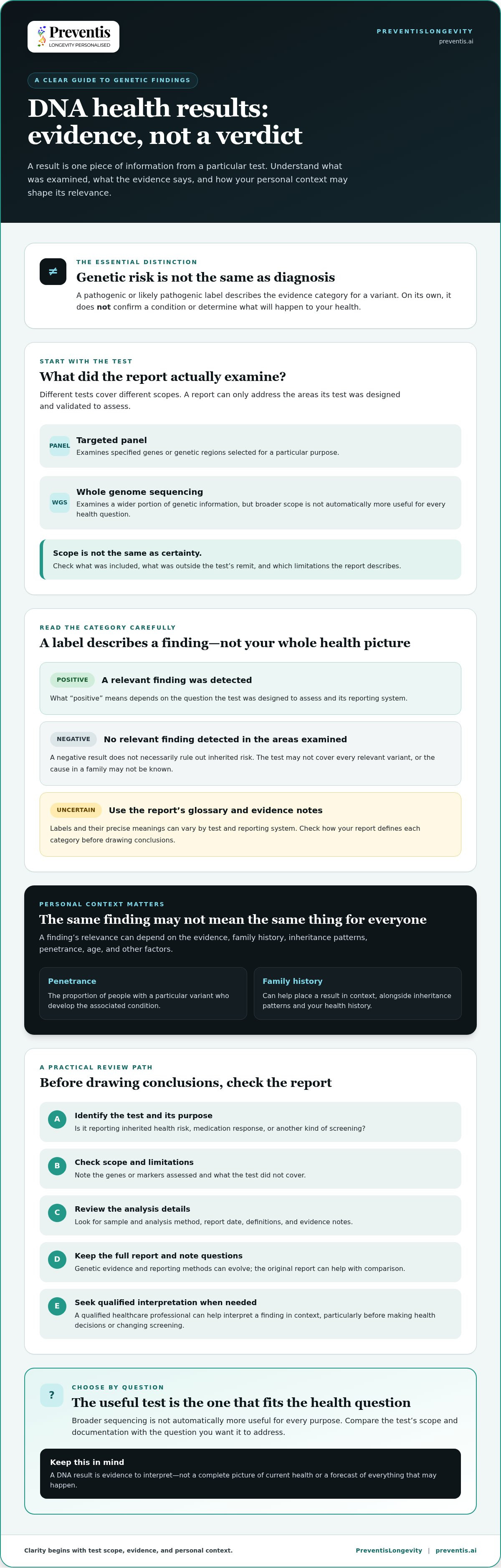
A genetic risk result isn’t the same as a confirmed condition. Its meaning depends on the evidence behind it and your personal context. The type of test matters too: targeted panels and whole genome sequencing examine different scopes of genetic information, so their reports have different limits.
This guide will help you identify common types of findings, understand the difference between increased risk and diagnosis, and recognise when qualified clinical interpretation or follow-up may be sensible. You’ll also learn what to check about test scope and evidence, so you can approach your results with greater clarity and consider next steps without jumping to conclusions.
Key Takeaways
- To understand how to interpret DNA health results, check what the test examined and read the report’s definitions and evidence notes.
- A pathogenic or likely pathogenic classification describes a variant’s evidence category; it doesn’t, on its own, confirm a condition.
- Consider how family history, inheritance patterns and penetrance may shape the relevance of a finding for an individual.
- Keep the full report, note what’s unclear and seek qualified interpretation when you need help deciding on follow-up.
- Choose a test that fits your health question. Broader sequencing isn’t automatically more useful for every purpose.
How to Interpret DNA Health Results: Start With What the Report Actually Measures
To learn how to interpret DNA health results, connect each reported finding to the evidence behind it, the scope of the test and your personal context. A report records findings from a particular test. It isn’t a complete picture of your current health or a forecast of everything that may happen in the future.
A genetic finding is evidence to interpret, not a confirmed diagnosis. Its meaning depends on what was tested, how the finding is classified and whether it is relevant to your health history. This overview of genetic testing describes its different uses, from assessing health risks to informing medical decisions, as well as the limits of testing.
What does a DNA health report measure?
A targeted panel examines specified genes or genetic regions selected for a particular purpose. Broader sequencing examines a wider portion of genetic information, but a broader scope doesn’t automatically make a result more useful for every health question. Any test can only address the areas it was designed and validated to assess. It may not detect findings outside that scope.
For a closer look at what broader sequencing involves, read this whole genome sequencing guide. Use it to consider scope, rather than assuming every report covers the same regions or provides the same interpretation.
Which report details should you check first?
Before focusing on an individual result, find the test name and stated purpose, then check which genes or markers were assessed. Look for details about the sample and analysis method, the report date, and any limitations or areas the test doesn’t cover. These details help you judge what conclusions the report can reasonably support.
- Identify the type of information: Does the report discuss inherited health risk, medication response or another kind of screening?
- Check the scope: Which genes or markers were included, and what was outside the test’s remit?
- Note the date and method: These details can help you assess whether a later report reflects a different analysis or an updated interpretation. Genetic evidence and reporting methods can evolve, so keep the original report for comparison.
Test scope is a practical starting point for reviewing any genomic report. PreventisLongevity offers targeted genetic panels and Preventis Whole Genome, but the findings and interpretation available depend on the test and its report. Read the documentation for the test you took instead of assuming its name alone tells you what was assessed.
How to Read DNA Result Categories: Positive, Negative, and Uncertain Findings
Labels such as “positive”, “negative” and “uncertain” can sound definitive, but their precise meaning depends on the test and its reporting system. Read the report’s own glossary and evidence notes before drawing conclusions. A result’s category describes what the test found and how that finding is classified. It doesn’t automatically explain what will happen to your health.
For context, the US Food and Drug Administration’s information on direct-to-consumer tests outlines different test purposes, including health-risk and pharmacogenetic testing. It relates to the US regulatory context, so don’t treat it as guidance on UK pathways.
What does a positive or pathogenic result mean?
A positive result generally means the test detected a finding relevant to the question it was designed to assess. If a variant is classified as pathogenic or likely pathogenic, that describes the strength of evidence that it may affect health. It does not, by itself, confirm that someone has a disease or will develop one.
Penetrance is the proportion of people with a particular genetic variant who develop the associated condition. It helps explain why risk can differ between individuals, even when they share a finding. Age, family history and other factors may also matter. Before changing screening or making health decisions based on a result, discuss it with a qualified healthcare professional who can interpret it in context.
How should you understand negative and uncertain results?
A negative result may mean that no relevant finding was detected in the genes or regions examined. It doesn’t necessarily mean there’s no inherited risk: the test may not cover every relevant variant, or the cause of a condition in a family may not be known. A negative genetic result can reduce concern about the findings tested for, but it cannot always rule out inherited risk. Family history may still be relevant, so consider the test’s stated scope and limitations.
A variant of uncertain significance (VUS) is a finding for which the available evidence isn’t sufficient to classify it confidently as harmful or harmless. “Uncertain” means unresolved, not proof of increased risk. Evidence may change as knowledge develops, but a VUS alone isn’t a sound basis for changing treatment, screening or family plans. Ask a qualified professional to explain the report and whether any follow-up is appropriate.
Understanding these distinctions can make results easier to discuss and put into perspective. If you’re considering a test, you can explore Preventis genomic and preventive testing and review which test scope fits the question you want to explore.
How Personal and Family Context Changes the Meaning of a DNA Health Result
A genetic finding is one part of the picture. To understand how to interpret DNA health results, consider it alongside the reason for testing, the test’s scope, relevant health information and family history. No result alone determines whether someone has a condition or what their future health will be.
How do family history and inheritance affect interpretation?
For a clinical discussion, note which close relatives have had relevant diagnoses, their ages when diagnosed and whether similar conditions appear across different branches of the family. These details may help a qualified professional assess whether a result fits a known inheritance pattern, or whether family history remains relevant despite no finding on the test.
Some genetic variants can be inherited and may therefore be relevant to biological relatives. But a finding in one person doesn’t establish which relatives carry it. Share what you know with a healthcare professional rather than trying to infer or assign relatives’ results yourself.
Variant-level finding: A report identifies a specific genetic change and gives a classification or estimate based on the test and its evidence.
Wider interpretation: A professional considers the finding alongside the test’s limitations, personal and family history, inheritance pattern, penetrance and other relevant clinical information.
Inheritance patterns describe how a variant may be passed through a family; penetrance describes how often people with a particular variant develop its associated condition. Both can inform risk estimates, but neither makes an individual outcome certain. A negative report also needs context: if the test didn’t assess all relevant genes or variants, family history may still warrant discussion.
What can different types of DNA health findings tell you?
A single-gene finding concerns a variant in a particular gene and may be interpreted using evidence about that gene and associated conditions. A polygenic risk score combines information from multiple genetic markers to estimate risk. Its meaning depends on the evidence and method used, and it shouldn’t be treated as a diagnosis or a complete measure of personal risk.
Pharmacogenomic findings address a different question: how genetic differences may affect the way someone responds to certain medicines. They don’t establish disease risk, and they shouldn’t prompt someone to start, stop or change medication without appropriate clinical advice. For more on this distinction, see the pharmacogenomic testing guide.
Use the report as a starting point for informed questions. The test type, evidence and family context together can help a qualified professional decide what the finding may mean and whether any follow-up is appropriate.
Next Steps After DNA Health Results: A Checklist
Once you’ve reviewed what the report covers, use a calm, structured approach to decide what to ask next. How to interpret DNA health results in practice depends on the finding, why the test was taken, your personal and family history, and current clinical guidance. A report can inform a discussion, but it doesn’t replace medical advice.
How can you prepare for a results discussion?
- Keep the complete report. Save the full document, including the test description, methods, result details and limitations, rather than relying on a summary or screenshot.
- Write down your questions. Note the terms or findings you don’t understand and what prompted you to take the test.
- Review what was and wasn’t assessed. Check which genes or markers were included, the test’s purpose, and any stated limitations.
- Bring relevant context. Prepare a brief medical history and notes about family diagnoses, including who was affected and their age at diagnosis, if known.
- Seek qualified interpretation. Ask a suitable healthcare professional to explain what the finding may mean for you and whether any follow-up is appropriate.
When might confirmation or further advice be appropriate?
A professional may consider whether a result needs confirmation or whether additional evaluation is appropriate. Ask what was tested, whether the finding should be confirmed, what follow-up is relevant, and whether the result could have implications for relatives. Don’t assume relatives carry a variant based on your result. Discuss family implications with a qualified professional.
The right next step varies with the result, test purpose and personal history. Check current UK clinical guidance and referral routes with a healthcare professional rather than relying on a general online checklist for a specific pathway.
Don’t start, stop or change medication based on a DNA report alone. Discuss medication-related findings with the professional responsible for your care. A consumer genetic report is also not an urgent diagnostic service. If you have urgent or severe symptoms, seek appropriate medical care; for a life-threatening emergency in the UK, call 999.
If you’re looking for context on broader screening, read this comprehensive preventive health panel guide. You can also view Preventis testing options.
Choosing a Useful DNA Health Test: Match the Test Scope to Your Next Question
A useful test is one that fits the question you want to explore and makes its scope and limitations clear. Before choosing, consider what information you hope to gain, which genes or regions the test examines, and what interpretation support is available. A wider analysis can provide more data, but more data doesn’t automatically mean clearer or more clinically useful answers.
How should you compare targeted panels and broader sequencing?
Start with the purpose. If you have a defined question, check whether a targeted panel assesses the genes or markers relevant to it. Broader sequencing examines more genetic information, but may also return findings unrelated to your original question. Those findings may have varying levels of evidence and may not be actionable.
Before deciding, check the provider’s test description and ask:
- Question: What is the test designed to assess?
- Scope: Which genes or regions are examined, and what is outside the test’s remit?
- Limitations: What kinds of findings might the test not detect or interpret?
- Interpretation: What information is available to help you understand results and decide whether to seek clinical advice?
These checks help you judge whether a test’s breadth is relevant to your needs, rather than assuming broader sequencing is always the better choice.
When might preventive or pharmacogenomic panels be relevant?
A targeted panel may be relevant when you have a specific question, but its suitability depends on your circumstances and the test’s stated purpose. PreventisLongevity offers options including Preventis 17 Gene BRCA/Lynch and Preventis MyPharma Panel, as well as broader genomic and preventive health testing. The product names alone don’t establish exactly what a report includes, so check the current test information for its scope, limitations and available interpretation support.
Pharmacogenomic testing addresses how genetic differences may relate to medication response. It doesn’t provide a prescription or mean you should change a medicine without advice from the professional responsible for your care. Preventive health screening and genomic testing can address different questions, so clarify which type of information you’re seeking before selecting a test.
Choosing thoughtfully is part of how to interpret DNA health results: match the test to your question, understand what it can and can’t tell you, and consider how you’ll make sense of the findings. To explore options, review Preventis genomic and preventive health testing and check the details of the tests that interest you.
Turn Genetic Insight Into Informed Next Steps
Learning how to interpret DNA health results begins with knowing what the test measured and what its findings can reasonably tell you. A genetic result is one piece of information, not a diagnosis or a complete forecast of your health. Its meaning depends on the evidence, the test’s limitations and your personal and family context.
Use the report to guide thoughtful questions. Check its definitions and scope, keep the full document, and seek qualified interpretation when a finding is unclear or may affect health decisions. Choose any future test to match the question you want answered, rather than assuming broader analysis is always more useful.
PreventisLongevity offers targeted genetic panels and Whole Genome sequencing, alongside preventive screening and pharmacogenomics testing options. These provide different kinds of information, so review each test’s details to understand its purpose and scope. Explore PreventisLongevity genomic and preventive health testing as a next step in gathering information. With the right context and support, genetic insights can help you make more informed choices about your health.
Frequently Asked Questions
Can a DNA health test diagnose a disease?
A DNA test may identify a genetic finding relevant to a condition, but a result from a consumer test isn’t, by itself, a diagnosis. Some genetic tests can contribute to diagnosis when used and interpreted in an appropriate clinical context. If a report raises a concern, discuss the complete report with a qualified healthcare professional, who can consider your symptoms, medical history and test limitations and advise whether confirmation or further assessment is appropriate.
What does a positive DNA test result mean?
A positive result usually means the test detected a finding relevant to its stated purpose. Check how the report defines “positive” and whether the variant is classified as pathogenic or likely pathogenic. These labels describe the evidence about a variant, not certainty that you have or will develop a condition. The meaning can depend on the test’s scope, your personal and family history, and other health factors.
Does a negative genetic test mean I have no inherited risk?
No. A negative result may mean the test didn’t detect a relevant finding in the genes or regions it examined. It may not assess every gene or variant associated with a condition, and some inherited risks may not yet be understood. If a condition runs in your family, share that history with a healthcare professional even if your result is negative. They can consider whether the test’s scope addresses your concern.
What does a variant of uncertain significance mean?
A variant of uncertain significance, or VUS, is a genetic change for which the available evidence isn’t enough to classify it confidently as harmful or harmless. It’s an unresolved finding, not proof of increased risk. Don’t use a VUS alone to change screening, treatment or family plans. Ask a qualified professional to explain the report and whether any follow-up is appropriate; interpretation may change if the evidence develops.
Should I change my medication based on DNA test results?
No. Don’t start, stop or change a medicine based on a DNA report alone. Pharmacogenomic results may provide information about how genetic differences could affect response to some medicines, but their relevance depends on the specific test and clinical situation. Discuss the result with the healthcare professional responsible for your care before making any changes. A DNA report doesn’t replace a medication review or an individual treatment decision.
Can DNA health results predict whether I will get cancer or heart disease?
DNA results can sometimes indicate an inherited predisposition or estimate aspects of risk, but they can’t predict with certainty whether an individual will develop cancer or heart disease. Risk also depends on factors such as personal and family history and other influences on health. Check what the test assessed, and discuss a concerning result or strong family history with a qualified healthcare professional before making decisions about screening or prevention.
Who can help me interpret DNA health results in the UK?
Your GP or another qualified healthcare professional can help you decide how to discuss a result and whether further advice is appropriate. Depending on the finding and your circumstances, a genetics professional, such as a genetic counsellor or clinical geneticist, may be relevant. Bring the full report, test description and family history notes. UK referral routes can vary, so ask your healthcare professional what current pathway applies to you.


