

NHS eligibility isn’t the only route: adults can access BRCA1 and BRCA2 testing privately, including when they don’t qualify for NHS testing. The cost varies with the tests selected and the company providing them, so the panel’s scope matters when comparing options. Private testing is generally for people aged 18 or over.
It’s understandable to want clear answers before taking a genetic test, especially when results could affect your family and raise questions about insurance. A result can identify an inherited gene variant linked to higher cancer risk, but it can’t predict with certainty whether someone will develop cancer.
This guide explains who may be eligible, what a panel can reveal and how positive, negative or uncertain results are interpreted. It also covers how predictive test results relate to insurance in the UK, what can affect private testing costs, and how PreventisLongevity’s genetic panels may support a proactive approach to health.
Key Takeaways
- You can pay for private inherited cancer-risk testing even if you don’t meet NHS testing criteria; the NHS England Jewish BRCA testing programme requires participants to be at least 18 years old.
- Private panel costs vary with the genes tested and the company providing the test, so compare what each panel covers before weighing the price.
- In the UK, predictive genetic test results for cancer don’t need to be disclosed to insurers under an agreement between the Government and the Association of British Insurers.
- Learn how positive, negative and uncertain results differ, and why a result should be understood in the context of family history and future risk management.
What if you don’t have a strong family history?
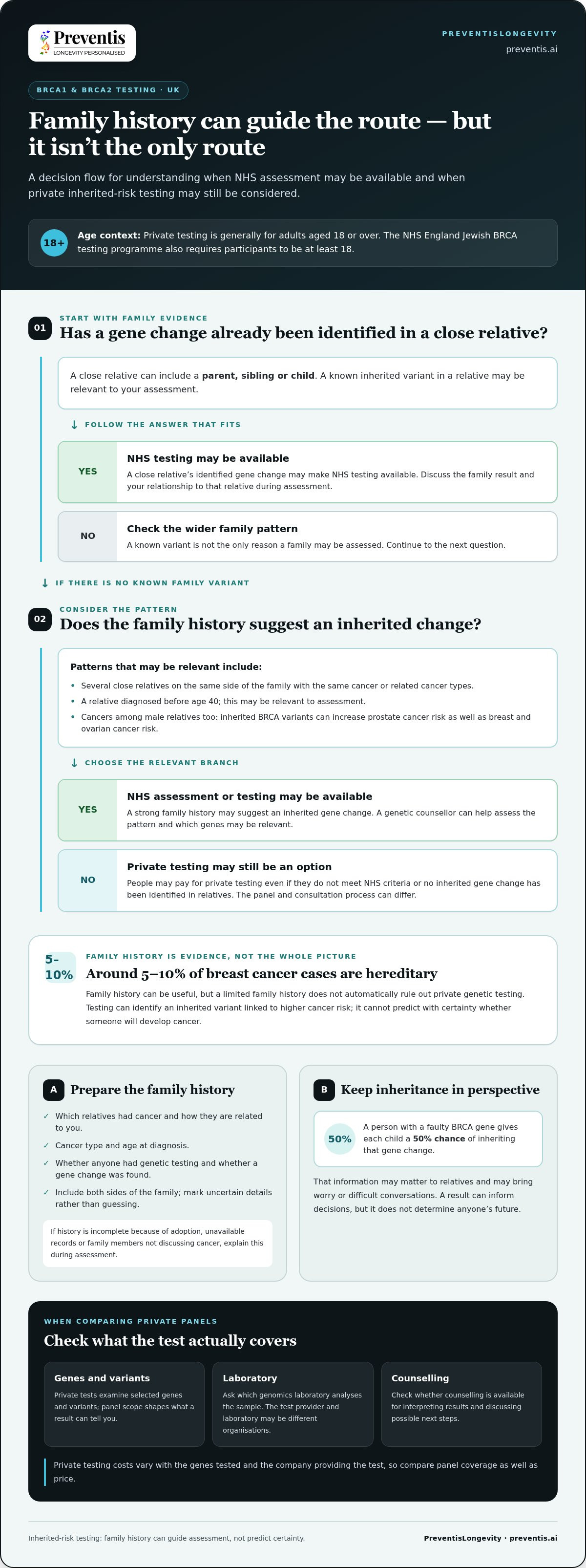
A limited family history doesn’t automatically rule out private genetic testing. In the UK, people may pay for testing even when they don’t meet NHS criteria or no inherited gene change has been identified in relatives. Around 5-10% of breast cancer cases are hereditary, so family history is useful evidence, but it isn’t the only consideration.
NHS genetic testing may be available when a strong family history suggests an inherited gene change, or when a relative’s test has already identified one. A strong history can involve several close relatives on the same side of the family with the same cancer or related cancer types. A relative diagnosed before age 40 may also be relevant. NHS England’s Jewish BRCA testing programme requires participants to be at least 18 years old.
One affected relative may be significant if they have a known gene variant. A close relative, such as a parent, sibling or child, with an identified gene change may make NHS testing available. Several relatives with certain cancers may also prompt an assessment. If these patterns don’t apply, private testing may still be an option, although the panel and consultation process can differ.
Men can also have inherited BRCA variants and should include cancers among male relatives in their family history. Faulty BRCA1 or BRCA2 genes can increase the risk of prostate cancer, as well as breast and ovarian cancer. A genetic counsellor can help assess whether the pattern of cancers in a family supports testing and which genes may be relevant.
Prepare for an appointment by noting which relatives had cancer, how they are related to you, the cancer type and their age at diagnosis. Record whether anyone has had genetic testing and whether it identified a gene change. Include both sides of your family, and mark details you’re unsure about rather than guessing. A counsellor may ask about relatives and previous test results.
The appointment is also a chance to discuss what testing can and can’t answer. A faulty BRCA gene gives each child a 50% chance of inheriting that gene change. That information may be important to relatives, but sharing it can bring worry or difficult conversations. Consider whom you might want to tell and what support you’d value before testing.
A result can inform decisions, but it doesn’t determine anyone’s future. If your family history is incomplete because relatives were adopted, records are unavailable or family members haven’t discussed cancer, explain this during the assessment. These details help put the available evidence in context and clarify possible next steps.
How does a genetic test result affect my insurance?
In the UK, predictive genetic test results for cancer don’t need to be disclosed to insurers under an agreement between the Government and the Association of British Insurers. This applies to predictive testing, which estimates future risk rather than diagnosing cancer. A negative result can still be shared, because insurers may ask about family history. Keep those two points separate when completing an insurance application.
Private BRCA testing differs from NHS testing mainly in access. NHS testing usually follows a specialist or genetic counselling appointment, with a blood test offered when an inherited gene variant is suspected. Private testing may be available to people who don’t qualify through the NHS, although some services require a GP or specialist referral. Both routes can involve counselling and laboratory analysis.
Private genetic testing for cancer should use an accredited genomics laboratory, and genetic counselling should be available as part of the service. Accreditation helps show that a laboratory follows recognised quality standards; ISO15189:2022 is one accreditation named for a BRCA testing service. Ask which laboratory analyses the sample and whether counselling covers both result interpretation and next steps. These details help you understand what the service includes.
Private clinics and specialist genetic services arrange BRCA1 and BRCA2 tests through genomics laboratories. The laboratory may be a separate organisation from the clinic that arranges testing, so the test provider and testing laboratory aren’t always the same. Private tests examine selected genes and variants; they can’t guarantee whether someone will develop cancer. A panel’s coverage also shapes what a result can tell you.
Genetic counselling gives you space to discuss breast cancer, other cancers and your relatives’ diagnoses before deciding. A counsellor asks about your family history and whether relatives have had genetic testing. This can clarify whether a targeted test is appropriate and what a result might mean for relatives. Counselling supports informed planning, while an uncertain or increased-risk result may also raise difficult questions.
Before testing, consider whether you’d use the result to inform health decisions and whether you’re ready to discuss it with relatives. A positive result may be relevant to family members, while a negative result doesn’t erase the family history insurers may ask about. Write down your questions in advance, including what the test covers, how results are explained and what support follows.
If you want to explore the implications before testing, an online genetic counselling service can help you discuss family history, possible results and the decisions they may inform.
Who can be tested for inherited faulty genes?
In the UK, people who don’t qualify for NHS genetic testing can pay for a private test. BRCA1 and BRCA2 testing privately may be considered when no inherited variant has been identified in the family or the family history doesn’t meet NHS criteria. The process usually involves discussing your health and family history, selecting a test, providing a sample and receiving a report.
Age is one factor. Children under 18 usually can’t have cancer gene testing, because they may not be old enough to make an informed choice. For adults, a known BRCA gene change in a relative can help focus the test. If a family member has a confirmed variant, ask whether the proposed analysis checks for that specific change.
Test costs vary with the genes included, the analysis performed and the company providing the service. A test focused on BRCA1 and BRCA2 may differ from a broader hereditary cancer panel. Consultation and laboratory analysis may be itemised separately or combined. Compare the full scope and package contents, not just the test name or headline cost.
Before booking, ask the provider:
- Which genes and variants does the panel examine?
- Are consultation, sample processing, the report and follow-up included?
- Is a GP or specialist referral required?
- Which laboratory analyses the sample, and what accreditation does it hold?
These questions help clarify what a quoted fee covers. One package might include an initial consultation, while another may charge separately for discussing results. Ask for an itemised breakdown, including any referral fee. If a relative’s specific BRCA variant is known, confirm whether the test assesses that variant or uses broader sequencing.
Sample collection and result delivery are also part of the testing process. Find out what type of sample is required, how to return it and how the report will be explained. Genetic counselling can help put findings in the context of your family history of breast or other cancers. It also gives you an opportunity to discuss what different result types may mean.
Testing can provide information that matters to relatives as well as the person tested. Each child of a person with a faulty BRCA gene has a 50% chance of inheriting that gene change. If you’re considering BRCA1 and BRCA2 testing privately, think about how you might share relevant findings with family members. A known variant may help relatives discuss whether they want their own assessment.
Receiving and understanding test results
A BRCA report explains whether the laboratory found a gene variant and what its classification means. The delivery method, timescale and follow-up discussion all affect how useful the result is.
Receiving Your Results
Private result times depend on the service and testing process. A hereditary BRCA1 and BRCA2 test is advertised with results in 10-15 working days, while another process describes sample processing and reporting within 15-20 working days. These are different stated timelines, not one combined estimate. Ask how the provider will send your report and who will explain it.
The NHS says cancer-risk genetic test results usually arrive within a few weeks. Waiting can be difficult, so clarify when the stated timeframe begins and how you’ll be notified if processing takes longer. Keep your appointment details and provider’s contact information together, and remember that a risk assessment is not a diagnosis.
Results Consultation and Written Report
A written report should identify the genes tested and clearly classify any findings. The results consultation gives you a chance to discuss the report, your family history and possible next steps. Check that the discussion covers what the test examined, what it did not examine, and whether the findings relate to your own cancer risk or to relatives.
Bring questions to the consultation, such as whether a reported variant is pathogenic, likely pathogenic or uncertain. Ask how the result relates to the test’s scope and whether the report can be shared with your healthcare team. A clear explanation turns technical language into useful information when considering screening or risk management.
Interpreting Results and Follow-Up
A pathogenic or likely pathogenic BRCA variant indicates increased risk, not certainty that cancer will develop. A genetic test may also identify a change whose effect on cancer risk remains unclear. A counsellor should explain the result, offer support and discuss what happens next, including whether further assessment or risk-management options may be relevant.
A negative result generally means the test found no relevant variant in the genes examined. It may indicate that inherited risk is not significantly above the general population, but interpretation depends on family history and whether a familial variant was known. Even when no cancer-risk variant is found, the result should be considered alongside the test’s limitations.
After an increased-risk result, follow-up may include regular checks intended to find cancer before symptoms appear. A positive result may also have implications for relatives, so discuss how to share relevant information with them. Keep the written report for future appointments, and ask the counsellor to explain any screening recommendations in practical terms.
Private BRCA1 and BRCA2 panel price
The cost of private BRCA1 and BRCA2 testing depends on what the panel analyses and what support comes with it. BRCA1 and BRCA2 testing privately can involve a focused gene test or a broader hereditary cancer panel, so similar-sounding options may cover different information. Compare the genes and variants analysed, consultation, laboratory work and result interpretation before weighing the cost.
A focused BRCA1 and BRCA2 panel differs from a broader hereditary cancer panel. Some private panels include additional genes associated with breast, ovarian, prostate or pancreatic cancer. Broader testing can provide more genetic information, but may also identify a variant whose effect is unclear. The useful choice is the panel that addresses the clinical question and relevant family history.
Consultation charges can affect the total. One package may include a pre-test discussion or results appointment, while another may list these separately. Ask for an itemised breakdown covering the test, sample processing, consultation and follow-up. If a consultant referral is required, establish whether that fee is included or charged separately before arranging testing.
Before comparing quotes, ask what each package includes:
- Which genes and variants are analysed, including BRCA1 and BRCA2?
- Are pre-test counselling and a results consultation included?
- Does the package include a written report and follow-up discussion?
- How are uncertain results explained?
These questions are particularly useful when a known inherited variant or strong family history informs your decision. If a relative has a specific BRCA gene change, ask whether the test checks for it. A test designed for a particular ancestry-related pathway may examine selected variants, while another may assess a wider range. Clarifying the scope helps you compare equivalent options.
Consider price alongside laboratory accreditation and clinical interpretation. One quote may cover laboratory analysis alone, while another may include counselling and an explanation of findings. Ask who will discuss the report and whether the conversation addresses cancer risk, implications for family and possible next steps. This gives you a clearer picture of what the package includes than its headline price alone.
To compare options, record each panel’s scope and included support beside its quoted cost. Note any separate consultation or follow-up charges, then compare equivalent services. If you’re weighing BRCA1 and BRCA2 testing privately, focus on whether the analysis answers your question, not simply on choosing the broadest panel. Explore genetic testing options as you consider which level of genetic insight fits your needs.
PreventisLongevity: Preventis 17 Gene BRCA/Lynch
PreventisLongevity’s Preventis 17 Gene BRCA/Lynch offers a genetic testing option for people seeking information about BRCA- and Lynch-related inherited cancer risk. It may be relevant when you’re considering a focused panel after reviewing your personal or family history, or want to explore genetic testing beyond BRCA1 and BRCA2 alone.
The right panel depends on the question you want testing to address. Consider how its scope relates to your family history and what you hope to learn. Preventis Max Prevention and the Preventis Preventive panel are options within PreventisLongevity’s genetic testing range, while the Preventis MyPharma Panel addresses a different area of genetic insight.
Genetic results are most useful when you understand their scope and how they may inform decisions. Contact PreventisLongevity to explore which testing option best aligns with your health questions.
Turn genetic insight into a considered next step
Choosing private BRCA1 and BRCA2 testing is not only about obtaining a result. It’s also about deciding what question you want answered and how genetic information could support future conversations about your health. A thoughtful next step is to match the scope of testing to your priorities, rather than treating a broader panel as automatically better.
PreventisLongevity offers the Preventis 17 Gene BRCA/Lynch, alongside the Preventis Max Prevention and Preventis Preventive panel. These options can support different approaches to genetic insight. Consider which best aligns with the questions you want to explore, and what information would help you make informed decisions.
If you’re ready to explore your options, contact PreventisLongevity. A clear question is a strong place to begin, and the right information can help you move forward with greater confidence.
Frequently Asked Questions
Can you have testing with a private company?
Yes, people in the UK can pay for private testing even if they don’t qualify for NHS genetic testing. This may be an option when no inherited variant has been identified in the family or the family history doesn’t meet NHS criteria. Before choosing, establish whether the test addresses your question: checking a known family variant differs from assessing a broader set of cancer-risk genes.
Who will do it?
A specialist doctor or genetic counsellor can discuss whether testing suits your circumstances, while a genomics laboratory analyses the sample. Private genetic testing should use an accredited laboratory, with genetic counselling available. The clinic arranging the test and the laboratory performing the analysis may be separate organisations. Find out who explains the report so you know where to direct questions about the result or its implications.
Who is eligible for private BRCA1/BRCA2 testing in the UK?
Adults can access private testing, including people who don’t meet NHS eligibility criteria. Cancer-risk testing is usually not offered to children under 18, because testing concerns future health choices. Eligibility requirements and referral arrangements vary between private services. A known BRCA variant in a relative, a personal cancer diagnosis or a family history of related cancers can help determine which test is relevant.
How much does private BRCA testing cost in the UK?
A quote may cover laboratory analysis alone or include consultation and interpretation. Compare the genes examined, whether counselling and a written report are included, and whether follow-up carries a separate charge. Compare the total cost for equivalent testing and support, not just the headline figure.
What is included in a private BRCA test: targeted variants or full gene sequencing?
Test scope varies: some tests look for selected variants, while others sequence genes or include BRCA1 and BRCA2 within a wider panel. A broader panel may examine additional hereditary cancer genes, but it isn’t automatically more suitable. Read the test description for the genes and variant types analysed. If a relative’s specific variant is known, establish whether the test assesses that exact change.
How long do private BRCA test results take, and how are they delivered?
Private result times vary. Hereditary BRCA testing timelines include 10-15 working days in one description and 15-20 working days in another process description. The NHS says cancer-risk genetic results usually arrive within a few weeks. Results are commonly provided as a report, with a discussion to explain findings. Ask when the turnaround period starts and whether the service includes a results appointment.
What do positive, negative and variant-of-uncertain-significance BRCA results mean?
A positive result means a pathogenic or likely pathogenic variant was identified, indicating increased risk rather than certainty of cancer. A negative result means the test found no relevant variant among those analysed, though family history may still matter. A variant of uncertain significance is a gene change whose effect on cancer risk is unclear. Don’t treat an uncertain finding as a confirmed harmful variant.
Can private BRCA test results affect NHS care, insurance or family members in the UK?
A result indicating increased risk can inform discussions about risk management and checks through healthcare services. Under the UK agreement between the Government and the Association of British Insurers, predictive cancer-test results don’t need to be disclosed to insurers; insurers may still ask about family history. A faulty BRCA gene gives each child a 50% chance of inheriting it, so relatives may find the information relevant to their own assessment.


