

More health data doesn’t always lead to a better health decision. The right private health assessment kits are designed to inform a question that matters to you, whether it concerns inherited risk, medication response or a broader view of preventive health. A larger panel may sound more comprehensive, but its value depends on what it measures, what it leaves out and whether the findings can inform a practical next step.
Before choosing a test, compare its purpose and scope with the question you want to explore. Genetic panels, screening kits and broader health assessments can provide different kinds of information, so don’t assume that products with similar names cover the same ground. This guide explains how to compare them and where Preventis options, including Preventis Max Prevention, may fit. Check each product’s current documentation to confirm what it includes.
You’ll also find questions to ask about sample collection, processing, data handling, result interpretation and available support. The aim is to help you understand a kit’s limits before providing a sample and decide whether its findings could inform a conversation with an appropriate healthcare professional. A test can support a proactive discussion, but it doesn’t replace personalised medical advice or care.
Key Takeaways
- Choose private health assessment kits by the health question you want to explore, not by how many measures they claim to cover.
- Compare targeted panels with broader assessments by their stated scope, evidence and limitations.
- Before choosing, check how samples are collected and processed, how results are reported, and what privacy terms apply.
- Assess whether the findings could inform a practical next step or a discussion with a healthcare professional.
- Consider Preventis Max Prevention only after checking its current product documentation against your goals and the details you want confirmed.
What should private health assessment kits help you understand?
A private health assessment kit is a consumer test designed to provide specified information about particular aspects of health; it is not, by itself, a clinical diagnosis. A result may offer insight or help shape a conversation with a healthcare professional, but it doesn’t establish that you have a condition or determine what care you need.
Kits vary in what they analyse and the kind of result they provide. Some examine genetic factors, while others assess different health measures. “Assessment” can describe a focused test or a broader set of information, so check the product documentation rather than infer the scope from the name. For context on the benefits, risks and information types associated with Direct-to-consumer (DTC) genetic testing, see this overview.
What kinds of health questions can a kit address?
Start by naming the question you want the test to help explore. That might be inherited predisposition, how genetic factors may relate to medication response, cardiovascular risk or a broader preventive health picture. These are different aims. A test focused on one area shouldn’t be assumed to provide answers about the others.
Preventis offers options including Preventis 17 Gene BRCA/Lynch, Preventis MyPharma Panel, Preventis Men’s Cancer Cardio, Preventis Women’s Cancer Cardio and Preventis Preventive panel. The product names identify different offerings, not interchangeable results or a promise that each panel addresses every question above. Check the description of the specific kit to confirm what it analyses and reports.
What a home health assessment cannot tell you
A result reflects the scope and methods of that particular test. It may not cover every relevant factor, and a finding about genetic predisposition is not a prediction that a condition will develop. Likewise, a report that doesn’t identify a finding cannot rule out every health concern. Consider the test’s stated limitations alongside its results.
A kit can support informed, proactive decision-making, but it shouldn’t replace care for symptoms or screening recommended for you. If a result raises questions, discuss it with an appropriate healthcare professional, who can consider it alongside your symptoms, medical history and other relevant information. That context can help you decide what to ask or do next.
How private health assessment kits differ in scope and results
Compare kits by asking four questions: What health question is it designed to address? What does it analyse? How are findings presented? What limitations does the provider state? A long report or wide-ranging test is not automatically more useful. Its value depends on whether the information fits your goal and is clear enough to inform a sensible next step.
Targeted panels versus broader health assessments
A targeted panel focuses on specified genes or a particular health question. A broader assessment may cover a wider area, but you’ll need to confirm its exact scope in the product documentation. For example, Preventis 17 Gene BRCA/Lynch and Preventis Whole Genome are distinct offerings, not interchangeable options. Compare what each analyses and reports before deciding which, if either, fits your purpose.
| Purpose | Scope | Possible use | Details to verify |
|---|---|---|---|
| Explore specified genetic factors | A targeted genetic panel, such as Preventis 17 Gene BRCA/Lynch | Consider information related to a defined inherited-health question | Genes and variants analysed, report format, limitations and recommended follow-up |
| Explore genetic information more broadly | Whole-genome testing, such as Preventis Whole Genome | Consider a wider genetic testing approach | Which findings are analysed and reported, and what the report does not cover |
| Explore medication response | A pharmacogenomic panel, such as Preventis MyPharma Panel | Discuss genetic information relevant to medication response | Relevant genes or medicines, interpretation and how findings may inform a professional discussion |
| Consider preventive health information | A preventive assessment, such as Preventis Preventive panel | Explore whether the documented assessment matches a broader preventive goal | Measures included, report content, limitations and available support |
Genetic insight versus other health assessment information
Genetic findings describe inherited information; they don’t provide a complete picture of current health or determine whether a condition will develop. Pharmacogenomics addresses a different question from disease-risk testing: it concerns how genetic factors may relate to medication response, rather than serving as a general assessment of disease risk. For additional context, look for the article on genetic markers for longevity in the site’s related resources.
For a general explanation of direct-to-consumer testing and the FDA’s role in the United States, see FDA oversight of direct-to-consumer tests. That information isn’t a substitute for checking the relevant UK product documentation or the status of a specific test. You can also explore Preventis health testing options and check each kit’s stated scope, report and limitations before choosing.
Are private health assessment kits reliable and worth considering?
A detailed report can look authoritative, but its usefulness depends on what was tested, how the findings were produced and what the results can reasonably tell you. Reliability isn’t a single feature. It depends on the specific test, its laboratory process and analysis, and the evidence behind claims about the result.
Test quality and clinical usefulness are related, but distinct questions: a well-performed test may still offer limited value if its findings don’t answer your health question or guide an appropriate next step. MedlinePlus explains different kinds of at-home medical tests, including self-tests and kits where a sample is collected at home. The type of test matters when considering what its result can mean.
How to assess evidence and interpretation
Look beyond polished presentation when comparing private health assessment kits. Product information should explain the test’s scope and limitations in clear terms. Check for a description of the methods and relevant evidence, and confirm that claims about performance or interpretation are supported by information specific to that test. A sophisticated report, a broad panel or a laboratory claim doesn’t guarantee that a result will answer your personal question.
Review the documentation for answers to these practical questions:
- What does the test measure, and what does it exclude?
- How are findings described, including uncertainty and limitations?
- What laboratory process and analysis are used, and what evidence supports the test’s stated purpose?
- Is interpretation or professional support included, or should you seek advice elsewhere?
Verify the laboratory process, evidence references, report contents and available support for the specific kit. If the product information doesn’t explain something important to you, ask for clarification before deciding instead of filling in the gaps with assumptions.
Privacy, consent and emotional readiness
Genetic and other health information is personal. Read the privacy and consent terms to understand how data is stored, used, shared and retained, and what choices you have. These details can vary, so don’t assume one provider’s approach applies to another. Also consider whether inherited-risk findings could raise questions for relatives who may share some genetic factors.
Choosing a test should feel informed, not pressured. Consider whether you’re ready to receive the kind of information it may provide and how you’d respond if a result is unclear or raises concerns. A healthcare professional can help put relevant findings in context. If the purpose, evidence, privacy terms or support arrangements aren’t clear, pause and ask questions before proceeding.
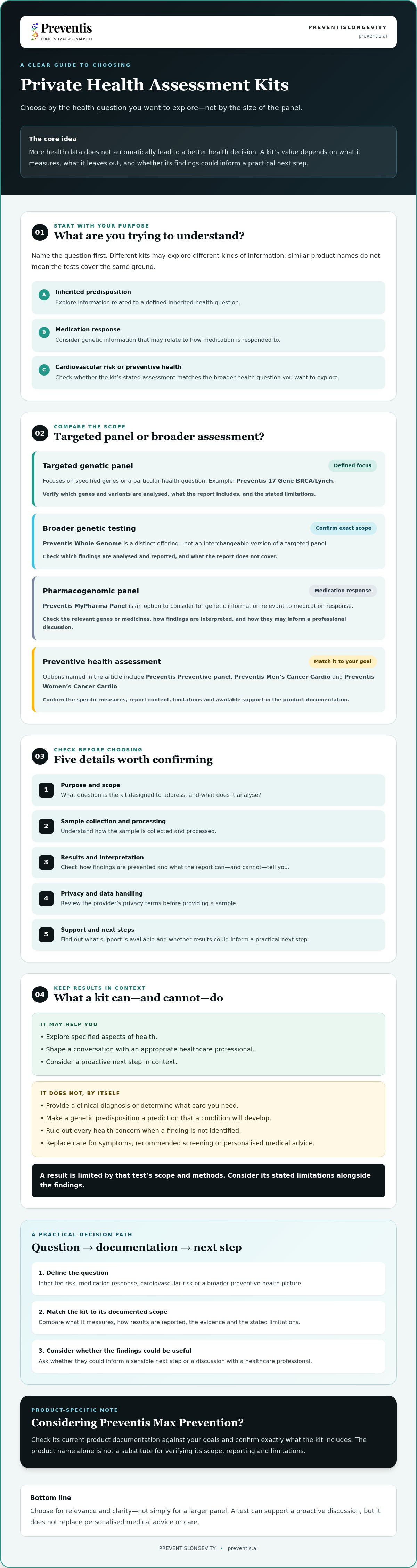
How to choose a private health assessment kit for your goals
Begin with the decision you hope the result will inform, not with a product name or the promise of a wide-ranging report. This gives you a practical way to check whether a kit’s documented scope matches your question.
Match your health goal to the appropriate assessment
Use this sequence to narrow your options:
- State your question. Are you exploring inherited risk, medication response or a broader preventive health goal?
- Match the test type to that question. A pharmacogenomics panel concerns how genetic factors may relate to medication response. It differs from testing focused on inherited disease risk. For an inherited-risk question, consider a targeted panel only after checking its scope and whether it’s appropriate for you.
- Compare the documented purpose. Preventis MyPharma Panel is a pharmacogenomics offering, while Preventis 17 Gene BRCA/Lynch is a named targeted panel. For a broader preventive aim, compare the stated purposes of Preventis Max Prevention and Preventis Preventive panel. Don’t assume they contain the same tests or provide the same findings. Check current product documentation for the tests, measures and report details.
- Identify a useful next step. Ask whether the result could inform a discussion with a healthcare professional or another action relevant to your goal. If you can’t see how it would help, reconsider whether the test is the right fit.
If you’re exploring genetic information in a wider health context, the DNA health score comparison guide and practical guide to long-term DNA insights can help you frame further questions. They don’t replace checking the exact scope of a specific kit.
Questions to ask before ordering a kit
Read the current product information and consent terms before deciding. Check the details that affect both the result and what happens to your information:
- What does the kit test, what does the report include, and what limitations are stated?
- What are the sample collection instructions and processing details? How and when are results delivered?
- Is interpretation or other professional support available, and what happens if you have questions?
- How is your data stored, used or shared? How long is the sample retained, and what happens after results are delivered?
Confirm these details in up-to-date product documentation rather than relying on assumptions about home testing. If a key point is unclear, pause and seek clarification. To compare the available Preventis testing options with your health question, explore Preventis health assessments.
Preventis Max Prevention: consider your next step with confidence
Preventis Max Prevention is one of Preventis’ preventive health testing kits. Whether it fits your needs depends on your health question and the information it provides. Compare the current product documentation with the outcomes you’re hoping for. Don’t infer what’s included from the word “Max” or assume the kit covers every preventive health concern.
What to confirm about Preventis Max Prevention
Check the product information for the exact assessment scope, the markers or measures included and what the report explains. Confirm the practical details that shape the experience and help you understand what to expect:
- How is the sample collected and processed, and how and when are results delivered?
- What interpretation or other support, if any, is available?
- What limitations are stated, and what follow-up is recommended?
- How are personal data and samples handled, including consent, use and retention?
Confirm these details in current documentation rather than assuming them. Then return to your original goal. Does the documented scope address the preventive question you want to explore? If you expect a diagnosis, a complete picture of your health or a specific clinical next step, check whether those expectations are realistic for this test. If important information is unclear, seek clarification before ordering.
Move from insight to an informed conversation
Preventis provides testing kits and analysis. Its kits aren’t emergency diagnostics or prescriptions, and a result shouldn’t be treated as a diagnosis or a replacement for healthcare advice. If findings prompt questions, note what you’d like to understand and discuss relevant results with an appropriate healthcare professional, who can consider them in the context of your health and history.
The value of private health assessment kits depends on how well their documented scope matches the question you want to explore. Check the evidence, report, practical process and data terms as well as that initial fit. If Preventis Max Prevention appears relevant, review its current product information and compare the confirmed details with your goals before deciding whether to proceed.
Make your next health decision with clarity
Choose private health assessment kits for the question they can help you explore, not simply for the amount of information they promise. Before providing a sample, compare the test’s documented scope and limitations, how results are reported, and what privacy and support arrangements apply. Then consider whether the findings could inform a useful next step or a conversation with a healthcare professional.
PreventisLongevity offers targeted genetic, pharmacogenomic and preventive health testing options. Preventis Max Prevention is one of its offerings, but check its exact contents and practical details in current product information rather than assuming what the name means. Results can provide context, but they aren’t a diagnosis or a replacement for appropriate medical advice and care.
If its documented scope aligns with the health question you want to explore, explore Preventis Max Prevention and review whether it fits your goals. Start by checking the product details, then decide whether they match what you’re looking for.
Frequently Asked Questions
What are private health assessment kits?
Private health assessment kits are consumer tests designed to provide specific health-related information. Depending on the kit, this might include genetic insights, medication-response information or other screening measures. The exact scope varies, so check what the test measures, what its report explains and what it doesn’t cover. A result can inform a conversation with a healthcare professional, but it isn’t automatically a diagnosis or a substitute for appropriate care.
Are private health assessment kits accurate?
Accuracy depends on the specific test, its methods and the evidence supporting how its findings are interpreted. Private health assessment kits don’t all measure the same things or have the same performance. Before ordering, review the stated scope, laboratory process, limitations and reporting information. If these details aren’t clear, ask the provider or an appropriate healthcare professional before relying on a result to inform a decision.
Can a private health assessment kit diagnose a medical condition?
A consumer assessment kit shouldn’t automatically be treated as a diagnostic service. Some tests may provide information relevant to health risks or management, but what a finding means depends on the test and your individual circumstances. If you have symptoms, seek appropriate healthcare advice rather than waiting for a kit result. Don’t delay recommended screening or treatment, and discuss any concerning result with a healthcare professional.
How do I choose a private health assessment kit?
Start with the health question you want the test to address, then compare its scope, supporting evidence, report, limitations, privacy terms and available support. Check whether the result could inform a practical next step. Review current instructions for sample collection and result delivery, too. A broader test isn’t automatically a better fit: its usefulness depends on whether its stated purpose matches your needs and expectations.
Are home health assessment kits suitable for everyone?
No, suitability can depend on a test’s intended use, any eligibility criteria, your circumstances and whether you feel ready to receive the information. Genetic findings may also prompt questions about relatives. Read the provider’s guidance before ordering. If you’re unsure whether a test is appropriate for you, or how its findings might affect your decisions, speak with an appropriate healthcare professional before proceeding.
What happens after I receive a health assessment kit result?
Read the report alongside the test’s stated scope and limitations, then note any findings or terms you’d like clarified. Check what interpretation or follow-up support the provider actually offers rather than assuming it’s included. A result isn’t a diagnosis. If it concerns you or could affect your care, discuss it with an appropriate healthcare professional and don’t make treatment decisions based solely on the report.


