

What if the most useful health check isn’t the one with the longest list of tests? Proactive health screening UK options range from NHS programmes for specific groups to private tests that explore particular health questions. The value lies not in collecting more data, but in understanding what a test can show, what it cannot, and whether the result could guide a sensible next step.
It’s understandable to feel unsure about where screening ends and diagnosis begins, or whether a paid test will offer information you can use. Screening looks for signs of possible risk or disease in people who may not have symptoms. It doesn’t confirm a diagnosis or predict with certainty what will happen.
This guide explains how proactive screening fits alongside NHS services, what to consider before choosing a test, and how to interpret results calmly. You’ll learn where genomic and preventive panels, including PreventisLongevity options, may add focused information, why different tests address different questions, and how to discuss relevant findings with a healthcare professional. The aim is a clearer path from curiosity to informed health planning, not a bigger test menu.
Key Takeaways
- Use the question you want answered to guide your choice of proactive health screening UK, rather than choosing tests simply because they’re available.
- Compare NHS programmes, blood tests, genetic panels and broader assessments by what they can tell you and where their limits lie.
- Consider personal and family history as useful context for health planning, not as proof that a condition is present.
- Plan how you’ll interpret a result before testing: a finding may need follow-up, while a normal result cannot rule out every condition.
- Explore how different Preventis panels address distinct areas, from inherited cancer risk to medication response and health scoring.
What does proactive health screening in the UK actually mean?
Proactive health screening is an assessment offered or chosen before symptoms prompt investigation, to look for signs or risk factors that could inform a person’s next health decision. It can support earlier awareness, but it doesn’t diagnose a condition, guarantee that disease will be prevented, or detect every health problem.
The useful question isn’t simply, “What can I test?” It’s, “What information could meaningfully change what I do next?” A result may help guide a conversation with a healthcare professional or focus future planning. If you already have symptoms or a specific concern, seek appropriate clinical assessment rather than relying on a screening test.
This fits within the broader principles of Preventive medicine, which includes approaches to reduce health risks and identify possible problems earlier. In practice, proactive health screening UK can refer to several different things. Understanding their purpose helps you judge what is relevant.
Screening, diagnosis, and health checks: what is the difference?
Screening looks for an early signal or a higher likelihood of a condition in people who may feel well. A result that suggests a possible concern is not a diagnosis; further assessment may be needed. Diagnostic investigations examine a clinical concern, such as symptoms or an abnormal finding, and should be interpreted through appropriate medical care.
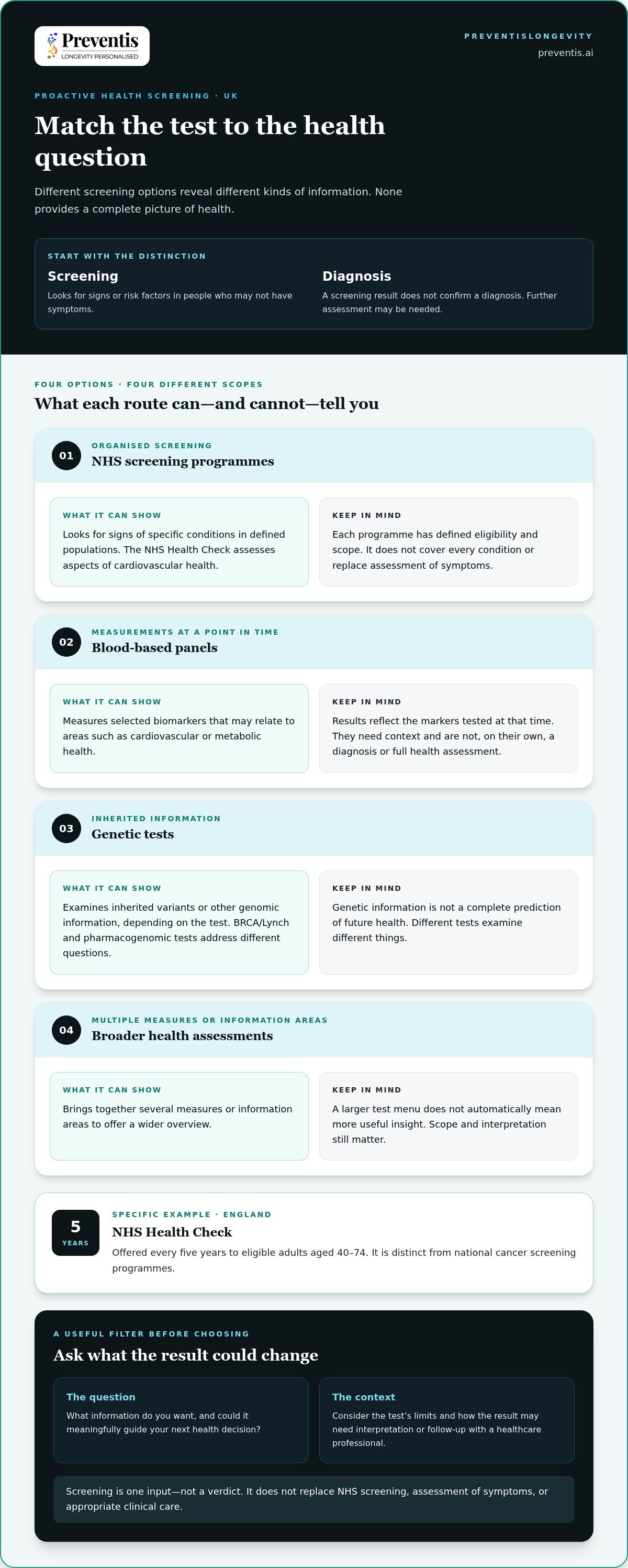
A routine health check may assess general measures such as blood pressure or cholesterol without being a disease-specific screening programme. For example, the NHS Health Check in England is offered every five years to eligible adults aged 40-74. It’s distinct from national cancer screening programmes, which focus on defined conditions and groups.
How NHS screening differs from private proactive testing
NHS screening programmes are organised around defined populations and eligibility criteria, with recommendations informed by evidence about whether screening is beneficial. Details and eligibility can differ across the UK’s nations, so refer to current NHS guidance for the programme relevant to you. These services are part of routine care, not a general search for every possible condition.
Private testing may address additional personal questions, including some about inherited risk, medication response or broader health information. Genomic and preventive panels can offer focused information for health planning, but their scope varies and a result isn’t a diagnosis or a certain prediction. They don’t replace NHS screening, assessment of symptoms or follow-up with a healthcare professional.
Think of screening as one input, not a verdict. Its value depends on the question being asked, the limits of the test and whether the result can support a considered next step.
Which proactive health screening options are available across the UK?
Different tests answer different questions. A blood test measures markers in your body at a particular time; a genetic test can provide information about inherited variants; an NHS programme focuses on conditions and groups covered by an organised screening pathway. None offers a complete picture of health. Use the comparison below to match the information you want with the test’s purpose and limitations.
| Option | Purpose and possible insight | Key limitation |
|---|---|---|
| NHS screening programmes | Look for signs of specific conditions in defined populations. The NHS Health Check, for example, assesses aspects of cardiovascular health. | Each programme has a defined scope and eligibility criteria; it doesn’t screen for every condition or replace assessment of symptoms. |
| Blood-based panels | Measure selected biomarkers that may relate to areas such as cardiovascular or metabolic health. | Results reflect the markers tested at that time. They need context and aren’t, on their own, a diagnosis or full health assessment. |
| Genetic tests | Examine inherited variants or other genomic information, depending on the test. A BRCA/Lynch panel and a pharmacogenomic test address different questions. | Genetic information is not a complete prediction of future health, and different tests examine different things. |
| Broader health assessments | Bring together several measures or information areas to offer a wider overview. | A larger test menu doesn’t automatically mean more useful insight. Scope and interpretation still matter. |
What can blood-based and general health assessments tell you?
Blood markers provide measurements relevant to specific aspects of health, not a standalone verdict. Their meaning may depend on your health history, other findings and the question being assessed. Don’t assume that the same marker panel or testing frequency suits everyone. For a closer look at how these panels can be approached, see this comprehensive preventive health panel guide.
When might genomic screening add a different kind of insight?
Inherited predisposition and current biomarkers are distinct kinds of information: one concerns genetic variants, while the other measures a present biological state. Neither tells the whole story. For example, BRCA/Lynch testing and pharmacogenomics focus on separate questions, so they aren’t interchangeable. Preventis options include the Preventis 17 Gene BRCA/Lynch panel and Preventis MyPharma Panel. Explore the whole genome sequencing guide for more technical context, or review Preventis genomic and preventive testing as one source of focused information for health planning.
What are the benefits and limitations of proactive health screening?
Screening can make certain health information visible before symptoms arise, giving you an opportunity to consider whether further assessment or a change in health planning is appropriate. A relevant finding may also help you have a more focused conversation with a healthcare professional. Its usefulness depends on the question asked, the test’s scope and your personal context, including health and family history.
Screening results can inform decisions, but they are not diagnoses. That distinction matters whether you’re considering an NHS programme, a blood-based panel or genomic testing. A result is one piece of information to interpret, not a complete account of your health or a certain prediction of what will happen.
How screening can support informed health planning
A result may highlight a factor worth discussing or help clarify what information to gather next. For example, a finding related to a particular risk area could prompt a conversation about whether additional assessment is relevant to your circumstances. In proactive health screening UK, the aim should be a useful next step, not simply a larger collection of results.
More tests don’t automatically lead to better decisions or outcomes. Each test has its own scope and limitations, and a result is useful only if you understand what it measures and how it relates to your situation. Screening doesn’t guarantee disease prevention, extend life or forecast an individual’s future with certainty.
False positives, uncertain results, and false reassurance
A false positive is a result that suggests a possible concern when the condition or finding being screened for isn’t present. It may lead to further assessment to clarify what the result means. An uncertain finding is information that can’t be interpreted clearly as either reassuring or concerning. Neither should be treated as a definitive answer without appropriate context.
A normal result has limits, too. It means no relevant signal was identified within the test’s scope at that time; it doesn’t rule out every condition, guarantee future health or replace recommended screening. Likewise, an abnormal result may require follow-up rather than indicating that a disease is present. Before testing, understand what the test examines, what a positive or unclear finding could mean, and what follow-up may be appropriate.
Symptoms or an urgent health concern need appropriate medical assessment, regardless of a previous screening result. Screening is intended to support considered planning, not to delay care or provide reassurance in place of assessment.
How can you approach proactive health screening step by step?
A clear process can help you focus on information that may support a useful decision, rather than testing without a defined purpose. Use these five steps to shape your approach to proactive health screening UK.
- Define the question. Are you looking for general health information, insight into inherited risk, or information about how your body may respond to certain medicines? A specific question gives you a basis for judging whether a test is relevant. Curiosity-led screening is different from investigating symptoms, which need appropriate clinical assessment.
- Review your context. Consider your health history, family history and any existing care or screening you receive. A pattern of illness in your family may help you decide what to ask about, but it doesn’t establish that you have an inherited risk or a condition. Share relevant details with a healthcare professional when discussing next steps.
- Understand the test’s scope. Check what the test measures, what its report can tell you, and what it cannot conclude. Preparation and sample type vary between tests, so follow the instructions for the specific screening you choose. A blood-based panel and a genomic test provide different kinds of information; neither gives a complete picture of health.
- Plan how results will be understood. Before testing, find out how findings are presented and what an unclear or unexpected result might mean. Review the privacy information to understand what personal or genomic data is collected, how it is used, who may access it and how long it is retained. This helps you make an informed choice about sharing sensitive information.
- Decide on sensible next steps. Consider in advance who you might speak to about a result and what information could help guide that conversation. Follow-up depends on the finding and your circumstances; a test result doesn’t automatically mean you need treatment, confirm a diagnosis or require further testing.
Start with a health question, not a test catalogue
Your starting point might be a general overview, inherited-risk information or a question about medication response. If cardiovascular risk is the focus, a heart health DNA screening guide can help you explore how genomic information relates to that topic. If symptoms are driving your concern, seek clinical assessment rather than treating a screening test as a substitute.
Make the result usable
Good preparation means knowing what sample is required, following the test instructions and understanding the report’s limits before you begin. It also means having a realistic plan for interpreting the findings. Use relevant results as information for a considered discussion and health plan, not as a standalone diagnosis or prediction.
Explore Preventis genomic and preventive testing options as one way to investigate focused health questions through testing and genomic analysis.
How can Preventis support a more informed proactive health plan?
Once you’ve defined the health question you want to explore, a focused test may add relevant information to your planning. PreventisLongevity offers direct-to-consumer genomic and preventive health testing kits in the UK. Different panels address different areas, so the right starting point depends on whether you’re exploring inherited risk, broader prevention, medication response or health scoring.
Match a Preventis panel to the question you want to explore
Each panel has a distinct focus. For example:
- Preventis 17 Gene BRCA/Lynch focuses on genetic testing related to BRCA and Lynch genes. Its findings provide information about inherited variants, not a diagnosis or certain prediction of future health.
- Preventis MyPharma Panel is a pharmacogenomics panel. It addresses medication-response information, a different question from screening for disease risk. For more context, read this pharmacogenomic testing UK guide.
- Preventis Max Prevention and the Preventis Preventive panel are separate preventive testing options for people exploring broader health information.
- Preventis MyHealthscore offers a health-scoring approach, which is distinct from a focused genetic-risk or medication-response question.
These examples aren’t interchangeable, and no single panel is automatically suitable for everyone. Consider what information you’re seeking and how it could fit alongside your health history, family history and existing NHS care. That makes it easier to choose a test for a clear reason, rather than treating a wider panel as a complete account of your health.
Use screening insights as one part of long-term health planning
A report is best approached as one input among several: your personal context, health goals, relevant clinical advice and the scope of the test itself. A finding may help shape a conversation or inform a considered next step. Preventis testing provides genomic and preventive health insights, not in-person clinical care, emergency testing or prescriptions. A test also can’t guarantee that a condition will be detected or prevented.
That distinction is central to proactive health screening UK: the aim is to gather information that may support an informed choice, while being clear about what it can and can’t tell you. If you’re ready to compare options against the question you’ve identified, explore Preventis health testing and make a choice that fits your priorities.
Make your next health decision with greater clarity
The most useful proactive health screening UK choice starts with a clear question, not the longest list of tests. NHS screening, blood-based assessments and genomic panels serve different purposes, and each has limits. A result can inform planning, but it isn’t a diagnosis or a guarantee about future health.
Preventis offers distinct genomic and preventive testing options, including cancer-risk, cardiovascular, pharmacogenomics, health-score and whole-genome offerings. Panels such as Preventis 17 Gene BRCA/Lynch and Preventis MyPharma address different questions, so consider their scope alongside your personal context and health goals.
Explore the available options at your own pace and decide what information may be relevant to you. Explore Preventis health testing to take an informed next step towards a more considered health plan.
Frequently Asked Questions
What is proactive health screening?
Proactive health screening looks for selected health risks or indicators before symptoms prompt an investigation. In the UK, it can include organised NHS programmes, general health assessments, blood tests or genetic testing, depending on the question being explored. Screening isn’t the same as diagnosis: a finding may need interpretation or follow-up, and a normal result only reflects what that particular test assessed. It can’t rule out every condition.
Is private health screening worth it in the UK?
Private screening may be useful if a test addresses a clear question and provides information you can interpret and use. Consider its purpose, what it can’t establish, how results are presented and what follow-up may be appropriate. A broader test menu doesn’t automatically provide greater value. Private testing can complement NHS care, but it shouldn’t replace recommended NHS screening or assessment of symptoms.
What is the difference between NHS screening and private health screening?
NHS screening programmes are organised around particular conditions and defined eligibility criteria, which may change over time. Private screening offers other tests or panels that individuals can choose, with scope and follow-up arrangements varying by test. Neither is the same as diagnostic assessment for symptoms. Private testing doesn’t replace NHS screening or clinical care, so keep up with relevant NHS invitations and seek care for health concerns.
Can a health screening test diagnose a condition?
A screening result alone doesn’t necessarily diagnose a condition. Screening identifies indicators or risks that may need further interpretation or assessment, depending on the test and your health context. A result outside the expected range isn’t automatically a diagnosis, just as a normal result can’t rule out every health problem. If you have symptoms or receive a concerning finding, seek appropriate medical assessment rather than relying on the report alone.
What happens if a private screening test finds something unexpected?
Read the report carefully and check what the finding does and doesn’t establish. An unexpected result may be uncertain or require confirmation; its significance depends on the test and your circumstances. Consider discussing relevant findings with a qualified healthcare professional, who can help you understand whether follow-up is appropriate. A screening report isn’t a diagnosis or treatment plan, and symptoms should be assessed even if a screening result seems reassuring.
Can genetic screening predict whether I will develop cancer or heart disease?
Genetic screening can identify certain inherited variants associated with health risks, depending on the test, but it can’t predict your future with certainty. Health outcomes can involve genetic and non-genetic factors, and a test examines only the information within its scope. A result may contribute to health planning, not confirm a diagnosis or guarantee that a condition will or won’t develop. Understand the test’s focus and limitations before deciding what to do.
How should I choose a proactive health screening test?
Start by defining what you want to understand: general health markers, inherited risk or medication response, for example. Then review what the test measures, what it can’t conclude, how results are reported and what follow-up may be relevant. Your personal and family history can help shape the question, but neither is a diagnosis. Choose proactive health screening UK options for relevance and clarity, not simply the number of tests included.


