

A genetic health result is a clue about your future, not a verdict. If you’re focused on understanding my genetic health profile, technical terms and a flagged risk can make that distinction hard to see. A result isn’t automatically a diagnosis, nor does it predict with certainty what will happen to you. Genes are one part of a bigger picture that includes lifestyle, environment and family history.
This guide explains common report terms and findings, what results can and can’t tell you, and how to identify sensible next steps. You’ll learn why tests report different kinds of information, how a test’s scope shapes what it can reveal, and how to discuss relevant findings with a healthcare professional. From targeted genetic panels to whole-genome sequencing, testing can offer structured insights. The value lies in interpreting them in context and using them to support informed health decisions.
Key Takeaways
- Understanding my genetic health profile starts with knowing what a test examined. Results only speak to the genes and variants within its scope.
- Genetic variants may contribute to health risk alongside family history, age, behaviour and environment.
- Use the report’s definitions to interpret findings. A risk classification is not a diagnosis or a certainty.
- A negative result cannot rule out every inherited condition or other health risk, so interpret it within the limits of the test.
- Turn relevant findings into practical questions for a healthcare professional, while keeping routine health guidance in view.
What Does Understanding Your Genetic Health Profile Mean?
Understanding my genetic health profile means learning what selected differences in my DNA may indicate about health, while recognising the limits of the test behind the report. A profile brings together findings from the genes and variants examined for particular health questions. It isn’t a complete assessment of your health, a diagnosis or a certain prediction about your future.
Genetic tests vary in scope and purpose. As outlined in this Genetic testing overview, some examine specific genetic features, while others take a broader approach. A targeted panel focuses on selected genes or health questions; whole-genome sequencing assesses much broader genetic material. Broader doesn’t automatically mean more relevant to every question. PreventisLongevity offers both targeted genetic panels and PreventisLongevity Whole Genome, providing different approaches to genomic insight.
What information might appear in a genetic health report?
Genes are sections of DNA that carry biological instructions. A variant is a difference in the DNA sequence. Think of a gene as a line of instructions: a small spelling variation may be present without causing a health problem, while some variants may be relevant to particular health risks. A report describes findings within the test’s scope. It doesn’t necessarily assess every genetic difference that could matter to health.
Some reports focus on selected genes, while a whole-genome approach examines genetic material much more broadly. The layout and terminology also depend on the test’s purpose. One report might organise findings around a health topic; another may use technical classifications or variant names. Read the report’s explanations rather than assuming terms or categories mean exactly the same thing across different tests.
How are genetic results different from a diagnosis?
A genetic health profile describes selected genetic findings and their possible health relevance. On its own, it does not diagnose a condition or predict with certainty whether one will develop.
A risk-associated variant may suggest an inherited susceptibility, but susceptibility is not the same as having a disease. Symptoms, clinical findings and appropriate medical assessment are separate parts of understanding someone’s health. Not having a reported variant doesn’t settle every health question either. Results are most useful as one piece of context, alongside your health and family history, rather than as a verdict on your future.
This distinction helps you use a profile constructively. It can shape questions and inform discussions while leaving room for the many factors that influence health over time.
How Genes, Variants, and Health Risks Fit Together
Genes carry biological instructions, but their influence is only one part of health. A variant is a difference in DNA sequence; its significance depends on the specific variant, the condition being considered and the evidence behind its interpretation. Some variants are harmless, some have uncertain significance, and others may be associated with a change in risk. A label on a report needs this context before it can be useful.
Health outcomes can also reflect age, environment, behaviour and family history. A genetic finding may be relevant to a particular health risk, but it can’t show on its own whether or when an individual will develop a condition. The Genetic Testing glossary offers a concise reference for basic terminology. This wider perspective is central to understanding my genetic health profile: genetic information is one input, not a complete explanation of health.
What do genotype and SNP mean in a report?
Genotype describes the genetic pattern observed at a particular location in DNA. A report might show two letters, such as A/G, to represent the sequence found at that position. A single nucleotide polymorphism (SNP) is a common type of variation involving one DNA building block. These terms describe what was observed, not what it means for your health.
A genotype or SNP label alone doesn’t establish clinical importance. Interpretation depends on the evidence for that specific variant and its relevance to the health question the test examines. Use the report’s definitions and explanations rather than drawing conclusions from a letter combination or technical term in isolation.
Why doesn’t the same variant mean the same outcome for everyone?
Penetrance describes how often people with a particular genetic change show the associated trait or condition within a defined context. It helps explain why a risk-associated finding doesn’t affect everyone in the same way. Age, other genes, lifestyle, environment and family history can all contribute to a person’s overall risk.
An increased probability means an outcome may be more likely, not that it is certain. A relative with the same variant may have a different health experience, and a genetic result can’t reliably tell you whether or when a condition will occur. Consider the finding alongside your personal and family history, and discuss relevant questions with a healthcare professional.
The scope of a test shapes which aspects of a genetic profile it can inform. Preventis offers targeted genetic panels as well as Preventis Whole Genome, providing different approaches to genomic insights. Explore Preventis genetic testing options to compare the testing approaches with the questions you want to explore.
How to Read a Genetic Health Result Without Overinterpreting It
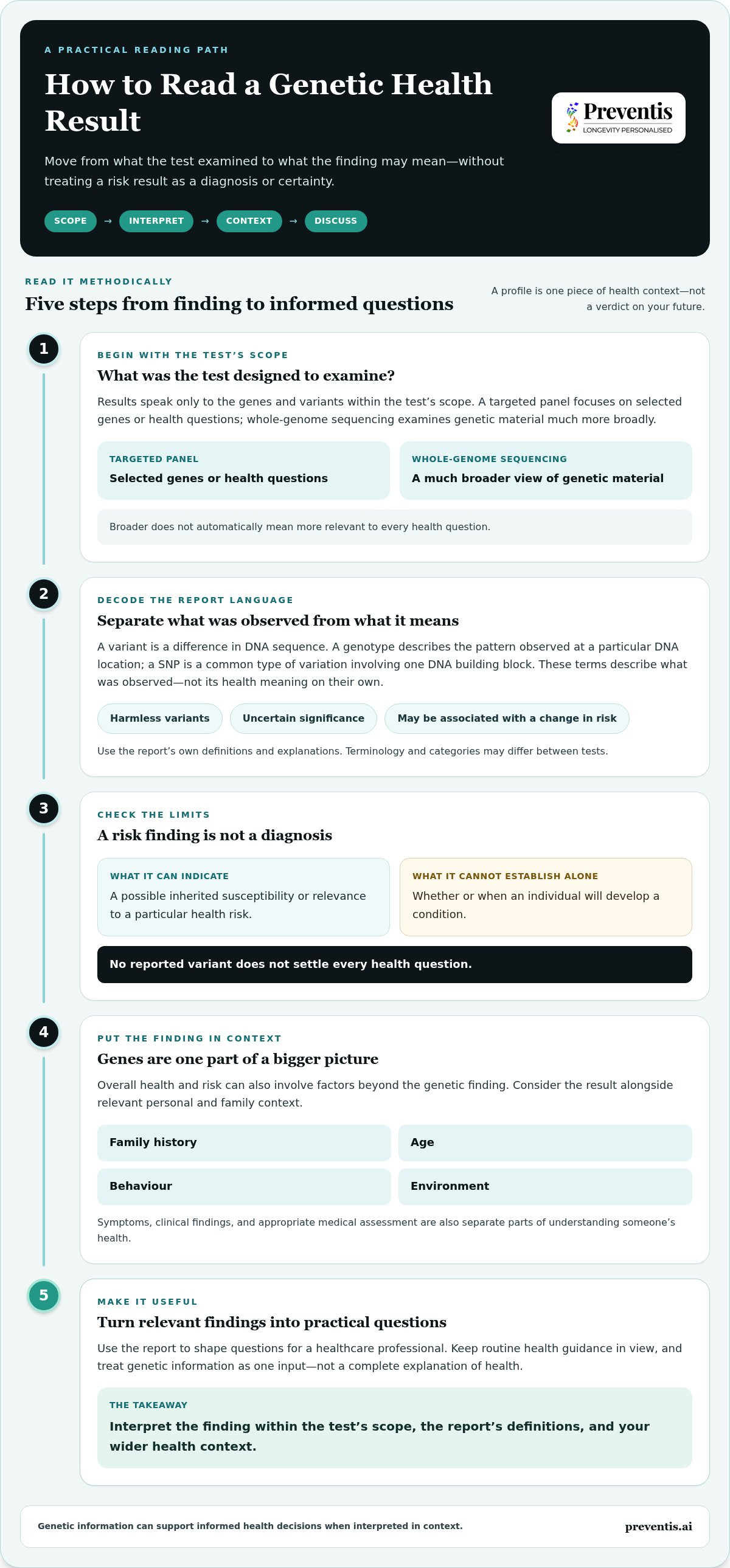
Start with the question the test was designed to answer, not the most striking term on the page. This sequence can help you review a report methodically and identify details that may need further discussion.
- Identify the test’s scope. Check which genes or variants were examined and what health question the test aimed to address. A result only relates to the areas included in that analysis.
- Locate the specific finding. Note the gene and variant details as written. If the report includes several findings, consider each separately rather than treating them as one overall verdict.
- Check the classification. Find the category assigned to the variant and read the report’s definition. Classification describes the evidence about the variant, not your personal diagnosis.
- Consider the context. Review any stated limitations and consider the finding alongside your health and family history. Write down questions before deciding whether to discuss the result with a healthcare professional.
What do pathogenic, benign, and uncertain findings mean?
Reports may use terms such as pathogenic or likely pathogenic for variants with evidence suggesting they can contribute to a condition, and benign or likely benign for variants not considered to cause it. Wording and definitions can differ, so follow the explanation in your own report.
A variant of uncertain significance (VUS) is a finding whose health meaning isn’t clear based on current evidence. Uncertain doesn’t mean harmful, and a VUS shouldn’t be presented as a confirmed disease risk. Classification isn’t the same as a diagnosis. Interpretation depends on the specific finding, the evidence and the health question being considered.
What questions should you ask when reviewing a report?
Understanding my genetic health profile becomes more practical when you turn unclear details into focused questions. Record them as you read, especially if a finding could affect a health conversation or follow-up.
- Which genes or variants did this test examine, and what question was it designed to address?
- How strong is the evidence behind this classification, and what limitations does the report describe?
- How might my personal or family history affect the relevance of this finding?
- Should this result change anything I discuss with a healthcare professional, or is any follow-up appropriate?
Bring the relevant report details and your questions to a healthcare professional when a finding is consequential or unclear. This keeps the discussion focused on what the result supports, what remains uncertain and whether it informs a next step.
What a Genetic Health Profile Cannot Tell You
A genetic health profile isn’t a complete forecast of your future health. It reports findings within a test’s scope, but can’t account for every influence on health or establish exactly what will happen to you. Genes are only part of the picture, alongside factors such as age, environment, behaviour and family history.
Keep the test’s boundaries in view. A profile may not examine every gene or variant relevant to a condition, and a result can only reflect the information assessed and interpreted at the time. Scientific understanding can also develop, so the meaning assigned to a finding may be refined as evidence changes. These limits don’t make genetic insights useless. They help you use them proportionately, as information that may guide questions rather than provide a complete answer.
Can a low-risk or negative result guarantee good health?
No. A negative result means the test didn’t report a relevant finding within its scope; it doesn’t prove that no inherited risk exists. A test may examine selected variants rather than every possible genetic difference, and health conditions can also arise through non-genetic factors.
Likewise, a low-risk result isn’t a guarantee against future illness. Consider what the test covered and how the result fits with your personal and family history. If a condition runs in your family or you have health concerns, a reassuring result shouldn’t replace routine care or a conversation with an appropriate healthcare professional.
How should you think about privacy and family implications?
Genetic information can be personal, so read the test’s privacy information before deciding how to proceed. Look for explanations of how data is collected, used, stored and shared, as well as any choices available to you about its future use. Understanding these details can help you make a considered decision about your information.
Some inherited findings may also be relevant to biological relatives, but a report doesn’t diagnose them or oblige you to share it. Whether, when and how to discuss a finding with family is a personal decision. If you’re unsure about its significance or how to approach a conversation, note your questions and seek appropriate professional guidance.
Understanding my genetic health profile means recognising both its potential value and its limits. If you’d like to explore different approaches to genomic insight, discover Preventis genetic testing options.
Turn Genetic Insights into Informed, Practical Next Steps
A useful result should help you decide what to ask, not push you towards a predetermined response. Start by reading the report’s explanation of the finding and its limitations. Note anything you’re unsure about, then consider whether the result is relevant to your health or family history.
Understanding my genetic health profile means fitting genetic information into the wider picture of my health. Keep following routine health guidance, and don’t use a result to replace existing care or professional advice. A genetic finding may be worth discussing, but the right next step depends on the evidence and your circumstances.
How can genetic insights inform a personal health conversation?
If a finding seems relevant, take the report details and any pertinent family history to a healthcare discussion. A concise set of questions can help keep the conversation focused:
- What does this result mean in light of my health and family history?
- What, if anything, does it change about the questions I should consider?
- What does it not change, and are any follow-up discussions relevant?
These questions help distinguish an evidence-based next step from a reaction to unfamiliar terminology. The aim is a proportionate conversation, not to treat a genetic result as a diagnosis or make changes based on a report alone.
How do different genetic testing approaches answer different questions?
Testing approaches vary in scope. A targeted panel examines selected genetic areas related to defined testing interests, while whole-genome sequencing looks across much broader genetic material. Neither approach is automatically better for every purpose. Broader analysis doesn’t mean every result will be relevant to your questions, and a targeted test won’t answer questions beyond its scope.
Preventis offers distinct options, including Preventis 17 Gene BRCA/Lynch and Preventis Whole Genome. These names represent different testing approaches, not a promise of diagnosis or a single, universal health score. Other options across genetic, pharmacogenomic, cancer, cardiovascular and preventive health testing address different interests. Match the type and scope of testing to the question you want to explore, then interpret findings in context.
Explore genomic and preventive health insights with Preventis testing options.
Make Your Genetic Insights Work for You
Understanding my genetic health profile means seeing a result as useful information, not a fixed prediction. The test’s scope matters, classifications need context, and a genetic finding is only one part of your health picture. Family history, everyday habits and routine health guidance remain important too.
Different testing approaches can help explore different questions. Preventis offers targeted genetic panels and Whole Genome sequencing, alongside genetic, pharmacogenomic, cancer, cardiovascular and preventive health testing. No single profile answers every health question, but a well-matched test can offer structured insights to support more informed conversations.
Explore Preventis’s genomic and preventive health testing options to find an approach that aligns with the questions you want to explore: explore Preventis genomic and preventive health testing. Use what you learn as a thoughtful starting point, and take your next steps with clarity.
Frequently Asked Questions
What does my genetic health profile tell me?
Your genetic health profile reports selected genetic findings and their possible relevance to the health questions examined by the test. Understanding my genetic health profile means checking which genes and variants were assessed, then interpreting findings within that scope. A result may offer useful information about inherited susceptibility, but it isn’t a complete health assessment or a certain forecast. Your health, family history and other influences remain important.
Does a genetic risk result mean I will develop the condition?
No, a genetic risk result does not mean you will definitely develop the condition. It may indicate that a particular variant is associated with increased susceptibility, but risk is not certainty. Age, other genes, lifestyle, environment and family history can also affect health outcomes. Read the report’s explanation and discuss consequential or unclear findings with an appropriate healthcare professional before making decisions based on them.
What is the difference between a genetic variant and a mutation?
A genetic variant is a difference in DNA sequence; “mutation” is a term often used for a change considered disease-causing, though usage can vary. A variant may have no known health effect, while another may be associated with a condition. The word alone doesn’t establish what a finding means for you. Check how your report defines and classifies the specific result, and interpret it in context.
What does a variant of uncertain significance mean?
A variant of uncertain significance, often shortened to VUS, is a genetic finding whose health meaning isn’t clear based on current evidence. It shouldn’t be treated as proof that you have, or will develop, a condition. Follow the report’s definition and avoid making health decisions based on the uncertain finding alone. If it concerns you or seems relevant to your family history, note your questions for a healthcare professional.
Can a negative genetic test rule out inherited health risks?
No, a negative result can’t rule out every inherited health risk. It means the test didn’t report a relevant finding within the genes or variants it examined. The test may not cover every genetic change associated with a condition, and some health risks aren’t genetic. Consider the test’s stated scope alongside your personal and family history. A negative result doesn’t replace routine health guidance or care.
How do I interpret SNPs and genotypes in my report?
A genotype describes the genetic pattern observed at a particular DNA location. A SNP, or single nucleotide polymorphism, is a common type of variation involving one DNA building block. A report may show letter combinations to represent the pattern found, but the label alone doesn’t tell you whether it matters to health. Use the report’s definitions and classification, and seek professional guidance if a finding is unclear or consequential.
Should I share my genetic health results with my family or doctor?
Consider discussing relevant or concerning findings with a healthcare professional, especially if you have related symptoms or a family history. Bring the report and note what you want to understand, including what the result changes, what it doesn’t, and whether follow-up is appropriate. Some inherited findings may matter to biological relatives, but sharing results is a personal decision, not an obligation. Review the test’s privacy information and consider family circumstances before sharing.


