

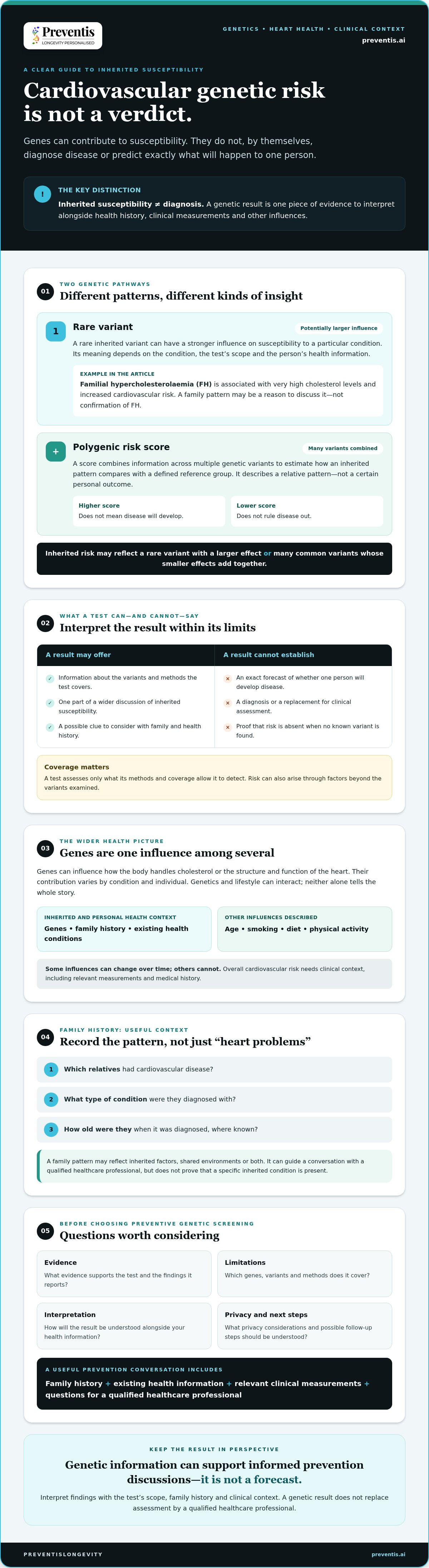
If heart disease runs in your family, does that mean it’s inevitable for you, too? A family history can raise understandable concerns, and a DNA result may seem like a verdict. It isn’t. Cardiovascular disease genetic risk describes inherited susceptibility, not certainty. Genes are one part of a broader picture that also includes health history, clinical measurements and other influences.
It’s also easy to confuse a single variant linked to an inherited condition with a polygenic risk score, which combines information from many genetic markers. Each can offer a different kind of insight, but no genetic test can establish exactly what will happen to one person or replace clinical assessment. This guide explains what genetic testing may reveal, where its limits lie and how to interpret results without treating them as a forecast. It also outlines questions to raise with a qualified healthcare professional, so family history and genetic information can support a clear, informed prevention conversation.
Key Takeaways
- Separate rare variants with larger effects from the combined influence of common variants when considering cardiovascular disease genetic risk.
- Check which genes, variants and methods a test covers before interpreting what its findings may mean.
- Bring your family history, existing health information and questions to a qualified healthcare professional for context.
- Before choosing preventive genetic screening, consider its evidence, limitations, interpretation, privacy and possible next steps.
What does cardiovascular disease genetic risk mean?
If heart disease appears in your family, or a DNA test flags a risk-associated variant, it’s natural to wonder whether you’ll develop the condition. The finding is better understood as one part of a wider health picture. Cardiovascular disease genetic risk is an inherited contribution to a person’s susceptibility, not a diagnosis or a guarantee of future disease.
Genes can influence factors such as how the body handles cholesterol or the structure and function of the heart. Their contribution varies by condition and individual. Other influences may include age, existing health conditions, smoking, diet and physical activity. Some of these can change over time, while others cannot. Genetics and lifestyle aren’t competing explanations: they can interact, and neither alone tells the whole story.
A broad overview of genetic predisposition for cardiovascular diseases describes how inherited influences can involve rare variants or the combined effects of many common variants. The presence or absence of any one finding needs to be considered in light of the test’s scope and the person’s health information. Overall cardiovascular risk requires clinical context, including relevant measurements and medical history.
How inherited susceptibility differs from a diagnosis
A risk-associated variant may raise the likelihood of a particular condition, but it doesn’t show that the condition is present. Diagnosis depends on appropriate clinical assessment, which may consider symptoms, examination and other health information. A genetic result is one piece of evidence, not a stand-alone answer.
The reverse is also true: not finding a known risk variant doesn’t remove the possibility of cardiovascular disease. A test assesses only what its methods and coverage allow it to detect, and risk can arise through factors beyond the variants examined. This uncertainty isn’t a reason to dismiss a result; it’s a reason to interpret it carefully.
Why family history can be a useful clue
Patterns among relatives can help guide a conversation with a healthcare professional. Note which relatives had cardiovascular disease and, where you know, their age when it was diagnosed. Include the type of condition rather than recording only “heart problems”.
Family history can reflect inherited factors, shared environments or a combination of both. A pattern may prompt further questions, but it doesn’t by itself prove that a specific inherited condition is present. Share what you know with a qualified healthcare professional, who can consider it alongside your own health information and advise whether further assessment may be appropriate.
How genes can influence cardiovascular disease risk
Inherited risk doesn’t follow one pattern for every heart or blood-vessel condition. In some cases, a rare genetic variant can have a stronger influence on susceptibility. For other conditions, risk may reflect the combined, smaller effects of many common variants, alongside health and lifestyle factors. Inherited cardiovascular risk can arise from a rare variant with a larger effect or from many common variants whose effects add together.
These different pathways help explain why relatives with similar family histories may have different health outcomes. They also show why a test’s findings need to be understood in relation to the condition and genetic patterns it assesses. Genes are only one influence on cardiovascular health, so inherited information should be considered with relevant health details rather than treated as a complete risk assessment.
Rare inherited conditions and family patterns
Familial hypercholesterolaemia (FH) is an inherited condition associated with very high cholesterol levels and increased cardiovascular risk. A family history of FH, or repeated cardiovascular disease at unusually young ages among relatives, may be a reason to discuss the pattern with a healthcare professional. It doesn’t confirm that you or your family has FH; assessment needs to consider relevant health information and appropriate clinical guidance.
If you speak with a professional, share what you know about which relatives were affected, their diagnoses and their ages when disease was identified. This can help establish whether further assessment is worth discussing, without assuming a particular genetic explanation.
Polygenic risk and the role of many variants
A polygenic risk score combines information across multiple genetic variants to estimate how a person’s inherited pattern compares with a defined reference group. It describes a relative pattern, not a certain personal outcome. A higher score doesn’t mean disease will develop, and a lower score doesn’t rule it out.
The score’s meaning depends on how it was developed and validated, which populations were represented, and how well it applies to the person being assessed. Scores may be less reliable for people whose ancestry is under-represented in the research used to develop them. Interpretation matters, too: a score should be considered alongside established health information, not as a stand-alone verdict. That context is central to understanding cardiovascular disease genetic risk.
If you’re exploring testing as one possible source of preventive health information, review PreventisLongevity genetic and preventive health testing options. Before choosing any panel, check its intended use, coverage and limitations, and consider how you’ll discuss relevant findings with a qualified healthcare professional.
What genetic risk testing can and cannot tell you
A genetic test can identify selected variants or estimate inherited susceptibility, but it cannot provide a complete forecast of your heart health. The result depends on what the test examines and how its findings are interpreted. A risk association is not automatically a clinically validated finding, and neither one on its own confirms a diagnosis.
| Information | What it can contribute | What it cannot establish alone |
|---|---|---|
| Genetic susceptibility | Information about specific variants or inherited patterns covered by the test. | Whether you currently have cardiovascular disease or will develop it. |
| Family history | Clues about patterns of disease among relatives that may be useful to discuss. | A confirmed inherited condition or a precise personal risk estimate. |
| Clinical risk assessment | A broader view informed by relevant health information, such as blood pressure, cholesterol and smoking status. | A guarantee of what will happen in the future. |
Genetic findings versus a conventional cardiovascular assessment
Genetic information adds context; it doesn’t replace a clinical assessment. A healthcare professional can consider it alongside family history, health measurements and other relevant details. Blood pressure, cholesterol and smoking status are examples, not a complete checklist. Genetic data alone cannot determine an individual’s prognosis or what treatment is appropriate.
That distinction matters even if a result sounds reassuring. A test that doesn’t identify a risk-associated variant cannot rule out cardiovascular disease or other contributors to risk. Continue routine care and discuss concerns or changes in your health with an appropriate healthcare professional.
Limitations to understand before testing
Every test has a defined scope: its findings depend on the genes and variants included, the methods used and what those methods can detect. A result may be uncertain, and a test may not assess every relevant genetic factor. Ask what evidence supports the test’s findings, how its performance has been evaluated and whether any findings are considered clinically actionable. Accuracy and usefulness can’t be assumed to be the same across all tests.
Genetic results may also be relevant to biological relatives, which can raise personal questions about whether and how to share information. Before deciding, check how your data will be handled, what privacy choices are available and whether interpretation is offered. These details can help you judge whether testing is likely to add useful context to a cardiovascular disease genetic risk conversation, rather than simply create a result that’s hard to apply.
How to act on cardiovascular disease genetic risk
A genetic result is most useful when it informs a broader prevention conversation. Start with the information you already have, then decide with a qualified healthcare professional whether testing or another form of assessment could add useful context. Consider your cardiovascular disease genetic risk alongside your health history and circumstances, not as the sole basis for a plan.
A practical sequence can keep the process focused:
- 1. Start with context. Write down which relatives had cardiovascular disease, what condition they had and their age at diagnosis, where known. Gather relevant personal health information, such as previous results or current medicines.
- 2. Understand the test before choosing it. Ask which genes, variants and conditions it assesses, which it may not detect, and what evidence supports its intended use.
- 3. Seek qualified interpretation. Discuss the family pattern and any result with an appropriate healthcare professional who can consider it alongside your wider health information.
- 4. Agree on proportionate next steps. Ask whether follow-up is appropriate and what prevention choices suit your circumstances. Don’t assume a result dictates a particular intervention.
Questions to prepare for a healthcare conversation
Taking a few questions can make the discussion more useful. You might ask: Does my family pattern suggest that assessment for a specific inherited condition is appropriate? What does this test cover, and what can’t it detect? If a result is found, how might it inform follow-up, if at all? These questions invite a practical conversation without assuming the test will lead to a particular decision.
Keep genetic results in proportion
A genetic finding needs interpretation alongside relevant clinical context. Don’t self-diagnose or start, stop or change medication based only on information from a consumer genetic test. Discuss the result with a healthcare professional before making health decisions, and check current NHS or NICE information where relevant rather than relying on a test report alone.
Genetic testing is not a response to urgent symptoms. If you experience symptoms that may signal an emergency, seek urgent medical help rather than waiting for a test or interpretation. For non-urgent concerns, use an appropriate healthcare route to discuss your history and questions.
If you’re considering a test as one source of preventive health information, explore Preventis genetic testing options and review the scope and intended use before deciding whether it fits your needs.
Where preventive genetic screening fits into a heart-health plan
Genetic screening may add useful context, but it’s one input within a broader heart-health picture, not a diagnosis or a guarantee about the future. Its value depends on whether the panel’s scope matches the question you want to explore and whether you can understand what the findings do and don’t mean. Treat cardiovascular disease genetic risk as one part of a considered conversation about your health.
Questions to ask before choosing a screening panel
Before choosing a panel, review its current product information and consider these questions:
- Scope: Which genes and conditions does it assess, and what is outside its coverage?
- Evidence and limitations: What is known about the findings, and what can the test not establish?
- Reporting and interpretation: How are results presented, and what interpretation or support is available?
- Privacy: How is genetic data handled, and what choices do you have about its use?
- Next steps: Could a result warrant discussion with a healthcare professional or other clinical follow-up?
Preventis offers Preventis Men’s Cancer Cardio and Preventis Women’s Cancer Cardio. Before deciding whether either is relevant to your needs, check the latest product information for its gene and condition coverage, intended use, limitations and available interpretation. Those details shouldn’t be assumed from a panel’s name. A genetic test can provide information, but it doesn’t diagnose cardiovascular disease or replace appropriate medical care.
Use relevant resources and take a considered next step
For more genomic context, read the heart health DNA screening guide. You can also explore the proactive cardiac health screening guide for related screening considerations. If you’re reviewing options specific to women’s health, the women’s cancer and cardio genetic test checklist offers another point of reference.
Use these resources to prepare questions, compare panel scope and consider how any result would fit with your existing health information. If you’d like to review available options, explore Preventis preventive health testing and check the current details before deciding whether a panel suits your needs. For personal medical decisions, discuss relevant results and concerns with a qualified healthcare professional.
Turn genetic insight into a considered next step
Your DNA can offer clues about inherited susceptibility, but it can’t tell you with certainty whether you’ll develop heart disease. Cardiovascular disease genetic risk makes most sense when considered alongside family history and relevant health information. A test’s usefulness also depends on what it assesses, what it can’t detect and how results are interpreted.
If you’re considering screening, use what you’ve learned to prepare focused questions for a qualified healthcare professional. Ask whether your family history merits further discussion and how any genetic findings might fit with your broader heart-health picture. A result can inform that conversation, but it shouldn’t replace routine care or guide medication changes on its own.
Preventis provides genomic and preventive health testing kits, including Men’s and Women’s Cancer Cardio panels. Check current product information for each panel’s specific cardiovascular scope and limitations before deciding whether it is relevant to your needs. To review available options, explore Preventis preventive health testing. For a clear next step, review the available panels and discuss any relevant findings or concerns with a qualified healthcare professional.
Frequently Asked Questions
Does cardiovascular disease run in families?
Yes, cardiovascular disease can occur more often within a family, but this doesn’t mean every relative will develop it. Shared genes, lifestyle and other circumstances may all contribute to family patterns. Note which relatives were affected, the condition they had and their age at diagnosis if known. Sharing these details with a healthcare professional can help them decide whether your family history warrants further discussion.
Can a genetic test tell me if I will have heart disease?
No genetic test can tell you with certainty whether you will develop heart disease. A test may identify selected variants associated with susceptibility, but its findings depend on what it assesses and cannot establish your future health on their own. A result needs to be considered alongside your health information and family history. Discuss it with a qualified healthcare professional rather than treating it as a prediction or diagnosis.
What is a polygenic risk score for cardiovascular disease?
A polygenic risk score combines information from multiple genetic variants to estimate how an inherited pattern compares with a reference group. It can offer one perspective on cardiovascular disease genetic risk, but it doesn’t give a certain personal outcome. Its usefulness depends on the evidence behind the score, the populations represented in its development and how it applies to the person taking the test. Ask how the score should be interpreted.
If I have no family history, can I still have genetic risk?
Yes. A lack of known family history doesn’t rule out inherited susceptibility or cardiovascular disease. Relatives may not have been diagnosed, family information may be incomplete, or relevant factors may not be apparent in the family pattern. Heart health is also influenced by factors beyond inherited variants. Share what you know about your health and family with a healthcare professional, and continue appropriate routine care even without a known family history.
Does a low genetic risk score mean I do not need heart-health checks?
No. A low score doesn’t rule out cardiovascular disease or account for every relevant health factor. It reflects only the variants and methods included in that particular score, and its meaning depends on the evidence and reference populations used. Don’t use it as a reason to skip routine health checks or ignore concerns. Discuss your personal circumstances with a healthcare professional, who can consider the result in a broader health context.
What should I do if a genetic test suggests increased cardiovascular risk?
Keep the report and arrange a conversation with an appropriate healthcare professional. Ask what the finding means, which variants or conditions the test assessed, what its limitations are and whether any follow-up may be appropriate. Bring relevant health information and family history if available. Don’t self-diagnose or change medication based only on a consumer test result. If you have urgent symptoms, seek urgent medical help rather than waiting for genetic interpretation.
Can a consumer DNA test diagnose familial hypercholesterolaemia?
No. A consumer DNA result alone shouldn’t be treated as a diagnosis of familial hypercholesterolaemia (FH). A test may assess selected genetic variants, but its scope and methods determine what it can identify, and a result needs appropriate clinical interpretation. If you’re concerned about FH, for example because of a family pattern or cholesterol findings, discuss this with a healthcare professional. They can advise whether further assessment is suitable for your circumstances.


