

What if your routine health checkup is only measuring cardiovascular damage after it has already begun? Standard blood pressure cuffs and lipid panels monitor your present state, but comprehensive heart health DNA screening decodes your inherited blueprint decades before physical symptoms ever emerge.
If you carry a quiet concern about a family history of early heart attacks or stroke, you know how unsettling reactive medicine can feel. It's deeply frustrating to wait for standard metrics to drift out of range before taking action, just as sorting through dense genetic jargon like polygenic risk scores and monogenic variants often creates more confusion than clarity. You deserve a clear, personalized roadmap that works ahead of the curve.
This definitive guide reveals how modern genomic insights identify hidden cardiac predispositions early. You'll discover how precise DNA analysis translates into targeted lifestyle, dietary, and clinical interventions, providing the data-driven foresight you need to protect your long-term vitality with complete peace of mind.
Key Takeaways
- Standard cardiovascular checkups detect existing vascular stress, whereas genomic profiling identifies your baseline biological vulnerabilities decades before physical symptoms emerge.
- Comprehensive heart health DNA screening evaluates both high-impact monogenic variants and broad polygenic risk scores to deliver a complete map of your inherited cardiovascular risk.
- Identifying inherited predispositions for conditions like familial hypercholesterolemia or inherited arrhythmias transforms passive family history concerns into structured, early clinical surveillance.
- Actionable genetic data removes trial and error by informing personalized nutritional plans, optimal exercise intensities, and targeted metabolic interventions tailored to your unique biology.
- Evaluating cardiac genetics alongside broader multi-system longevity panels provides a unified, data-driven strategy to safeguard your lifelong vitality.
What Is Heart Health DNA Screening and Why Does It Matter?
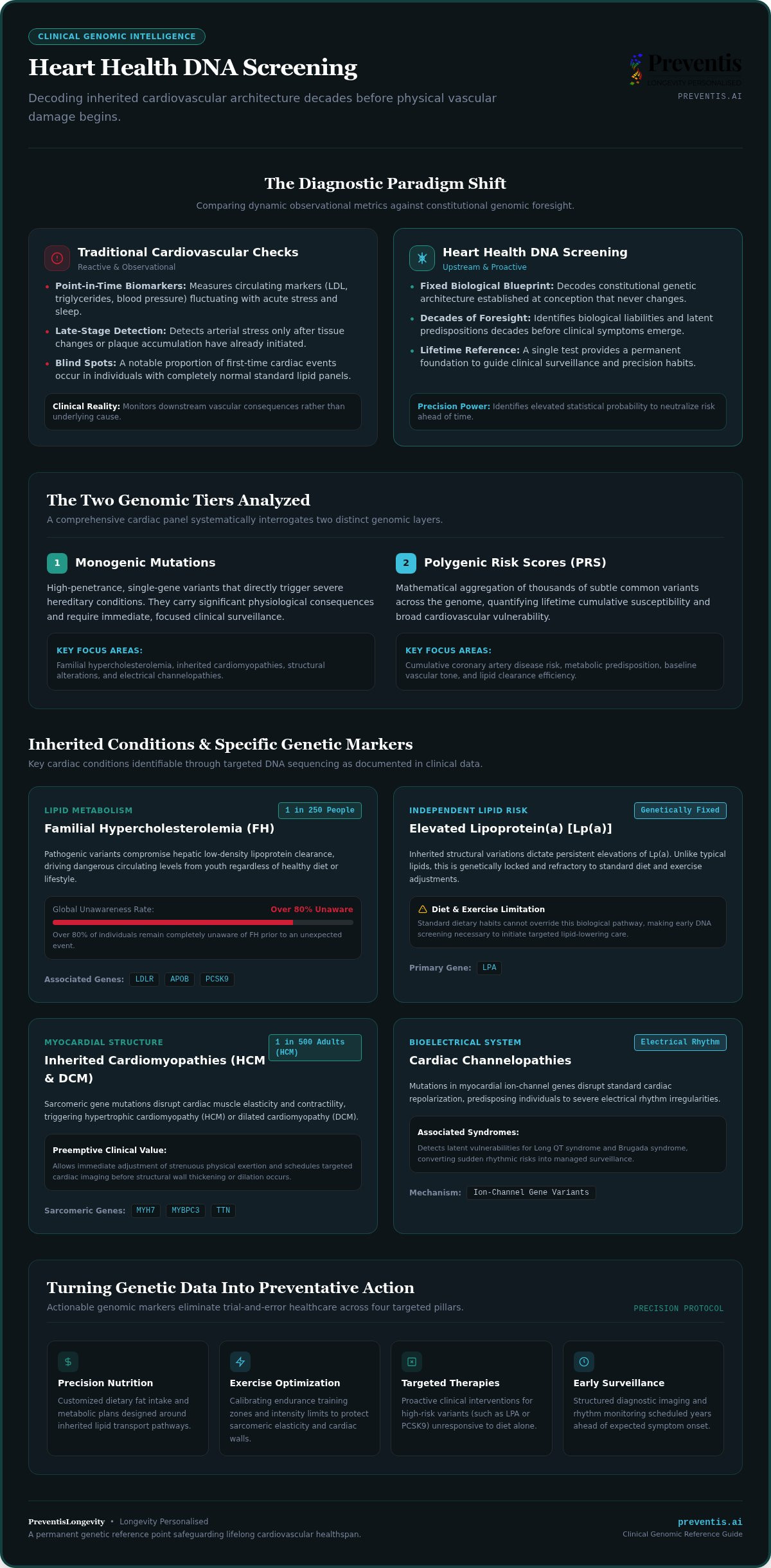
At its core, heart health DNA screening is the genomic analysis of your inherited cardiovascular architecture. Routine medical appointments typically assess dynamic circulating biomarkers like LDL cholesterol, triglycerides, and blood pressure. These metrics offer valuable insight, but they only capture your present physiological snapshot, fluctuating based on diet, sleep, and acute stress. Your genome represents a fixed biological blueprint established at conception. Examining this sequence reveals latent predispositions long before clinical markers drift or symptoms emerge, establishing genomic foresight as an essential foundation for lifelong cardiovascular wellness.
The Limitations of Traditional Cardiovascular Risk Checks
Conventional healthcare models rely on observational risk calculators that combine age, smoking status, systolic pressure, and basic lipid numbers. These tools provide population-level probabilities, but they often miss individual vulnerability. A notable proportion of first-time cardiac events occur in individuals who carry normal standard lipid panels and show no prior clinical indicators. Standard diagnostics simply measure arterial stress after tissue changes or plaque accumulation have started. Genomic screening operates entirely upstream, highlighting subtle metabolic and structural liabilities decades before physical vascular damage begins.
How DNA Screening Shifts Healthcare from Reactive to Proactive
Decoding your genetic markers fundamentally alters your approach to healthspan, shifting your strategy from treating manifest arterial disease to proactively preventing its onset. Rather than relying on generic diet and exercise advice, you gain access to precision protocols tailored to your specific cellular needs. By quantifying cumulative hereditary vulnerabilities through polygenic risk scores and screening for rare inherited traits, you can personalize everything from endurance training zones to targeted dietary fat intake. Because your constitutional DNA never changes, a single heart health DNA screening serves as a permanent reference point, guiding clinical surveillance and preventative lifestyle habits across your entire adult life.
Cardiovascular Conditions and Genetic Markers Detected by DNA Screening
A comprehensive heart health DNA screening examines two distinct biological tiers: high-penetrance monogenic mutations that directly trigger specific hereditary conditions, and broad polygenic risk profiles that reflect lifetime disease susceptibility. By assessing lipid clearance, vascular architecture, and myocardial function, genomic sequencing builds a detailed profile of your biological vulnerabilities. A genetic finding indicates an elevated statistical probability rather than an inescapable outcome. Knowing these predispositions gives you the agency to neutralize them long before symptoms arise.
Familial Hypercholesterolemia and Lipid Transport Variations
Pathogenic variants in the LDLR, APOB, and PCSK9 genes compromise how the liver clears low-density lipoprotein, driving dangerous circulating levels from early youth. Familial Hypercholesterolemia affects roughly 1 in 250 individuals, yet over 80% globally remain unaware of their condition prior to an unexpected event. Similarly, inherited alterations in the LPA gene dictate persistent elevations of Lipoprotein(a). Standard dietary and exercise habits cannot override these genetically fixed pathways, which makes early genomic identification essential for targeted lipid-lowering therapies.
Inherited Cardiomyopathies and Structural Vulnerabilities
Variants within sarcomeric genes like MYH7, MYBPC3, and TTN disrupt cardiac muscle elasticity and contractility. These mutations form the basis of conditions such as hypertrophic cardiomyopathy (HCM), affecting roughly 1 in 500 adults, and dilated cardiomyopathy (DCM). Uncovering structural gene variations early lets you adjust strenuous physical exertion and coordinate targeted imaging before wall thickening or chamber dilation compromises heart function.
Cardiac Channelopathies and Rhythm Irregularities
Electrical channelopathies, such as Long QT syndrome and Brugada syndrome, stem from mutations in ion-channel genes including KCNQ1, KCNH2, and SCN5A. These silent anomalies impair the heart's electrical recovery phase, heightening the risk of sudden arrhythmias during exercise or sleep. Screening identifies these subtle variants early, enabling life-saving precautions against specific prescription medications and intense electrolytic imbalances. In line with the American Heart Association guidance on cardiovascular genetic testing, identifying these mutations protects both individuals and their extended families.
To take complete ownership of these hereditary pathways, exploring proactive home-collection options like preventative genomic panels from PreventisLongevity can deliver the foundational clinical clarity needed to map your personal cardiovascular profile with absolute confidence.
Monogenic Mutations vs Polygenic Risk Scores: Decoding the Science
Understanding inherited cardiac risk requires examining two fundamentally different genomic mechanisms. Single-gene anomalies act like decisive binary switches, while multi-variant polygenic profiles operate like an adjustable volume dial. Advanced heart health DNA screening evaluates both architectures simultaneously, using high-throughput sequencing to decode everything from severe single-nucleotide errors to subtle, genome-wide patterns. This distinction explains why genetic predisposition is nuanced rather than one-dimensional.
Understanding Monogenic Cardiovascular Disorders
Monogenic traits stem from high-penetrance alterations within an isolated gene. These rare variations follow distinct Mendelian patterns, often carrying an autosomal dominant inheritance that gives first-degree relatives a 50% chance of inheriting the same variant. Documented familial hypercholesterolemia genetic markers represent a classic example, where a single mutation dramatically accelerates early plaque progression. Identifying a pathogenic monogenic variant demands immediate, structured clinical surveillance, prompting specialized diagnostic imaging such as echocardiograms or cardiac MRIs to track tissue integrity before complications occur.
The Role of Polygenic Risk Scores (PRS) in Common Heart Disease
Most common cardiovascular challenges do not trace back to a solitary defective gene. Instead, they arise from the cumulative influence of millions of common single nucleotide polymorphisms (SNPs) scattered across your genome. Polygenic risk scores aggregate these small effect sizes into a consolidated percentile score, quantifying your inherited susceptibility to conditions like coronary artery disease. A person can maintain textbook cholesterol and blood pressure readings yet remain in the top 10% of polygenic risk, conferring a two- to three-fold higher lifetime probability of arterial events. Genomic studies demonstrate that integrating PRS as a risk enhancer reclassifies roughly 16% to 18% of borderline-risk patients, ensuring preventative efforts focus where they matter most.
A complete heart health DNA screening bridges this divide by illuminating both extreme monogenic threats and subtle polygenic tendencies. Integrating targeted cardiac panels with broader assessments or comprehensive whole genome sequencing for prevention provides unmatched diagnostic clarity, granting you total agency over your lifelong cardiovascular trajectory.
Turning DNA Data into Action: Personalised Preventative Strategies
Raw genetic markers provide valuable insight, but their true power lies in direct application. Transforming complex sequencing into everyday routines requires a methodical translation from laboratory insight to proactive habit. A high-calibre heart health DNA screening replaces generic wellness tips with an evidence-based roadmap tailored precisely to your cellular biology.
Nutritional and Lifestyle Personalisation Based on Genetic Risk
Your genomic profile determines how efficiently your body metabolises specific nutrients and handles metabolic stress. Consider these targeted adjustments:
- Lipid Metabolism: Carrying the ApoE4 allele or heightened LPA expressions necessitates restricting saturated animal fats and focusing on monounsaturated oils to prevent atherogenic particle accumulation.
- Electrolyte Sensitivity: Variants affecting renal sodium-potassium channels indicate salt-sensitive hypertension, warranting higher dietary potassium and disciplined hydration.
- Exertion and Recovery: Specific collagen and vascular reactivity alleles highlight how well your arterial walls adapt to exercise, indicating whether high-intensity interval training or steady-state aerobic conditioning best preserves your vascular elasticity.
Targeted Clinical Surveillance and Advanced Diagnostics
High genetic risk warrants focused non-invasive clinical investigations rather than passive waiting. Elevated polygenic scores or pathogenic monogenic variants justify requesting an early CT coronary calcium (CAC) scan or CT coronary angiogram from your healthcare team to detect early calcification. When structural or sarcomeric anomalies are flagged, periodic transthoracic echocardiograms or extended ambulatory Holter monitoring track heart morphology and rhythm stability well before any functional compromise occurs.
Pharmacogenomics and Cardiovascular Medications
Preventative cardio care often intersects with pharmacology. Pairing your genetic baseline with pharmacogenomic testing UK eliminates dangerous trial-and-error prescribing. Variants within the SLCO1B1 gene modulate how your liver processes HMG-CoA reductase inhibitors, identifying increased risk for statin-induced muscle myopathy before starting therapy. Similarly, testing hepatic enzymes like CYP2C19 confirms whether antiplatelet medications like clopidogrel can activate properly, ensuring your clinical team prescribes optimal alternatives from day one.
Take control of your cardiovascular future with actionable genomic clarity. Order a targeted preventative genomic panel from PreventisLongevity today to decode your inherited risks and build your personalized roadmap for lifelong heart vitality.
Choosing the Right Heart Health DNA Screening Panel for Longevity
Selecting an effective genomic test requires looking beyond basic ancestry snapshots to find panels engineered specifically for clinical insight. Cardiovascular health does not exist in isolation; it interacts constantly with systemic inflammation, metabolic efficiency, and cellular repair mechanisms. Opting for comprehensive heart health DNA screening ensures you evaluate the full spectrum of inherited cardiac markers alongside connected physiological pathways, creating an integrated foundation for lifelong preventative health.
Targeted vs Multi-System Genomic Screening Panels
Targeted testing isolates specific organ systems, but multi-system panels reveal how interconnected biological vulnerabilities interact over time. Gender-optimised options, such as the Preventis Men’s Cancer Cardio and Preventis Women’s Cancer Cardio panels, evaluate sex-specific oncological and cardiovascular intersections within a single, coherent protocol. For individuals seeking broader systemic protection, the Preventis Preventive panel and Preventis Max Prevention deliver expansive oversight by evaluating multi-organ disease susceptibilities alongside critical metabolic factors. Pairing targeted cardiac scrutiny with a comprehensive preventive health panel or Preventis Whole Genome testing provides the deepest possible view into your biological future.
Quality Standards: Sequencing Depth, Privacy, and Lab Rigour
Clinical utility relies on rigorous laboratory precision. When evaluating genomic screening options, prioritize providers adhering to high clinical thresholds:
- Sequencing Depth: High-throughput next-generation sequencing ensures deep molecular coverage, which is necessary to detect subtle single-nucleotide variants and complex structural rearrangements without ambiguity.
- Strict UK Data Governance: Medical-grade data protection guarantees that your raw genomic information remains strictly confidential, secure, and shielded from third parties.
- Non-Invasive Convenience: Advanced testing now utilizes simple, non-invasive home-collection kits, with samples processed by accredited nationwide UK laboratories adhering to molecular standards.
Taking the Next Step Toward Cardiovascular Longevity
Leaving cardiovascular protection to chance or waiting for an unexpected medical event introduces unnecessary risk. Moving from passive worry to definitive foresight begins with understanding your unique inherited architecture. Discover your genetic blueprint with the PreventisLongevity genomic panels, and take active ownership of your healthspan today.
Future-Proof Your Heart with Genomic Foresight
Relying solely on reactive biomarkers leaves critical aspects of your cardiovascular trajectory to chance. Integrating proactive heart health DNA screening into your wellness strategy removes the guesswork, transforming static family history concerns into structured, measurable foresight. Understanding your unique balance of monogenic traits and polygenic predispositions empowers you to fine-tune nutrition, tailor exercise, and coordinate targeted clinical imaging decades before structural arterial changes can take root.
With seamless home-collection kits serving individuals across the entire United Kingdom, mapping your genomic blueprint has never been more accessible. PreventisLongevity pairs accredited high-throughput genomic sequencing adhering to strict laboratory standards with focused options like the Preventis Men’s Cancer Cardio and Preventis Women’s Cancer Cardio panels. Your biological future isn't predetermined; it's waiting for you to shape it. Explore Preventis Heart and Longevity Panels today and build a proactive foundation for lifelong cardiovascular vitality.
Frequently Asked Questions
How is heart health DNA screening different from standard cholesterol tests?
Standard cholesterol tests evaluate dynamic lipids circulating in your blood at a single moment, reflecting recent diet, exercise, and lifestyle factors. In contrast, heart health DNA screening analyzes your permanent genetic architecture. This laboratory evaluation identifies lifelong predispositions toward lipid clearance issues, structural heart anomalies, and vascular inflammation long before biological markers shift or physical symptoms appear on a routine clinical blood panel.
Can a cardiovascular DNA test diagnose an active heart attack or acute heart disease?
No, a genetic test cannot diagnose acute cardiac events or active heart disease. Genomic screening identifies inherited vulnerabilities and statistical risks rather than real-time arterial blockages or myocardial infarction. If you experience acute symptoms like chest pain, shortness of breath, or palpitations, seek emergency medical diagnostics immediately. DNA insights serve as an upstream preventative tool for long-term health optimization, not an emergency diagnostic service.
What should I do if my screening reveals a high genetic risk for cardiovascular disease?
Discovering an elevated risk score provides actionable data to refine your preventative strategy rather than cause alarm. You should share your comprehensive genomic report with your physician or a private cardiologist to coordinate advanced diagnostics, such as an early CT coronary calcium scan. From there, you can implement tailored nutritional protocols, targeted cardiovascular exercise zones, and disciplined lipid management to actively mitigate that inherited predisposition.
Does a low genetic risk score guarantee that I will never develop heart disease?
A low genetic risk score does not guarantee immunity from cardiovascular disease. Your overall heart health reflects an ongoing interplay between inherited baseline genetics and dynamic lifestyle exposures. Poor diet, chronic systemic inflammation, unmanaged hypertension, and smoking can induce arterial damage regardless of favourable genetics. Maintaining balanced nutrition, routine aerobic conditioning, and annual clinical biomarker monitoring remains essential for lifelong vascular integrity.
How is the DNA sample collected for home heart health screening?
Sample collection is completely non-invasive and conducted from the comfort of your home using an advanced cheek swab or saliva collection kit. After following the simple step-by-step instructions to capture your oral cellular sample, you return the specimen using the prepaid mailer. Your sample travels directly to an accredited nationwide UK laboratory adhering to strict molecular standards for high-depth genomic processing and analysis.
Are genetic screening results covered by medical confidentiality in the UK?
Yes, your genetic screening data is protected by strict UK data governance and medical confidentiality regulations. Accredited laboratories process your sample under stringent security protocols, and your genomic results remain your private property. They are never shared with employers, third parties, or public health bodies without your explicit consent. You maintain complete control over who accesses your detailed longevity reports.
Can cardiovascular genetic testing help determine my response to heart medications?
Yes, pharmacogenomic analysis reveals how your unique liver enzymes metabolise standard cardiovascular medications. Specific variations in genes like SLCO1B1 and CYP2C19 indicate whether you face an elevated risk of statin-induced muscle pain or whether antiplatelet therapies will activate effectively. Sharing these pharmacogenomic insights with your prescribing physician eliminates trial-and-error prescribing, ensuring you receive the safest, most effective therapeutic dosages from the outset.


