

What if a genetic result is a prompt for better questions, not a prediction of your future? DNA insights for long-term health can highlight information worth exploring, but they make the most sense when interpreted alongside your family history, habits and routine health checks.
It’s understandable to find a genetic report technical or unsettling, especially when it describes an increased risk without explaining what that means for you. DNA can provide one part of your health picture, but it can’t determine with certainty whether you’ll develop a condition or what your future health will look like.
This guide explains what genetic findings can and can’t indicate, how to put them in context, and which questions may be useful to discuss with an appropriate health professional. You’ll also learn how to consider genetic information alongside everyday health details and revisit decisions over time, creating a thoughtful, realistic approach to long-term wellbeing.
Key Takeaways
- DNA insights for long-term health are most useful when you connect a finding with your personal context and a clear health question.
- Record the exact result wording, report date and stated limitations before deciding what to ask next.
- A genetic risk result isn’t a certain forecast; its meaning depends on the evidence, report scope and your circumstances.
- Use a proportionate process: prioritise a concern, seek appropriate interpretation, consider evidence-informed next steps and review your plan.
- Choose a test based on the question you want to explore, since targeted panels, whole genome sequencing and preventive screening serve different purposes.
DNA insights for long-term health: what your genes can tell you
Curiosity about prevention is a sensible starting point. Learning about inherited genetic variants may help you explore selected health questions, but your genes aren’t a personal health verdict. DNA insights for long-term health are most useful as one source of information, interpreted alongside your environment, habits, age and medical history.
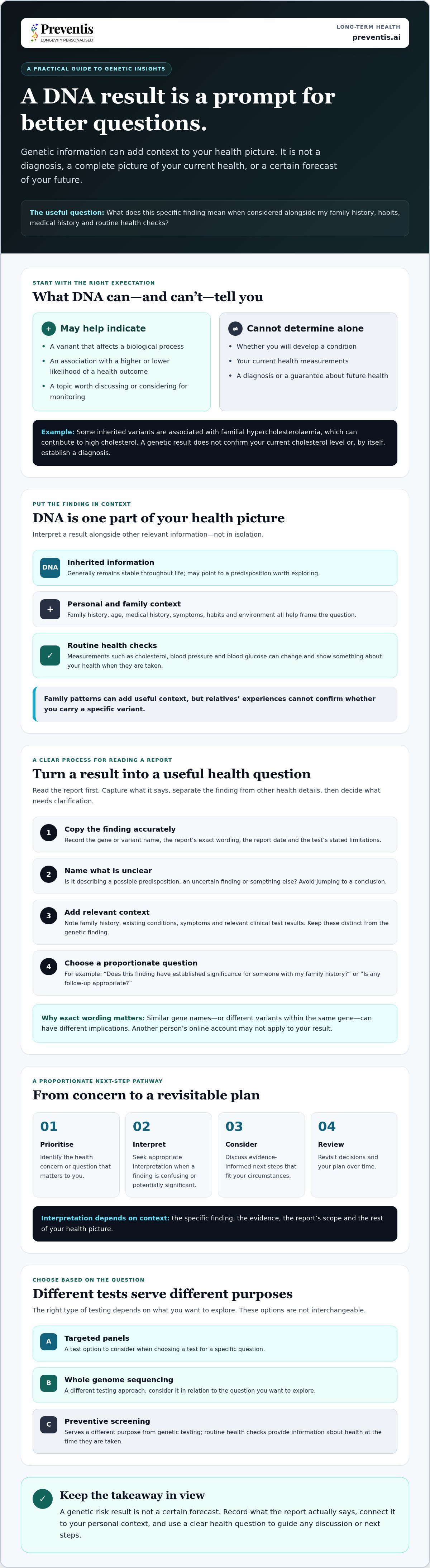
In brief: DNA insights may indicate that an inherited variant affects a biological process or is associated with a particular susceptibility. They can’t, on their own, diagnose a condition, measure your current health or guarantee what will happen in the future.
What does DNA reveal about long-term health?
Depending on the finding, a genetic variant may affect how a biological process works or be associated with a higher or lower likelihood of a particular health outcome. For example, some inherited variants are associated with familial hypercholesterolaemia, which can contribute to high cholesterol. A genetic result doesn’t confirm someone’s current cholesterol level or, by itself, establish a diagnosis.
That distinction matters. Inherited DNA generally remains stable throughout life, while measurements such as cholesterol, blood pressure and blood glucose can change. These health checks show something about your health at the time they’re taken. Genetic information may point to a predisposition worth discussing when considering what to monitor. For a broader overview of what your genes can tell you, including the types and limitations of genetic testing, see this introductory reference.
Genes, lifestyle, and family history work together
Family history can provide useful context. If close relatives have experienced a particular condition, share that pattern with a health professional. Relatives’ experiences can’t confirm whether you carry a specific variant, though. Families share genes, and they may also share aspects of their environment and habits.
Lifestyle and environmental factors can influence health without changing the inherited DNA you were born with. Consider a genetic result alongside health behaviours, medical history and appropriate routine checks, rather than in isolation. This broader view helps avoid treating either a risk result or a reassuring report as the whole story.
For a deeper discussion of how to interpret genetic findings and where their limits lie, explore this guide to genetic markers for longevity. Genes can add context to health conversations, while thoughtful interpretation helps determine what, if anything, to consider next.
How to turn a DNA report into meaningful health questions
A report becomes more useful when you treat it as a starting point for a focused conversation, not as a diagnosis or a list of instructions. This process can help turn DNA insights for long-term health into questions that fit your circumstances.
Start with the report, not an online search
Find the exact result and read the interpretation provided with it. Note any uncertainty, limitations or explanation of what the test covered. Similar gene names, or different variants within the same gene, can have different implications. Don’t assume an online account of someone else’s result applies to yours.
- Copy the finding accurately. Record the gene or variant name and the report’s exact wording. Include the report date and the test’s stated limitations.
- Identify what you want to understand. Is the report describing a possible predisposition, an uncertain finding or something else? Write down what remains unclear instead of jumping to a conclusion.
- Add relevant context. Note family history, existing health conditions, symptoms and relevant clinical test results. Keep these details separate from the genetic result, so a risk signal isn’t mistaken for a current measurement or diagnosis.
- Choose a proportionate follow-up question. For example: “Does this finding have established significance for someone with my family history?” or “Is there any appropriate follow-up to consider?”
Connect a finding to your wider health picture
Bring your notes and report to an appropriately qualified health professional if a finding is potentially significant or confusing. A GP or another professional with relevant expertise can help you consider what it means in context and whether any follow-up is appropriate. A genetic result needs interpretation in your personal context because its significance depends on the specific finding, the evidence and the rest of your health picture.
Before searching broadly, prepare your questions and check what type of test produced the report. Choosing a DNA test involves understanding its purpose and scope, not just the genes named in a result. If your report draws on broader genomic data, this whole genome sequencing prevention guide offers further context.
If you’re considering testing to explore a health question, review PreventisLongevity genomic and preventive testing options. Check each panel’s stated scope before deciding whether it fits what you want to learn.
What DNA insights cannot predict: limits, uncertainty, and reassurance
A genetic result isn’t a certain forecast of future health. Even when a finding is well understood, what it means for one person depends on the specific variant, the strength of the evidence, what the test examined and personal context. DNA insights for long-term health can inform questions, but they can’t tell you exactly whether or when a condition will develop.
Genes are one part of a complex picture. Lifestyle and environment may influence health, but changes to them don’t erase inherited variants or guarantee a particular outcome. The value lies in understanding what a result can reasonably contribute, then considering it alongside other relevant information.
Why a risk result is not a diagnosis
A predisposition describes a possible influence on susceptibility; it isn’t the same as having symptoms or a clinically established diagnosis. A negative result also has boundaries: it may mean a particular finding wasn’t detected within the test’s scope, not that every genetic or non-genetic health concern has been ruled out. If a result could have medical implications, discuss it with an appropriately qualified health professional before making decisions based on it.
| DNA data may help you | DNA data cannot answer alone |
|---|---|
| Identify a finding that may be relevant to a specific health question. | Confirm that you currently have a condition or explain symptoms by itself. |
| Provide information to discuss alongside family history and other health details. | Predict with certainty whether, when or how severely a health issue will affect you. |
| Prompt questions about whether further interpretation or follow-up is appropriate. | Rule out every possible genetic finding or non-genetic health concern. |
How to respond without unnecessary anxiety
Pause before making major health decisions based only on a report. Write down three things: what the result says, what remains unclear and who could help interpret it. Check the report’s stated scope and limitations, and don’t treat online accounts of similar results as a personal answer. If the finding is confusing or potentially significant, take your notes to a suitably qualified professional.
Health scores and genetic findings don’t necessarily measure the same thing, so compare their purpose and scope before drawing conclusions. For a separate discussion of how to assess score-based reports, read this DNA health score comparison guide. A measured next step can bring clarity without turning uncertainty into alarm.
How to build a practical, revisitable health plan from DNA insights
A genetic finding doesn’t need to trigger a complete lifestyle overhaul. Use it as one input in a measured plan: focus on a relevant question, seek interpretation where needed, agree proportionate next steps and revisit them if your circumstances change. That keeps DNA insights for long-term health connected to decisions that are practical and appropriate for you.
Choose one useful next step at a time
Start with the finding most relevant to a question you have, rather than trying to optimise every aspect of health at once. Check the report’s scope, then discuss potentially significant findings with an appropriately qualified health professional. This article offers general information, not personalised medical advice.
Separate everyday habits from decisions that call for clinical assessment or supervision. General wellbeing habits can be approached realistically, but don’t start, stop or substantially change treatment, supplements or health checks solely because of a DNA report. Ask a professional whether any action is relevant to your circumstances and supported by appropriate evidence.
Make your plan easy to revisit
Record the result and the reasoning behind any next step, so you can return to it without relying on memory. This simple template can help:
- Finding: What does the report say, and what are its stated limitations?
- Question: What do you want clarified, and who is the right person to ask?
- Agreed action: What step, if any, have you agreed is appropriate?
- Review point: When or under what circumstances should you revisit the question?
Repeat testing isn’t automatically necessary just because time has passed. Follow the report’s guidance and professional advice about whether further testing could be useful. New evidence, a change in family history or a shift in your health circumstances may be a reason to review how you understand a result, but it doesn’t automatically mean you need another test.
Keep the plan flexible. At review, ask whether the original question still matters, whether the agreed action remains appropriate and whether there’s new information to discuss. If you’re exploring testing as one source of information within a broader health picture, review Preventis genomic and preventive testing options and compare each option’s stated scope with your question.
Choosing DNA testing for long-term health: match the test to your question
The most suitable test depends on what you want to understand. Define the health question first, then compare it with each test’s purpose and stated scope. DNA insights for long-term health are most useful when the information you receive is relevant to that question and you understand what it can and can’t show.
Targeted panel or broader genomic testing?
A targeted panel examines selected areas of the genome, while whole genome sequencing examines much broader genomic data. Broader doesn’t automatically mean clearer or more actionable: interpretation depends on the findings assessed, the evidence behind them and how the report presents its limitations. Broader preventive screening is a different category, so check what information it covers rather than assuming it’s equivalent to genetic testing.
Preventis offers options including Preventis Whole Genome and the Preventis Preventive panel. Its other panels include Preventis 17 Gene BRCA/Lynch, which focuses on selected genes, and Preventis MyPharma, a pharmacogenomics panel. Preventis also offers Men’s and Women’s Cancer Cardio panels, Preventis Max Prevention and Preventis MyHealthscore. These options serve different testing purposes, so check each one’s stated scope and report information against your question before deciding whether it may fit. For additional context on preventive panels, see this comprehensive preventive health panel guide.
Questions to ask before choosing a DNA test
Look beyond the test name. Ask what findings or measures are included, what the report is designed to tell you and what it can’t establish. Check the sample process and whether the report explains uncertainty and limitations in clear language. These details help you assess whether the test addresses your question, rather than simply offering a larger volume of information.
Also review how your personal data is handled and what support is available to help you understand results. If you expect to use a finding in a health decision, consider in advance who you could speak to about its meaning and whether any follow-up is appropriate.
- Purpose: What question is this test designed to address?
- Scope: What does it examine, and what falls outside that scope?
- Interpretation: How are findings, uncertainty and limitations explained?
- Practical details: What is the sample process, how is data handled, and what support is available?
Taking time to compare these points can make your choice more considered. Explore Preventis genomic and preventive testing options and review the information for each option in relation to the health question you want to explore. A test can contribute information to a broader health picture, but it can’t guarantee prevention or a particular outcome.
Make your next health decision with greater clarity
DNA insights for long-term health are most valuable when you treat them as one part of your wider health picture, not a prediction or diagnosis. Focus on the specific finding, understand the report’s limits and bring relevant questions to an appropriately qualified health professional.
A thoughtful next step doesn’t have to be dramatic. Match any test to the question you want to explore, check its scope and data-handling information, and choose proportionate actions you can review as your circumstances change.
Preventis offers whole genome sequencing, targeted genomic panels, and preventive health and pharmacogenomics testing options. Explore the available information and consider whether an option’s stated scope aligns with your questions: Explore Preventis genomic and preventive testing options.
Use genetic information as a starting point for informed conversations and considered choices. Your long-term health plan can remain personal, practical and open to revision.
Frequently Asked Questions
Can DNA insights predict my long-term health?
No, DNA insights can’t predict your long-term health with certainty. They may identify inherited variants associated with a health predisposition or biological process, but they can’t establish exactly whether, when or how severely a condition might affect you. Interpretation depends on the specific finding, evidence, test scope and personal context, including family and medical history. Treat results as information to discuss, not a definitive forecast or a substitute for appropriate health checks.
What can a DNA test tell me about future health?
A DNA test may reveal selected inherited variants that could be relevant to particular health questions. What it tells you depends on what the test examines and how its report explains findings and limitations. It doesn’t measure your current health in the way a blood pressure reading or cholesterol test can, and it can’t rule out every possible concern. Use the report as one part of your health picture, alongside routine checks and professional advice.
How do I use genetic results to improve my health?
Start by noting the report’s exact wording, date and limitations, then identify one question you want answered. Consider relevant family history and existing health information, and discuss potentially significant or unclear findings with an appropriately qualified health professional. Any next step should fit your circumstances and be supported by suitable evidence. Genetic information can inform a conversation, but it doesn’t automatically mean you need a particular test, treatment or lifestyle change.
Can lifestyle changes change my DNA or genetic risk?
Everyday lifestyle changes don’t rewrite the inherited DNA you were born with, and they can’t guarantee that an inherited predisposition will disappear or that a condition will be prevented. However, habits and environmental factors are part of the broader health picture and can influence health independently of inherited variants. Aim for realistic, evidence-informed choices, and ask a health professional whether a genetic finding has any implications for your individual care.
What should I do if a DNA report shows a health risk?
Pause before making major health decisions based on the report alone. Record exactly what it says, what the test covered, which limitations it states and what remains unclear. Then discuss findings with potential medical implications with an appropriately qualified health professional, who can consider them alongside your personal and family history. A risk result isn’t a diagnosis, and the right response depends on the specific finding and your circumstances.
Is whole genome sequencing better for long-term health insights?
Not necessarily. Whole genome sequencing examines broader genomic data than a targeted panel, but more information doesn’t automatically provide clearer or more actionable answers. The right option depends on your question, the test’s scope and how its findings are interpreted and reported. Compare what each test includes, what it may not detect and how limitations are explained. Consider discussing the choice with a relevant health professional if you’re testing for a medical concern.
How often should I retake a DNA test?
There’s no automatic need to repeat a DNA test simply because time has passed. Inherited DNA is generally stable, so first check the original report’s scope and follow any guidance provided. A different test may be worth discussing if your health question changes, the original test didn’t cover what you need, or a professional advises that further testing could help. Don’t assume retesting is useful without a clear reason.


