

Could your DNA help explain why a medicine doesn’t seem to work, or why unwanted effects appear? Genetic testing for medication compatibility can offer useful clues about how your body may process certain medicines, but it can’t predict every response. Treat a result as a starting point for a more informed conversation, not as a diagnosis or prescription.
If you’re uncertain about a medicine’s effects, it’s understandable to look for a clearer explanation. Pharmacogenomic testing examines genetic variations that may influence how your body processes particular drugs. What it measures, and what the findings mean, depends on the genes and medicines covered, as well as your health and medication history.
This article explains what medication compatibility testing can and can’t indicate, how genes interact with medicines and clinical context, and how to discuss a result with your prescriber. It also introduces the Preventis MyPharma Panel as a source of pharmacogenomic insight to support that discussion, with professional judgement at the centre of medication decisions.
Key Takeaways
- Genetic testing for medication compatibility looks at inherited variants that may affect your response to particular medicines, not every medicine in a drug class.
- A detected genetic variant does not automatically have practical clinical significance for a specific medicine.
- Interpret findings alongside your medication history, symptoms and overall health to understand treatment considerations.
- For a prescriber discussion, bring the complete report, your current medication list and questions about medicine-specific findings.
- The Preventis MyPharma Panel offers pharmacogenomic insight to help inform a conversation about personalised medication decisions.
What does genetic testing for medication compatibility actually test?
Pharmacogenomic testing examines inherited genetic variants that may influence how some medicines are processed or affect the body. Genetic testing for medication compatibility looks for selected variations and considers whether they have evidence-based relevance to particular medicines. “Compatibility” means a possible consideration when assessing response, not a guarantee that a medicine will be effective, safe or free from side effects.
Pharmacogenomics is the study of how genetic variation may influence drug response and help inform treatment choices. Unlike a disease diagnostic test, pharmacogenomic testing does not establish whether you have a medical condition. It assesses selected inherited variants that may matter when considering certain medicines. It’s also distinct from ancestry testing, which explores genetic patterns related to ancestry rather than medicine response.
Which parts of a medicine response can genes influence?
Some genetic variants can affect the activity of drug-metabolising enzymes, which help the body break down medicines. Others may influence transporters that move a medicine through the body or targets that a medicine interacts with. Genes such as CYP2C19 and CYP2D6 are examples assessed in pharmacogenomics, but their relevance depends on the medicine and the evidence for that gene-medicine relationship.
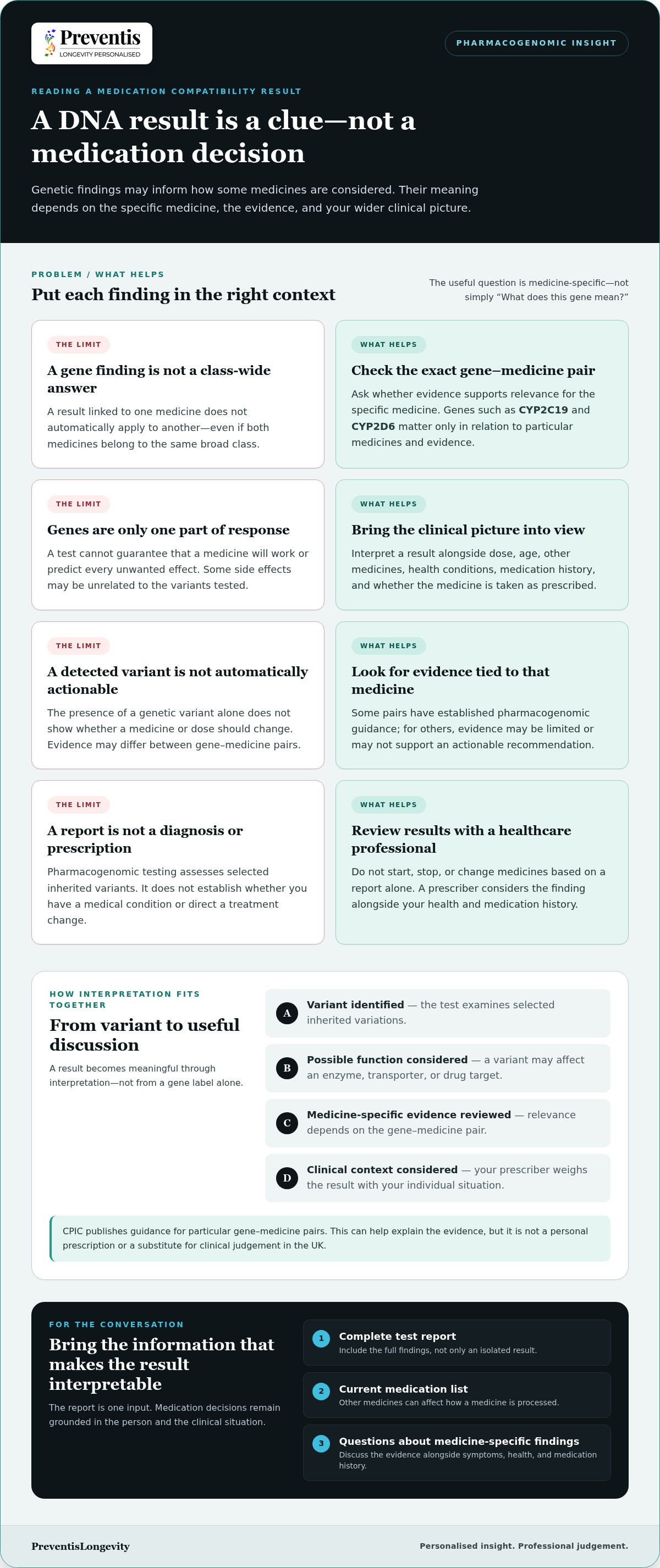
A finding linked to one medicine doesn’t automatically apply to another, even if both belong to the same broad class. Read reports at the medicine-specific level. The useful question is not simply “What does this gene mean?” but “Is there evidence that this variant matters for this medicine?”
What genetic compatibility testing cannot tell you
A DNA result is one part of a wider clinical picture. Dose, age, other medicines, health conditions and whether a medicine is taken as prescribed can all shape its effects. A test can’t guarantee that a medicine will work for you or predict every unwanted effect. Some side effects may occur for reasons unrelated to the variants tested.
Results also depend on what a test examines and what is known about the relevant gene-medicine relationship. A finding may offer a useful consideration for a prescriber, but it isn’t a diagnosis or an instruction to start, stop or change treatment. Don’t alter your medicines based on a report alone. Instead, discuss the specific finding with an appropriate healthcare professional alongside your health and medication history.
How do genes affect medication response and pharmacogenomic results?
A genetic variant can change how much of a particular enzyme the body produces or how well it works. If a medicine relies on that enzyme, the difference may influence how quickly the medicine is processed. That can be relevant to the specific treatment, but it doesn’t decide which medicine is right for you.
Pharmacogenomic relevance belongs to a specific gene-medicine pair, not to all medicines or even every medicine in the same class. A result becomes useful when laboratory findings are interpreted against evidence for the medicine in question.
How a genetic variant can influence drug metabolism
Think of a drug-metabolising enzyme as one of the body’s processing tools. A genetic variation may make a tool work more slowly, more quickly or in a typical way, but different medicines can use different tools and pathways. Genes can also affect transporters or drug targets, so metabolism is only one part of the picture.
For example, variation in CYP2C19 may be relevant to the processing of some medicines. A laboratory identifies genetic variants, then methods and evidence are used to infer a likely enzyme function, sometimes called a phenotype. If a report uses labels such as “poor”, “normal” or “rapid metaboliser”, their meaning depends on the gene and interpretation framework. They aren’t universal ratings of how your body handles every medicine, and this example isn’t personal medical advice.
Why the same result may not mean the same thing for every medicine
For some gene-medicine pairs, established pharmacogenomic guidance describes how a genetic result may be considered. For others, evidence may be limited or may not support an actionable recommendation. The presence of a gene finding alone doesn’t tell you whether a medicine or dose should change.
The Clinical Pharmacogenetics Implementation Consortium (CPIC) publishes guidance on using genetic results for particular gene-medicine pairs. Its guidance can help explain the evidence, but it isn’t a personal prescription or a substitute for clinical judgement in the UK. A prescriber still needs to consider the medicine’s purpose, your current dose, other medicines, organ function and health history. Interactions with other drugs can also affect how a medicine is processed, so a genetic result is interpreted alongside these factors.
This is what makes genetic testing for medication compatibility most useful: it can add an inherited factor to the discussion, while medication decisions remain grounded in the person and the clinical situation. The Preventis MyPharma Panel offers pharmacogenomic insight to help inform that conversation, alongside your medication history and a healthcare professional’s judgement.
Is genetic testing for medication compatibility reliable, and what are its limits?
It helps to separate two questions: can a test identify the genetic variants it examines, and does a finding meaningfully inform a decision about a particular medicine? The first concerns analytical detection. The second depends on evidence for that gene-medicine relationship and its relevance to the person’s circumstances. Neither means the test chooses or prescribes a medicine.
A genetic result is one component of medication decision-making, alongside medicine-specific evidence, medication history, symptoms, health conditions and professional clinical assessment. Evidence strength and actionability vary by gene, medicine and result, and guidance may be updated as evidence develops.
What makes a result useful in practice?
A finding is more informative when it relates to a specific medicine and has relevant clinical evidence behind it. Clear reporting matters too: the result should be understandable in context, rather than presented as a stand-alone label. Appropriate interpretation connects what the test detected with what is known about that medicine and the person’s clinical situation.
A result may be analytically sound yet have limited practical value if the relevant gene-medicine link is uncertain or doesn’t apply to the treatment being considered. Genetic testing for medication compatibility can inform a discussion, but it can’t determine the treatment plan on its own.
| Information source | What it can contribute |
|---|---|
| Pharmacogenomic result | Selected inherited variants that may be relevant to the processing or effects of particular medicines. |
| Medication history | Previous benefits, unwanted effects, doses, and medicines taken together. |
| Clinical assessment | Current symptoms, health conditions, treatment goals and other factors that inform care. |
Why genes are not the whole medication picture
Age, dose, other medicines, health conditions and adherence can all influence response. These factors can change: a new medicine may create an interaction, a health condition may affect treatment considerations, and a dose or treatment goal may be revised. A genetic result doesn’t capture every change in your health or circumstances.
Use a report as a prompt for a careful conversation, not as an instruction. Don’t start, stop or change prescribed treatment based solely on a genetic finding. Share the report with an appropriate healthcare professional, who can consider it alongside your current medication list and clinical history. The aim is a better-informed decision, not a decision made by DNA alone.
How should you use a medication compatibility genetic test result?
A report is most useful when you turn it into a focused conversation, rather than trying to interpret it as a treatment plan. These steps can help you prepare for a medication review:
- Read the report’s scope. Note which genes and medicines it covers, and the report date. A result only speaks to the information the test assessed.
- Look for medicine-specific findings. Identify whether the report mentions a medicine you currently take or may be prescribed. Record the exact wording, but don’t treat a category or result as a direction to change treatment.
- Gather your medication history. List current and recently used prescription medicines, over-the-counter medicines and supplements. Include relevant past effects, such as a medicine seeming ineffective or causing unwanted symptoms.
- Discuss the findings with your prescriber. Bring the full report and medication list, and ask how the result fits with your health history and treatment goals.
The genetic finding can inform the discussion; you and your prescriber make treatment decisions together, using the complete clinical picture. For broader context on test types and interpretation, read this pharmacogenomic testing guide.
Questions to take to a medication review
Keep the conversation practical. You might ask: “Does this report contain a finding relevant to a medicine I take or may be prescribed?” “How do my other medicines, health conditions or dose affect its interpretation?” and “Does current clinical guidance support an action, or is this useful context without a specific recommendation?” These questions connect the report to a real decision without assuming the result dictates one.
How to keep a genetic report useful over time
Store the full report securely and note when it was issued, which laboratory produced it and what the test covered. Share relevant findings when your treatment changes; don’t assume every healthcare professional can access a consumer genetic report. Keep your medication list current too, since new treatments and health changes can affect how a result is considered.
Targeted pharmacogenomic testing focuses on selected gene-medicine relationships. Whole genome sequencing for proactive health examines a much broader range of genetic information, so it serves a different purpose and doesn’t automatically provide the same focused medication insight. To explore targeted pharmacogenomic insight, see the Preventis MyPharma Panel.
What to expect from Preventis MyPharma genetic testing
The Preventis MyPharma Panel is PreventisLongevity’s pharmacogenomics offering. It provides genetic insight that may help inform a conversation about how some medicines could be processed or affect the body. Its role is to add a relevant piece of information, not to diagnose a condition, select a medicine or replace a prescriber’s judgement.
People considering genetic testing for medication compatibility may want more context about a medicine that hasn’t worked as expected, unwanted effects or a future treatment discussion. Testing isn’t necessary for everyone, and its usefulness depends on whether a result relates to a particular medicine and can be considered alongside personal health and medication history.
How a pharmacogenomics panel fits into personalised health
A pharmacogenomics panel focuses on genetic information that may relate to medication response. That differs from disease-risk screening, which looks at inherited factors associated with the chance of developing certain conditions, and from broader genomic testing, which examines a wider range of genetic information. These approaches answer different questions.
For broader context, a comprehensive preventive health panel guide explains how preventive screening differs from medication-related insight. Whatever the scope of a test, treat a genetic result as potential context for a clinician-led discussion, not a standalone treatment decision.
A considered next step for medication insight
Medication-focused genetic insight may be relevant if you have questions about how a medicine has affected you or want to include genetic information in a future treatment conversation. It won’t explain every response or side effect. Discuss current symptoms, concerns about a prescribed medicine and proposed treatment changes with an appropriate healthcare professional, who can consider the full clinical picture.
Approach the result as a prompt for questions: does it relate to a medicine you take or may be offered, and how does it fit with your health and medication history? The insight may help make that conversation more informed, while you and your prescriber remain central to care decisions.
Explore the Preventis MyPharma Panel to learn more about pharmacogenomic insight and how it may fit into a personalised approach to health.
Turn genetic insight into a more informed conversation
Genetic testing for medication compatibility can reveal inherited factors that may be relevant to how you respond to certain medicines. Its value depends on the specific gene-medicine evidence and how the finding fits with your medication history, health and clinical assessment.
A result is a prompt for discussion, not a diagnosis or an instruction to change treatment. Share the full report and your current medication list with an appropriate healthcare professional, and consider findings alongside your symptoms and treatment goals.
PreventisLongevity offers genomic testing panels for direct-to-consumer health insights, including the Preventis MyPharma Panel, its pharmacogenomics offering. It may provide useful context for a medication conversation, while treatment decisions remain grounded in your complete clinical picture and professional judgement.
Explore the Preventis MyPharma Panel to learn about pharmacogenomic insight and consider how it may support a personalised approach to health. A thoughtful conversation is a practical next step towards greater clarity.
Frequently Asked Questions
Can a genetic test tell me which medication will work best?
No, a pharmacogenomic test can’t select the best medicine or guarantee how you’ll respond. It can identify inherited variants that may influence how your body processes or responds to certain medicines. Whether a finding is relevant depends on the specific medicine, evidence for that gene-medicine relationship and your wider health circumstances. Discuss the full report with your prescriber before making any changes to your treatment.
Is genetic testing for medication compatibility accurate?
Genetic testing for medication compatibility may reliably detect the variants it’s designed to assess, but detection isn’t the same as predicting your individual response. Clinical usefulness depends on the genes and medicines covered, how findings are interpreted and the strength of evidence for each association. Age, dose, other medicines and health conditions also matter. Ask what a report supports and review its findings with a healthcare professional.
Can a DNA test tell me why my medication is not working?
It may offer context, but a genetic test can’t establish the cause on its own. Genetic variation is one possible influence; dose, interactions with other medicines, the condition being treated, how consistently you take the medicine and other health factors can also play a part. If treatment isn’t working as expected, raise this with your prescriber. Don’t stop or change your medicine independently based on a test result.
What happens if a genetic test shows I may respond differently to a medicine?
Share the complete report and your current medication list with your prescriber. They can consider whether the finding relates to the exact medicine, alongside relevant guidance, your health history and treatment goals. A result doesn’t automatically mean your medicine or dose must change. Don’t start, stop or adjust treatment based solely on a genetic report; discuss the appropriate next step with the professional responsible for your care.
Can genetic testing detect interactions between all my medications?
No, pharmacogenomic testing isn’t a complete medication interaction checker. It examines selected genetic factors that may affect response to certain medicines, while interactions can also depend on the combination of medicines, supplements, doses and health conditions. Don’t use a genetic report instead of a medication review or professional advice. Share an up-to-date list of everything you take with your pharmacist or prescriber when discussing a result or medication concern.
Is pharmacogenomic testing useful if I already take medication?
It may provide relevant information for some medicines, depending on the genes and drugs assessed and the evidence for each finding. A result doesn’t mean existing treatment should change. If you have a report, discuss it with your prescriber alongside your current medicines and health history. If you’re experiencing a concerning reaction, seek appropriate medical advice promptly rather than relying on genetic information to decide what to do.
Does a medication compatibility DNA test replace my doctor or pharmacist?
No, a genetic test provides additional information, not a replacement for clinical assessment, prescribing judgement or medication advice. A healthcare professional can consider the result alongside your symptoms, diagnosis, dose, other treatments and personal circumstances. Treat the report as one source of context, not a prescription or emergency assessment. Continue your current treatment plan unless the professional responsible for your care advises you to change it.


