

What if the checks that help you understand cancer risk and heart health answer different questions? That distinction matters when considering mens cancer and cardio screening. Cancer screening looks for signs of disease, while cardiovascular assessments estimate the likelihood of future heart and circulation problems. A genetic risk assessment can offer insight into inherited predisposition. None of these is a diagnosis, and feeling well or having no known family history doesn’t necessarily settle what’s relevant to you.
It’s understandable to wonder whether these checks belong in one plan, or which questions to raise first. The answer depends on personal context, including age, health history and family history, as well as the purpose and limits of each assessment.
This guide explains how cancer screening, cardiovascular risk assessment and inherited-risk testing differ, and how considering them together can help you plan next steps. It also introduces the Preventis Men’s Cancer Cardio panel, which brings cancer predisposition and cardiovascular risk into one preventive health perspective. Risk insight is not a substitute for clinical care. The aim is a clearer conversation about prevention, shaped around your individual health picture.
Key Takeaways
- Learn why cancer checks, cardiovascular assessments and genomic risk insights answer different questions, and what each can and can’t tell you.
- See how a combined view of mens cancer and cardio screening may help you consider risk without treating an assessment as a diagnosis.
- Use your age, health history, family history and current care to shape a focused discussion about preventive checks.
- Prepare for a clinician conversation by noting existing diagnoses, medicines and previous test results, then identifying the questions that matter most to you.
- Explore how the Preventis Men’s Cancer Cardio panel considers cancer predisposition and cardiovascular risk together.
What Men’s Cancer and Cardio Screening Can, and Cannot, Tell You
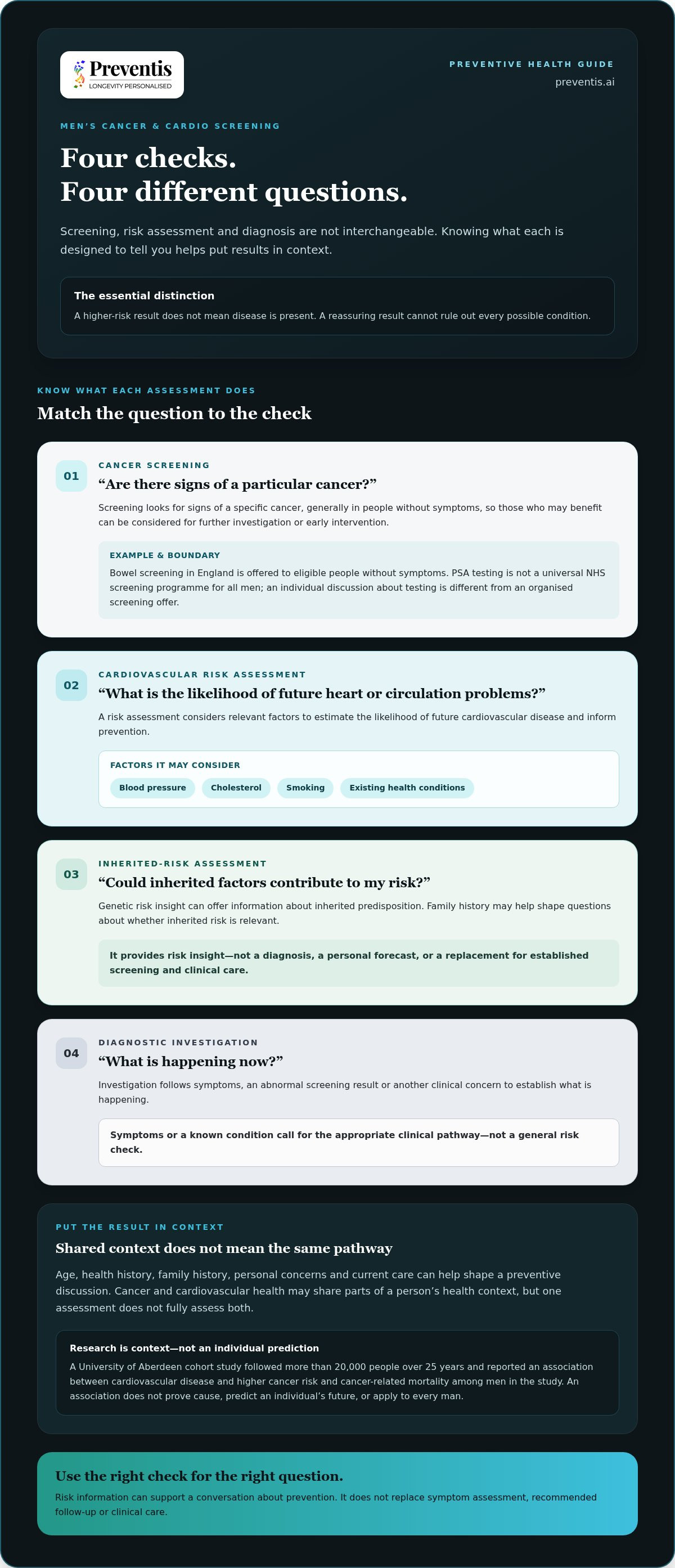
Wanting to understand your cancer and heart health before symptoms create uncertainty is a sensible reason to explore prevention. The first step is knowing what each check is designed to reveal. In UK health guidance, screening generally means offering a test to people without symptoms to identify those who may benefit from further investigation or early intervention. It differs from investigating a symptom or a confirmed diagnosis. The Cancer screening overview describes the broad aim: looking for signs of cancer before symptoms develop.
Risk assessment answers a different question. It estimates the likelihood of developing a condition using relevant information, which may include age, health factors and family history. A diagnostic investigation, by contrast, follows symptoms, an abnormal screening result or another clinical concern to establish what is happening. A result indicating higher risk does not mean disease is present, and a reassuring result cannot rule out every possible condition.
Risk information can guide a conversation about prevention, but it is not a diagnosis. No single assessment can identify every cancer or cardiovascular condition. Each method has a defined scope, and results need to be understood in that context.
How cancer screening differs from cardiovascular risk assessment
These assessments answer different questions. A cancer screening programme looks for signs of a particular cancer in an eligible group, while a cardiovascular risk assessment estimates the likelihood of future heart or circulatory disease. For example, bowel screening in England is offered through the NHS to eligible people without symptoms; the precise programme and eligibility arrangements can differ across the UK. PSA testing is not a universal NHS screening programme for all men, and an individual discussion about testing is distinct from an organised screening offer.
Cardiovascular checks may consider factors such as blood pressure, cholesterol, smoking and existing health conditions to estimate risk and inform prevention. Neither this type of assessment nor an inherited-risk assessment replaces established NHS screening, assessment of symptoms or follow-up recommended by a clinician.
Why men may look at both areas of health
Considering cancer predisposition and cardiovascular risk together can bring a broader health picture into a preventive discussion, but it does not make the conditions interchangeable. Family history, existing risk factors, personal concerns and current care provide useful context. A pattern of illness in relatives may prompt questions about inherited risk, while symptoms or a known condition call for the appropriate clinical pathway rather than a general risk check.
Research may report associations between cardiovascular disease and cancer outcomes, but an association does not prove that one condition causes the other. Population findings also cannot predict an individual’s future. Use them as context for informed questions, not as a personal forecast. For mens cancer and cardio screening, start by clarifying what you want to understand, then match that question to the appropriate assessment and follow-up.
How Cancer Risk and Cardiovascular Health Relate Without Being the Same
Cancer and cardiovascular disease can share parts of a person’s health context, such as age, lifestyle factors or family history. But they are not the same condition, and they don’t follow the same screening pathway. Cancer checks look for signs of particular cancers or help assess predisposition; cardiovascular assessments consider factors relevant to heart and circulatory health. Each has its own methods, interpretation and clinical follow-up.
A shared risk context does not make cancer and heart screening interchangeable. Considering both areas may help someone ask a more complete set of preventive health questions, but it doesn’t mean one test fully assesses both or that a finding in one area predicts a condition in the other.
What the research on men’s health suggests, and what it does not
A long-term cohort study reported by the University of Aberdeen followed more than 20,000 people over 25 years. Researchers reported an association between cardiovascular disease and higher cancer risk and cancer-related mortality among men in the study. Lung and colorectal cancers accounted for the highest risks described in its findings. This is a population-level observation, not evidence that cardiovascular disease caused cancer.
The findings don’t establish an individual reader’s risk, apply to every man or show that all cancer types share the same relationship with cardiovascular health. Study results depend on who was included and what was measured. Treat them as context for a discussion, not as a personal forecast or a reason to change a screening plan without clinical guidance.
Why prostate cancer care can include cardiovascular considerations
There is another point of connection: treatment context. Some prostate cancer treatments, including androgen-deprivation therapy, can affect metabolic health and may prompt clinicians to consider cardiovascular factors as part of a patient’s wider care. This is about monitoring and managing health alongside treatment, not evidence that cardiovascular checks screen for prostate cancer.
That distinction matters. Prostate cancer screening discussions concern whether testing for signs of cancer is appropriate; cardiovascular assessment considers heart and circulatory risk. In the UK, screening offers and follow-up should be considered through the relevant NHS and clinical pathways, which can differ across the four nations. A risk assessment alone does not determine treatment.
For a practical mens cancer and cardio screening conversation, keep the questions separate but connected: what cancer-related concern do you want to understand, what cardiovascular factors are relevant, and what follow-up would make sense for each? The Preventis Men’s Cancer Cardio panel brings cancer predisposition and cardiovascular risk together as preventive insight, not a diagnosis. You can explore combined preventive health insight as part of a personalised discussion.
Compare Screening, Risk Assessment and Follow-Up Before Choosing a Path
Before choosing a check, match its purpose to the question you want answered. An established screening programme, a cardiovascular risk check and a genomic risk assessment can each contribute useful insight, but they don’t look for the same thing or lead to the same next steps. The table offers a starting point for comparing them.
| Assessment | Purpose and what it may assess | Possible follow-up |
|---|---|---|
| Established cancer screening | Looks for signs of a specific cancer in people without symptoms. NHS bowel screening is one example; screening arrangements vary across the UK. | An abnormal result may lead to further clinical investigation. New symptoms need appropriate clinical assessment, not reliance on a screening test. |
| Cardiovascular risk check | Estimates risk of heart and circulatory disease using relevant factors, which may include blood pressure, cholesterol, smoking and health history. | A clinician may discuss risk reduction, monitoring or further assessment in light of the whole health picture. |
| Genomic risk assessment | Explores inherited predisposition to certain conditions. It doesn’t test for every cancer or cardiovascular condition, or establish whether disease is present. | Results can inform a conversation about personalised prevention and whether established screening or clinical advice is relevant. |
A screening result only becomes useful when its limits, personal context and appropriate follow-up are understood. A result is not a diagnosis or a guarantee about future health. In the UK, the relevant NHS screening programme and clinical pathway depend on the type of check and where you live, so use current national guidance when considering next steps.
What to compare when a screening option covers two health areas
Check whether cancer predisposition and cardiovascular risk are considered together or as distinct areas within an assessment. Then look for a clear explanation of the assessment’s purpose, limitations and how results can guide next steps. The Preventis Men’s Cancer Cardio panel considers cancer predisposition and cardiovascular risk together. It is preventive insight, not a replacement for established screening or clinical assessment.
Where family history and existing health information fit
Gather relevant family health history, existing diagnoses, medicines and previous test results before a discussion. Note which relatives were affected and, if known, the condition and age at diagnosis. This information can help frame questions, but it cannot account for every influence on risk. A lack of known family history does not, by itself, mean there is no inherited predisposition.
For mens cancer and cardio screening, use the comparison to identify what you want to understand and what follow-up a result could reasonably prompt. That makes the next conversation more focused, whether it concerns an NHS screening invitation, heart-health factors or inherited risk.
Prepare for a Men’s Cancer and Cardio Screening Discussion
A little preparation can make a preventive health conversation more focused. You don’t need to arrive with a screening plan already decided. Explain what you want to understand, share relevant health information and leave with clear next steps. A discussion can help clarify which pathway may be appropriate, but it can’t promise a particular result.
- Set your goal. Note whether you’re exploring inherited cancer predisposition, heart and circulatory risk, an NHS screening invitation or a concern raised by a clinician. If you’re considering both cancer and cardiovascular health, write down what you hope to learn about each.
- Gather relevant history. Record known family health patterns, including which relatives were affected and any details you know about their diagnosis. Add your own diagnoses, current medicines, previous test results and any ongoing monitoring. These details help put the conversation in context.
- Review your current care. Make a note of screening invitations, referrals or follow-up already in progress. Bring available results or letters if relevant. This can help avoid confusion or unnecessary duplication and give the clinician a clearer picture of what has already been considered.
- Prepare questions. Ask what each assessment measures, what it can’t determine and how its findings may be interpreted alongside your health history. Find out what follow-up might be appropriate if a result is unexpected, and who should discuss it with you.
Questions to take into a preventive health conversation
Useful questions are specific and open-ended: “What does this assessment cover?”, “How might the result fit with my existing diagnoses or test results?” and “If something unexpected appears, what would the next step be?” You might also ask whether the assessment is intended to inform risk planning or investigate a current concern. The Heart Health DNA Screening guide can help you prepare questions about genomic insight and cardiovascular risk.
How to keep screening decisions proportionate
Use current UK guidance and your personal circumstances, rather than assuming a screening schedule from another country applies to you. Screening offers and pathways can vary across the UK. If you have symptoms or an active clinical concern, raise that directly with a healthcare professional rather than treating a preventive risk assessment as an investigation. Avoid repeating tests or changing existing care without appropriate clinical discussion.
A men’s private health screening overview can provide further context for considering checks alongside routine care. For mens cancer and cardio screening, keep your goal, health information and follow-up questions together. If you’re exploring cancer predisposition and cardiovascular risk in one preventive perspective, explore the Preventis Men’s Cancer Cardio panel as a source of personalised health insight, not a diagnosis or substitute for clinical care.
Explore Preventis Men’s Cancer Cardio as a Preventive Health Option
For men seeking a broader view of preventive health, the PreventisLongevity Men’s Cancer Cardio panel considers cancer predisposition and cardiovascular risk together. It brings two important areas into one health perspective while recognising that they involve distinct conditions and questions. This can be useful if you want to consider both as part of a thoughtful discussion about personal health.
The panel provides risk insight, not a diagnosis. It doesn’t establish whether cancer or cardiovascular disease is present, replace NHS screening pathways or take the place of clinical care. Understanding that distinction helps set realistic expectations: an assessment can inform questions and planning, but it can’t promise disease prevention or a particular health outcome.
How the panel fits a proactive health perspective
Preventive health is most useful when insight connects to a practical next step. Considering cancer predisposition and cardiovascular risk together may help you organise questions, then discuss how these areas fit with your wider health picture. It doesn’t make the risks interchangeable or mean that one assessment covers every condition. If you’re exploring mens cancer and cardio screening, consider what you hope to understand in each area and how that information might support a conversation about prevention.
PreventisLongevity offers the Men’s Cancer Cardio panel as a specialised health screening for cancer predisposition and cardiovascular risk. It provides a way to consider these two areas together. Keep the focus on that purpose rather than assuming the panel uses particular genes, biomarkers or procedures.
What to understand before taking a next step
Before deciding whether this kind of insight fits your goals, think about the health question you want to explore and what information you already have. Relevant context may include family history, existing diagnoses, medicines, previous test results and any current clinical follow-up. Organising those details can help you discuss how risk insight relates to your circumstances, rather than interpreting it in isolation.
If you have symptoms, an existing condition or an unexpected finding, discuss it through appropriate clinical care. A preventive panel isn’t an emergency test, doesn’t investigate symptoms and shouldn’t be used to change care without clinical guidance. NHS screening and follow-up remain important parts of health care where relevant. The panel can complement a considered prevention conversation, not replace it.
A calm next step is to consider whether exploring both areas aligns with your health questions. Explore the PreventisLongevity Men’s Cancer Cardio panel for preventive insight into cancer predisposition and cardiovascular risk.
Make Your Next Health Conversation More Personal
Preventive health doesn’t need to begin with a sweeping plan. Start with one clear question: what would help you make a more informed decision about your future health? Use it to guide what you learn next, what information you gather and which topics you raise in a clinical conversation.
A thoughtful approach to mens cancer and cardio screening is less about collecting checks and more about making sense of relevant insight. Your circumstances can change, so let new information support an ongoing conversation rather than stand alone as a final answer. Keep space for professional guidance, especially if you have symptoms, existing health concerns or an unexpected finding.
To explore a preventive perspective across cancer predisposition and cardiovascular risk, view the Preventis Men’s Cancer Cardio panel. Use it as a starting point for informed questions and a discussion about your health.
Frequently Asked Questions
Can one screening check assess both cancer and heart disease?
A combined health perspective can consider both, but it doesn’t mean one check assesses every cancer and cardiovascular condition. The Preventis Men’s Cancer Cardio panel is a preventive health screening option for cancer predisposition and cardiovascular risk. If you’re comparing options, consider which health questions each addresses and whether separate clinical checks remain relevant to your circumstances.
Is cancer and cardiovascular screening suitable for men without symptoms?
It may be relevant to men without symptoms, but suitability depends on the purpose of the check and individual circumstances. Use current UK guidance for established screening programmes, and discuss personal concerns with an appropriate health professional. For example, an NHS screening invitation and a private risk assessment have different purposes. A result can’t confirm that disease is present or promise that it won’t develop.
What is the difference between screening and a genetic risk assessment?
Screening generally checks for signs of a condition in people without a confirmed diagnosis, while genetic risk assessment considers inherited information that may relate to future risk. The exact scope depends on the assessment. A screening result may prompt further investigation, whereas inherited-risk information may help frame prevention questions. Neither should be treated as a diagnosis or a substitute for investigations recommended for symptoms.
Does a family history mean I need cancer and heart screening?
No, family history alone doesn’t determine which checks are right for you. It can make a discussion more specific: note which relatives had a condition, whether they were on your mother’s or father’s side, and their age at diagnosis if known. Combine this with your own health information. No known family history doesn’t prove there’s no risk, and a relative’s diagnosis doesn’t predict your outcome.
Can a screening panel diagnose cancer or cardiovascular disease?
No. The Preventis Men’s Cancer Cardio panel is a preventive health screening option for cancer predisposition and cardiovascular risk, not a diagnostic test. Risk insight can help shape questions, but it doesn’t establish whether either disease is present. If you have symptoms or a finding that concerns you, seek appropriate clinical assessment rather than relying on a preventive panel to investigate it.
What should I do if a screening result raises concern?
Discuss the result with an appropriate health professional, who can consider it alongside your medical history and decide whether further assessment is relevant. Keep the result available, along with related test records and a list of medicines, so the conversation has useful context. Don’t change treatment or delay care based on a screening result alone. For acute or rapidly worsening symptoms, seek urgent medical care.


