

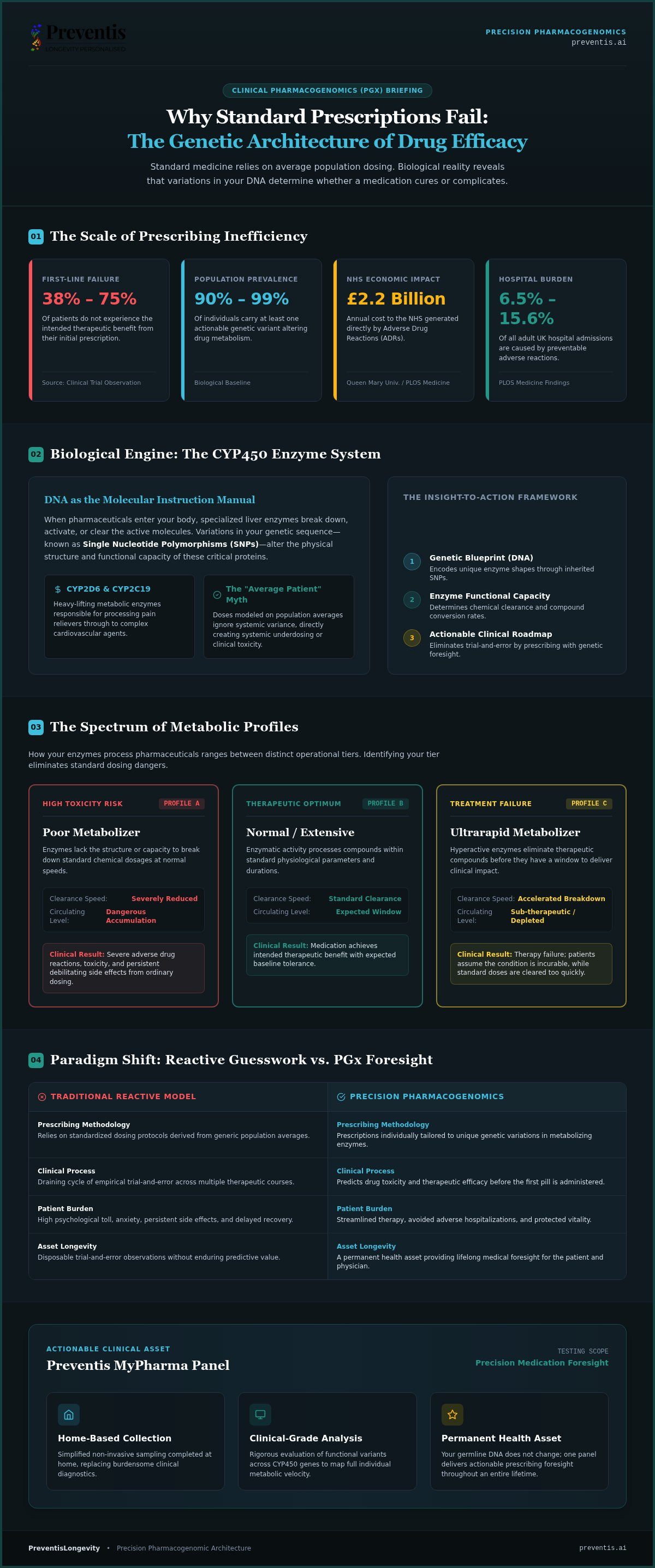
Between 38% and 75% of patients don't experience the intended therapeutic benefit from their first prescription. This staggering statistic highlights a systemic flaw in traditional, reactive medicine. You've likely felt the frustration of a medication that causes persistent side effects, or perhaps you've spent months in a draining cycle of trial and error. It's easy to feel like your body is failing the treatment, but the reality is that the treatment is failing your unique biology.
Understanding why medications don't work DNA provides the essential link between a standard dose and your specific genetic reality. Your blueprint dictates exactly how you metabolize pharmaceutical compounds, turning a routine prescription into either a cure or a complication. By leveraging the science of pharmacogenomics, you can replace clinical guesswork with data-driven precision. This article explores how your DNA influences drug efficacy and how the Preventis MyPharma Panel provides a permanent, actionable roadmap for your long-term vitality. It's time to move beyond the one-size-fits-all approach and secure a future of personalized health foresight.
Key Takeaways
- Move beyond the trial-and-error approach by understanding how your genetic blueprint dictates your unique response to standard prescriptions.
- Discover the biological reasons why medications don't work DNA and how specific genetic variations in your enzymes can lead to unexpected side effects or treatment failure.
- Learn to identify your personal metabolic profile—ranging from poor to ultrarapid—to predict drug toxicity and ensure therapeutic efficacy before taking the first dose.
- Understand how to interpret a pharmacogenomic report as a permanent health asset that provides a lifetime of medical foresight for you and your physician.
- Explore how the Preventis MyPharma Panel simplifies precision medicine with home-based collection and clinical-grade analysis for long-term health optimization.
The Trial and Error Dilemma: Why Standard Prescriptions Often Fail
Modern medicine has long relied on a "one-size-fits-all" approach to pharmaceutical care. When a physician prescribes a medication, they typically rely on standardized dosing protocols derived from broad population averages. However, this method ignores the profound biological diversity that exists at the molecular level. The emerging field of pharmacogenomics (PGx) reveals that our genetic makeup significantly influences how we absorb, distribute, and process drugs. Without this insight, prescribing becomes a reactive process of trial and error, often at the expense of the patient's well-being.
The statistics in the UK highlight the urgency of addressing this systemic issue. Research from Queen Mary University of London and PLOS Medicine indicates that adverse drug reactions (ADRs) cost the NHS up to £2.2 billion annually. These reactions account for between 6.5% and 15.6% of all adult hospital admissions. This is often why medications don't work DNA variations mean that a dose considered "safe" for the general population can be toxic or entirely ineffective for an individual. Transitioning to a model of genomic foresight allows us to predict these outcomes before the first pill is taken.
The Hidden Cost of Ineffective Medication
The cycle of failing multiple treatment courses carries a heavy psychological burden. Patients often feel a sense of defeat or anxiety when a prescribed therapy fails to alleviate symptoms or introduces debilitating side effects. This physical toll can compromise long-term vitality, as the body struggles to process chemical compounds it isn't genetically equipped to handle. Standard doses are calculated using data from the "average" patient. In a population where 90% to 99% of people carry at least one actionable genetic variant affecting drug metabolism, the concept of an "average" patient is a statistical myth that leads to unnecessary suffering.
Moving Toward Precision Medicine
Precision medicine represents a fundamental shift from reactive treatment to proactive health management. Rather than waiting for a medication to fail or cause harm, clinicians can use genetic data to tailor treatments to an individual’s unique biological profile from the start. This approach ensures that prescriptions are optimized for both safety and efficacy. Integrating pharmacogenomic testing UK wide is a critical step for anyone looking to refine their health roadmap and gain control over their biological future. By moving away from the traditional, reactive healthcare model, we can prioritize foresight and long-term vitality.
The Genetic Blueprint: How DNA Governs Your Response to Medication
Your DNA acts as a sophisticated instruction manual for every protein and enzyme your body produces. When you ingest a medication, your system relies on specific enzymes to break down the compound, activate it, or clear it from your bloodstream. Variations in your genetic code, known as Single Nucleotide Polymorphisms (SNPs), can subtly alter the physical shape and efficiency of these enzymes. This biological reality is often why medications don't work DNA differences can cause one person to process a drug perfectly while another experiences toxic buildup or no effect at all.
By analyzing these genetic variations, we can move through an insight-to-action framework. The clinical insight provided by a genetic test identifies which enzymes are functioning optimally and which are compromised. The resulting action is a personalized prescribing plan that eliminates the risk of adverse reactions. Understanding how DNA affects medication response allows you to transition from being a passive recipient of healthcare to an active manager of your biological future.
The CYP450 Enzyme System: Your Body's Chemical Processor
The Cytochrome P450 (CYP450) family of enzymes is responsible for metabolizing the vast majority of modern medications. Genes such as CYP2D6 and CYP2C19 are the heavy lifters in this system; they process everything from common painkillers to complex cardiovascular drugs. If your DNA contains a variation that makes these enzymes hyperactive, you might clear a drug before it ever has a chance to work. Conversely, sluggish enzymes can lead to a dangerous accumulation of the drug in your system. The first-pass effect is the process by which the liver metabolizes a drug so extensively that only a fraction of the active dose reaches the systemic circulation.
Beyond the Liver: Transporters and Receptors
Drug metabolism isn't just about the liver. Your DNA also codes for transporters, which act as cellular gatekeepers that move drugs in and out of cells. If these transporters are inefficient, a medication might never reach its intended target, such as the brain or heart. Furthermore, genetic variations can alter receptor sensitivity. If your receptors are less "sticky," even a standard dose of an antidepressant or painkiller might fail to trigger the necessary biological response. This is why some individuals appear resistant to standard therapies despite having normal liver function. To gain clarity on your own cellular gatekeepers, exploring a genomic health evaluation can provide the precise data needed for a more effective health roadmap.
Identifying Your Metabolic Profile: Extensive, Normal, or Poor?
Every individual possesses a unique metabolic signature that dictates the speed at which their body processes pharmaceuticals. This "DNA speed" is a primary reason why medications don't work DNA profiles that deviate from the expected baseline often lead to clinical complications. By utilizing CYP450 genotyping tests, clinicians can categorize patients into distinct phenotypes. This classification replaces the guesswork of traditional prescribing with a clear, data-driven roadmap for your long-term health.
The Four Levels of Drug Metabolism
Pharmacogenomic reports typically group individuals into four primary categories based on enzyme activity. Understanding which category you fall into is the first step toward optimizing your treatment plan.
- Poor Metabolizers (PM): These individuals have little to no enzyme activity. Because they cannot clear drugs efficiently, standard doses often lead to toxic accumulation and severe side effects.
- Intermediate Metabolizers (IM): This group has reduced enzyme capacity. They are at a moderate risk of drug buildup and often require personalized dose adjustments to maintain safety.
- Normal Metabolizers (NM): Historically referred to as "extensive metabolizers," these individuals have fully functioning enzymes. They typically respond to standard clinical doses as intended.
- Ultrarapid Metabolizers (UM): These patients process medications so quickly that the drug often clears the system before it can take effect. This frequently results in "treatment resistance" or total therapeutic failure.
Why Your 'DNA Speed' Matters for Dosage
The clinical danger of a "standard" dose becomes most apparent when distinguishing between active drugs and prodrugs. For an active drug, such as many common statins or antidepressants, a poor metabolizer risks toxicity because the body cannot break down the parent molecule. However, the logic reverses for prodrugs like codeine or the blood thinner clopidogrel. These medications are inactive when swallowed and require specific enzymes to "switch them on."
A poor metabolizer cannot activate these drugs, meaning they receive zero therapeutic benefit despite taking the correct dose. Conversely, an ultrarapid metabolizer might convert a prodrug into its active form too quickly, leading to an accidental overdose. Statistics show that between 38% and 75% of patients fail to benefit from first-line prescriptions for chronic conditions. Knowing your metabolic status prevents years of ineffective treatment and ensures your medication aligns with your biological reality.
Turning Data into Health Foresight: Navigating Your PGx Report
A pharmacogenomic report transforms complex laboratory data into a clear, actionable roadmap for your medical future. Unlike routine blood tests that capture a fleeting moment in time, your genetic profile is a lifelong asset. Your DNA remains constant; therefore, the insights gained today will remain relevant for every prescription you may need in the decades to come. This permanent record is the ultimate tool for genomic foresight, ensuring that you never have to guess about a treatment's safety or efficacy again.
Understanding why medications don't work DNA insights allows you to bypass the dangerous cycle of trial and error. By integrating these findings into a comprehensive preventive health panel, you create a holistic view of your longevity trajectory. This clinical-grade accuracy is essential for making informed decisions about your health before symptoms even arise. It's about moving away from reactive care toward a philosophy of optimization and precision.
Interpreting Red, Amber, and Green Signals
The Preventis MyPharma Panel utilizes a sophisticated "traffic light" system to categorize drug-gene interactions. This visual framework makes it easy for both you and your healthcare provider to identify potential risks at a glance. It simplifies the transition from technical lab results to practical application in your daily life.
- Red: This signal indicates a significant genetic interaction. It suggests a high risk of toxicity or treatment failure, prompting the need to consider an alternative medication entirely.
- Amber: An amber result denotes a moderate interaction. In these cases, a dosage adjustment or closer clinical monitoring is typically required to ensure the drug remains within the therapeutic window.
- Green: This represents a clear path. No significant genetic interactions were detected, meaning the medication should work as expected at standard doses according to your unique biology.
Collaborative Care: Discussing Results with Your Consultant
Sharing your pharmacogenomic profile with your GP or specialist changes the fundamental nature of your clinical consultations. You're no longer simply reporting symptoms and hoping for a solution; you're providing high-fidelity data that guides the prescribing process. This shift empowers you to act as a partner in your own care, facilitating more precise and confident decision-making. It turns a standard appointment into a strategic planning session for your long-term vitality.
Pharmacogenomics is a cornerstone of whole genome sequencing for prevention, offering a level of detail that traditional medicine cannot match. When you present your results, you offer your consultant a biological shortcut to the most effective treatment possible. To begin building your own data-driven health strategy, you can explore the Preventis MyPharma Panel and secure your biological future today.
Preventis MyPharma: Precision Medicine for Long-Term Vitality
The Preventis MyPharma Panel serves as the definitive bridge between advanced genomic research and your personal wellness journey. While we have explored the biological mechanisms that dictate drug response, this panel provides the practical application of that science. It addresses the fundamental question of why medications don't work DNA profiles that remain unmapped are simply missed opportunities for health optimization. By securing this data, you move from a state of medical uncertainty to one of clinical confidence, ensuring your treatment plans are as unique as your genetic code.
The process is designed for seamless integration into a proactive lifestyle. It begins with a straightforward, home-based collection kit that meets the highest clinical standards of laboratory-grade analysis. Once your sample is processed, the results are delivered as a clear, sophisticated roadmap. This is not a reactive diagnostic tool; it is a permanent asset for your long-term health trajectory. As a visionary partner in your longevity, Preventis ensures that sophisticated lab science becomes a personalized service that enhances your daily vitality.
The Preventis MyPharma Panel Advantage
Our analysis focuses on high-impact drug classes where precision is most critical. This includes cardiovascular health, mental health, and pain management therapies. In these areas, the difference between a standard dose and a genetically optimized dose can be life-changing. The panel provides a sophisticated genomic analysis designed for actionable health optimization, allowing you to bypass the risks of toxicity or therapeutic failure. By identifying your specific metabolic speeds, we create a seamless bridge between advanced lab science and your daily wellness routine, future-proofing your prescriptions for years to come.
Building Your Personalized Longevity Roadmap
Pharmacogenomics is an essential component of a broader philosophy we call 'Max Prevention.' This approach moves away from treating illness after it occurs toward a model of foresight and biological refinement. When you combine the insights from the MyPharma Panel with tools like Preventis MyHealthscore, you gain a 360-degree view of your current vitality and future risks. This integrated data allows you to make decisions based on evidence rather than averages, ensuring every intervention supports your long-term health goals.
Taking control of your biological future requires the right data at the right time. Whether you are currently managing a condition or looking to optimize your future health, understanding your genetic compatibility with medication is a vital step. We invite you to discover the Preventis MyPharma Panel today and begin building a health roadmap that prioritizes precision, safety, and enduring vitality.
Securing Your Biological Future with Precision
The transition from reactive medicine to proactive foresight begins with understanding your unique molecular blueprint. By mapping your genetic response to pharmaceuticals, you replace the uncertainty of traditional prescribing with clinical-grade accuracy. This data serves as a permanent reference, ensuring that every future medical intervention is tailored specifically to your metabolic profile. It's the difference between hope and evidence; between guesswork and a clear health roadmap for your long-term vitality.
Understanding why medications don't work DNA provides the clarity needed to avoid adverse reactions and treatment failure. As a cornerstone of the Preventis Max Prevention suite, our advanced pharmacogenomics panel offers the sophisticated analysis required for a lifetime of precision. You can optimize your medication response with the Preventis MyPharma Panel today. Embrace the power of your own data to build a future defined by clarity, safety, and enduring wellness.
Frequently Asked Questions
Why do some medications work for others but not for me?
Differences in your genetic makeup often dictate how your body processes pharmaceutical compounds. While standard doses are calculated for population averages, your specific enzymes may process a drug too quickly or too slowly. This biological variance is a central reason why medications don't work DNA profiles that deviate from the norm require personalized adjustments. Mapping these variations allows you to bypass the traditional trial and error approach to medicine.
Can a DNA test tell me which antidepressant will work best?
Yes, pharmacogenomic testing identifies how your body interacts with specific classes of antidepressants, such as SSRIs or SNRIs. By analyzing your enzyme activity, the test can predict which medications are most likely to reach therapeutic levels without causing severe side effects. This data helps your physician select the most effective treatment from the start. It significantly reduces the time spent on ineffective medication cycles and improves overall clinical outcomes.
Is pharmacogenomics testing the same as an ancestry DNA test?
No, pharmacogenomics is a clinical-grade analysis of specific genes that govern drug metabolism and response. While ancestry tests focus on lineage and geographical heritage, a pharmacogenomic panel provides actionable medical data. It's a tool designed for health optimization and safety, offering precise insights into how your body handles over 100 to 200 common medications. This is about your future vitality rather than exploring your family history or regional origins.
How long do the results of a pharmacogenomics test stay valid?
The results of a pharmacogenomic test are valid for your entire life because your core genetic blueprint remains constant. While new medications are developed, your metabolic profile for the enzymes that process them won't change. This makes the data a permanent health asset. You can share your report with consultants and specialists at any point in the future to inform safe and effective prescribing decisions across your entire healthcare journey.
Will my doctor accept the results of a private MyPharma panel?
Most physicians welcome the inclusion of clinical-grade genetic data in the prescribing process. The Preventis MyPharma Panel uses sophisticated Next-Generation Sequencing (NGS) to provide high-fidelity data that aligns with international clinical guidelines. Presenting this report allows your GP or specialist to move beyond reactive medicine. It provides them with a biological shortcut to the most appropriate dosage and medication for your unique profile, ensuring a higher standard of care.
What happens if I am an ultra-rapid metabolizer for a specific drug?
Being an ultra-rapid metabolizer means your body clears a medication much faster than the standard rate. In many cases, the drug never reaches a high enough concentration in your bloodstream to provide therapeutic benefit. This is a common reason why medications don't work DNA variations cause the treatment to fail before it begins. For certain prodrugs, however, ultra-rapid metabolism can lead to a dangerous, rapid buildup of active compounds in the system.
Does the Preventis MyPharma Panel cover all types of medications?
The Preventis MyPharma Panel analyzes interactions for over 100 to 200 common prescription medications across several key therapeutic areas. This includes cardiovascular drugs, antidepressants, painkillers, and statins. While it covers the majority of drugs with known genetic interactions, it doesn't cover every medication available. It focuses on those where genetic variation has the most significant impact on safety and therapeutic success, providing a focused roadmap for your health optimization.
How can pharmacogenomics improve my long-term health and longevity?
Pharmacogenomics is a cornerstone of a proactive longevity roadmap. By identifying potential drug toxicities before they occur, you protect your vital organs from the stress of adverse drug reactions. This foresight allows for the fine-tuning of preventive treatments, such as cardiovascular therapies, ensuring they contribute to your long-term vitality. It empowers you to manage your biological future with precision and a philosophy of optimization, which is central to the Preventis Max Prevention suite.


