

A standard blood panel reveals where your biomarkers stand today, but it tells you almost nothing about your biological trajectory decades from now. If you've spent years questioning an ambiguous family history of early heart disease or prostate cancer, you already recognise the flaws of a reactive healthcare model that waits for symptoms to surface before taking action. Clinical men's genetic health screening UK panels fundamentally alter this paradigm, replacing passive uncertainty with clear, actionable foresight.
You shouldn't have to rely on guesswork or lose valuable time travelling to specialist clinics to understand your hereditary profile. In this guide, you'll discover how advanced men's genetic health screening identifies hereditary cardiovascular and cancer risks long before any symptoms appear. We examine how medical-grade panels differ from surface-level ancestry kits, demonstrating how an accredited, at-home DNA assessment delivers a structured longevity roadmap tailored directly to your unique biology.
Key Takeaways
- Understand the critical difference between routine biomarker tests that measure current status and genomic sequencing that maps your lifelong disease predisposition.
- Identify the core hereditary cardiovascular conditions and male oncological risks, including prostate and colorectal susceptibilities, that can be managed through early intervention.
- Learn how comprehensive men's genetic health screening UK kits deliver accredited, medical-grade analysis to your home without the need for in-clinic appointments.
- Discover the criteria for distinguishing recreational ancestry kits from clinically actionable genomic panels that target validated risk genes.
- See how targeted profiles like the Preventis Men's Cancer Cardio panel provide a structured, data-driven longevity roadmap to optimize your future health.
What Is Men's Genetic Health Screening in the UK?
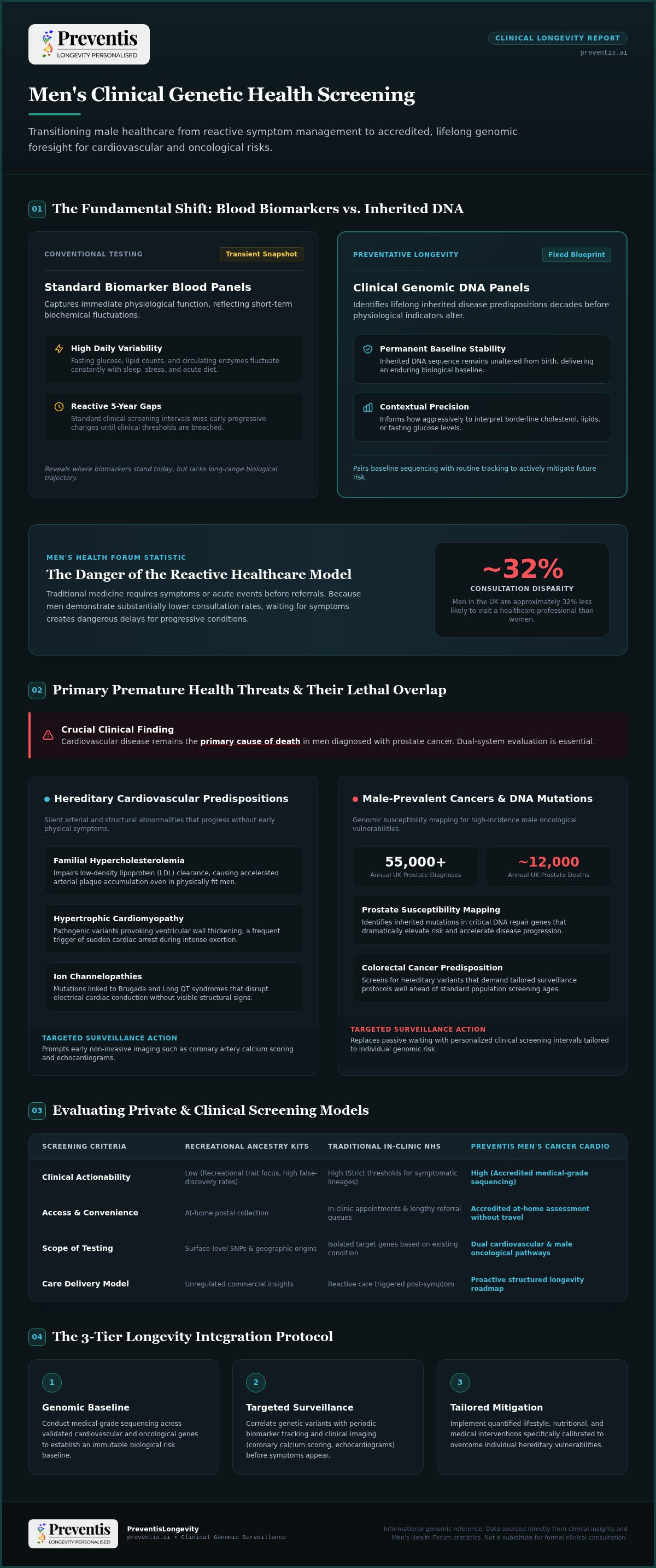
Most commercial health checks rely entirely on conventional blood testing to quantify your health. While standard biomarkers provide a helpful view of current metabolic function, clinical genetic testing operates on a fundamentally different timescale. Men's genetic health screening analyzes DNA for inherited variants linked to serious disease, mapping baseline predispositions rather than temporary biochemical reactions.
Predictive DNA sequencing identifies latent vulnerabilities years before biochemical indicators change. Standard clinical care often evaluates risk after symptoms emerge or relies on five-year screening intervals that miss early genetic predispositions. In contrast, comprehensive men's genetic health screening UK services evaluate high-impact variants across cardiovascular, oncological, and metabolic pathways, adhering to stringent laboratory quality standards that ensure diagnostic-level accuracy.
Transient Biomarkers vs. Inherited Genomic Profiles
Standard biomarkers capture your body's immediate physiological state:
- Daily variability: Blood glucose, lipid counts, and circulating enzymes fluctuate constantly based on recent sleep, acute stress, and dietary intake.
- Lifelong stability: Your inherited DNA sequence remains fixed from birth, providing a durable biological baseline that never alters.
- Contextual precision: Knowing your genetic predisposition clarifies how aggressively you should interpret borderline cholesterol or fasting glucose numbers.
Pairing static genetic blueprints with periodic blood tracking creates a unified surveillance strategy. It shifts preventative health from reactive management to active mitigation.
The Shift Toward Proactive Male Longevity
Traditional diagnostic paradigms depend on clinical intervention thresholds. Clinicians generally order invasive scans or specialist consultations only after an acute event occurs or symptoms cause persistent discomfort. Data from the Men's Health Forum indicates that men are roughly 32% less likely to visit a healthcare professional than women, making reactive models particularly dangerous for male longevity.
Modern longevity medicine inverts this outdated dynamic. By categorizing hereditary vulnerability through actionable genomic panels, men can bypass lengthy clinical referral queues and implement tailored surveillance schedules. This targeted strategy replaces passive health anxiety with quantifiable protocols, optimizing diet, exercise, and clinical screenings to match an individual's unique biological trajectory.
Core Health Risks Evaluated in Comprehensive Male DNA Panels
Cardiovascular disease and male-prevalent cancers account for the majority of premature deaths among men in the UK. Crucially, these two threats frequently intersect: cardiovascular disease remains the primary cause of death in men diagnosed with prostate cancer. While the NHS Genomic Medicine Service provides testing when severe symptoms or documented family lineages meet strict thresholds, clinical men's genetic health screening UK panels allow proactive individuals to evaluate both physiological systems simultaneously.
Hereditary Cardiovascular and Cardiometabolic Predispositions
Coronary artery disease often progresses silently for decades. Inherited variations in genes associated with familial hypercholesterolemia severely impair low-density lipoprotein clearance, causing early arterial plaque accumulation even in physically fit men. Comprehensive testing also examines dangerous structural abnormalities:
- Hypertrophic cardiomyopathy: Pathogenic variants that cause sudden ventricular wall thickening, a frequent trigger of cardiac arrest during intense exertion.
- Ion channelopathies: Genetic mutations linked to conditions like Brugada or Long QT syndromes that disrupt electrical signalling without structural warning signs.
For individuals wanting to explore these mechanisms further, dedicated heart health DNA screening provides targeted insight, prompting timely non-invasive imaging like coronary calcium scoring or echocardiograms long before an acute event occurs.
Male-Prevalent Cancers and DNA Repair Mutations
Over 55,000 men receive a prostate cancer diagnosis annually across the UK, resulting in approximately 12,000 deaths each year. Research demonstrates that roughly 58% of prostate cancer risk is inherited. Pathogenic variations in DNA repair genes, specifically BRCA1 and BRCA2, dramatically accelerate both the onset and aggressiveness of male prostate malignancies. Black men face double the baseline risk of developing prostate cancer compared to other demographics, making early genomic stratification indispensable.
Beyond prostate health, evaluating DNA mismatch repair genes associated with Lynch syndrome identifies elevated susceptibilities to colorectal, gastric, and pancreatic cancers. Establishing this genetic baseline empowers men to coordinate advanced surveillance with private clinicians, initiating early colonoscopies and targeted screening protocols years ahead of population guidelines.
Pharmacogenomics: Optimizing Treatment Response
Your liver's cytochrome P450 enzyme pathways determine the rate at which you activate or clear standard medications. For example, specific SLCO1B1 gene variants substantially increase your probability of developing statin-induced myopathy, leading to debilitating muscle aches and premature treatment abandonment.
Consult our guide to pharmacogenomic testing UK to explore how individual metabolic variations influence prescription efficacy. Mapping these profiles beforehand eliminates the trial-and-error cycle of cardiovascular and oncological therapies, allowing you to discover tailored clinical pathways with confidence through PreventisLongevity.
Comparing Private Screening Options: At-Home Panels vs. Traditional In-Clinic Checks
Selecting the right health assessment model often comes down to what you are trying to measure: current functional status or permanent biological risk. Traditional private checkups rely heavily on physical appointments, whereas advanced men's genetic health screening UK services deliver medical-grade DNA analysis directly to your door. Understanding the functional differences between these models ensures you invest your time and focus where they yield the greatest preventative return.
| Feature | Traditional In-Clinic Health MOT | At-Home Medical-Grade Genomic Panel |
|---|---|---|
| Diagnostic Focus | Current organ function and vital signs | Lifelong inherited disease predisposition |
| Time Required | Half-day clinical visit plus travel | 10-minute at-home saliva or buccal sample |
| Test Frequency | Annual or bi-annual repetition required | Single lifetime test per panel |
| Foresight Window | Real-time snapshot (days to weeks) | Predictive outlook spanning decades |
Traditional Private In-Clinic Health Assessments
Brick-and-mortar health assessments provide hands-on clinical interaction. They excel at immediate physical auscultation, resting electrocardiograms, abdominal ultrasounds, and broad blood counts. If you are experiencing active symptoms like chest tightness, unexplained weight changes, or digestive issues, an in-person assessment is essential.
Their chief limitation lies in their transient nature. A clean bill of health during an annual physical indicates normal physiological markers at that exact moment. It cannot confirm whether early atherogenic processes or oncological mutations remain quietly encoded in your genes.
At-Home Genetic Health Panels
At-home medical genomic panels eliminate the logistical friction of clinic appointments. You collect a high-integrity saliva or swab sample in privacy, return it by post, and receive a comprehensive sequencing analysis processed by an accredited laboratory. For busy executives, saving half a day of travel while accessing sophisticated genetic analysis represents a practical efficiency gain.
The resulting intelligence never expires. Because your genetic sequence remains unchanged, an at-home men's genetic health screening UK panel serves as a permanent reference architecture. It clarifies exactly which downstream clinical screenings, dietary strategies, and lifestyle adjustments deserve your attention, giving you total agency over your biological future.
How to Evaluate and Choose a Men's Health Screening Kit
The consumer genomics sector spans everything from recreational ancestry swabs to clinical-grade sequencing assays. When evaluating options for men's genetic health screening UK providers offer, discerning clinical validity from superficial novelty is essential. Choosing the right panel requires examining gene selection criteria, laboratory standards, and how data translates into preventative medical strategy.
Clinical Actionability and Gene Selection
Recreational tests often dilute their reports with benign phenotypic quirks like caffeine metabolism rates, sleep chronotypes, or sensory traits. While mildly interesting, these markers provide zero utility for disease prevention. Meaningful genomic screening concentrates strictly on clinically actionable genes vetted by medical consensus.
Clinical actionability means a detected variant directly informs medical management. Identifying a pathogenic mutation in a cardiac ion channel or tumour suppressor gene allows physicians to implement targeted surveillance, schedule advanced imaging, or alter pharmacological plans. Review our guide on selecting a comprehensive preventive health panel to understand how curated gene lists protect your long-term health rather than cluttering your inbox with trivial trivia.
Turnaround Time, Data Privacy, and Reporting Quality
The laboratory processing your sample dictates the reliability of your findings. High-depth next-generation sequencing requires strict quality control protocols to prevent false positives and missed mutations. Before ordering, verify that the testing service meets rigorous diagnostic standards and handles biological material in accordance with the UK Human Tissue Act.
Data governance is equally vital. Your genetic sequence represents your most fundamental personal identifier. High-quality diagnostic services ensure your genomic data remains confidential, protected under UK GDPR regulations, and never shared or sold to third-party commercial databases.
A raw list of genetic variants is virtually unreadable without specialist interpretation. Premium services provide structured insight-to-action reporting frameworks. These documents synthesize intricate variant classifications into clear, concise summaries that both you and your private physician can immediately review to build an informed longevity roadmap.
Ready to establish your personal health baseline? Take decisive ownership of your biological future and order your targeted genomic panel today.
Preventis Men's Cancer Cardio: Targeted Foresight for UK Men
Most health assessments treat cardiology and oncology as isolated silos, forcing men to coordinate separate investigations across disconnected specialties. The Preventis Men's Cancer Cardio panel resolves this fragmentation by targeting the specific genetic vulnerabilities that account for the vast majority of preventable male mortality. Delivering advanced next-generation sequencing directly to your home, it establishes a new benchmark for proactive men's genetic health screening UK wide.
Integrated Protection: Heart and Oncology Synergy
Premature cardiovascular incidents and aggressive cancers frequently share common pathways of biological stress and cellular repair disruption. By combining dual-system genomic mapping into a unified assessment, the panel evaluates high-penetrance risk factors simultaneously:
- Cardiovascular surveillance: Pinpoints pathogenic markers linked to inherited cardiomyopathies, arrhythmogenic disorders, and early-onset arterial calcification pathways.
- Male oncological markers: Screens for critical mutations that heighten predisposition to prostate malignancies, colorectal tumors, and hereditary pancreatic lesions.
- Physician enablement: Translates complex variant data into a structured report that gives your private clinician exact targets for focused surveillance, such as early-stage multiparametric MRI scans or preventive echocardiography.
This coordinated evaluation provides balanced oversight across both critical systems, replacing disjointed testing with a clear, singular health trajectory.
Seamless At-Home Collection and Precision Analysis
Accessing medical-grade genetic intelligence should not demand hours away from your professional commitments. The screening process uses a non-invasive buccal swab kit shipped directly across the United Kingdom. You collect the sample in minutes without phlebotomy fees or clinic appointments, using prepaid, secure packaging to return the specimen directly to accredited laboratories.
Once sequencing is complete, your findings arrive through a secure digital portal. Rather than delivering confusing bioinformatics sheets, the report follows a structured insight-to-action framework that outlines precise surveillance recommendations with clinical clarity. Explore the Preventis Men's Cancer Cardio panel to access targeted foresight tailored to your biology.
For individuals seeking absolute diagnostic thoroughness across their entire genetic blueprint, medical-grade Preventis Whole Genome sequencing offers comprehensive mapping across all actionable coding and non-coding regions, establishing the ultimate lifetime foundation for precision longevity.
Take Command of Your Health Trajectory
Waiting for clinical symptoms before investigating your health is a gamble you don't need to take. By distinguishing transient biometric shifts from fixed hereditary risks, modern genomics gives you the power to intervene decades in advance. High-depth panels transform ambiguous family histories into an exact, actionable strategy for cardiovascular resilience and male cancer protection.
Securing this foresight no longer demands disruptive hospital appointments or stressful waiting rooms. Medical-grade at-home testing delivers precision next-generation sequencing nationwide across the United Kingdom, focusing squarely on actionable cardiovascular and male cancer genes. When you pair your unique genetic blueprint with proactive clinical care, you shift from passive surveillance to deliberate biological leadership.
Your future vitality rests on the decisions you make today. Explore the Preventis Men's Cancer Cardio Panel to access advanced men's genetic health screening UK wide, and establish the definitive roadmap for your long-term longevity.
Frequently Asked Questions
What is the difference between private men's health screening and an NHS Health Check?
An NHS Health Check evaluates routine cardiovascular biomarkers like blood pressure, cholesterol, and BMI for individuals aged 40 to 74 every five years. In contrast, comprehensive men's genetic health screening UK services evaluate inherited DNA sequence variants. Instead of tracking fluctuating metabolic indicators, private genomic panels identify lifelong predispositions to conditions like familial hypercholesterolemia and hereditary cancers decades before symptoms develop.
Can men's genetic health screening diagnose active cancer or heart disease?
No, genetic panels do not diagnose acute, active disease or detect present tumours. Instead, genomic testing calculates your baseline biological vulnerability by identifying pathogenic mutations that increase your statistical probability of developing specific conditions. If your screening indicates an elevated inherited risk, private healthcare practitioners use that intelligence to initiate targeted diagnostic assessments, such as cardiac imaging or colonoscopies.
How much does a private men's genetic health screening kit cost in the UK?
Costs across the private UK diagnostic landscape vary considerably based on the technical scope of the test. Targeted panels focusing on specific hereditary conditions typically represent accessible investments, whereas comprehensive multigene evaluations and full genome sequencing reflect premium clinical profiling. Prospective patients should evaluate whether testing includes pre-test clinical context, accredited laboratory sequencing, and structured insight-to-action reporting frameworks.
Is genetic testing for men only necessary if there is a known family history?
Family history is an incomplete guide because many serious genetic mutations skip generations or remain unrecorded due to small family sizes, adoption, or early deaths from unrelated causes. Many individuals carrying clinically actionable cardiovascular or cancer variants have no documented familial pattern. High-depth genomic screening establishes an objective, definitive baseline independent of anecdotal lineage records.
What happens if a genetic health panel reveals an elevated disease risk?
Identifying an elevated risk provides actionable foresight rather than a medical diagnosis. Clinically structured reports categorize the finding and outline specific surveillance recommendations. You can present these data points directly to your GP or private consultant to establish customized surveillance schedules, such as earlier prostate monitoring, preventative medication adjustments, or non-invasive coronary imaging.
How accurate are at-home genetic screening kits compared to hospital tests?
Medical-grade home kits offer identical analytical precision to hospital testing when processed by accredited laboratories using advanced next-generation sequencing. A simple cheek swab or saliva collection captures genomic DNA with the exact same sequence fidelity as a hospital venous blood draw. The critical requirement is ensuring the service utilizes certified clinical laboratory pipelines rather than recreational profiling methods.
Can insurance providers in the UK access my private genetic screening results?
Under the Code on Genetic Testing and Insurance agreed between the UK Government and the Association of British Insurers, private insurers cannot require you to disclose predictive genetic test results for most standard policies. Your private men's genetic health screening UK data remains confidential personal medical information. Results are delivered securely to you, leaving full discretion over whether to share them with physicians.


