

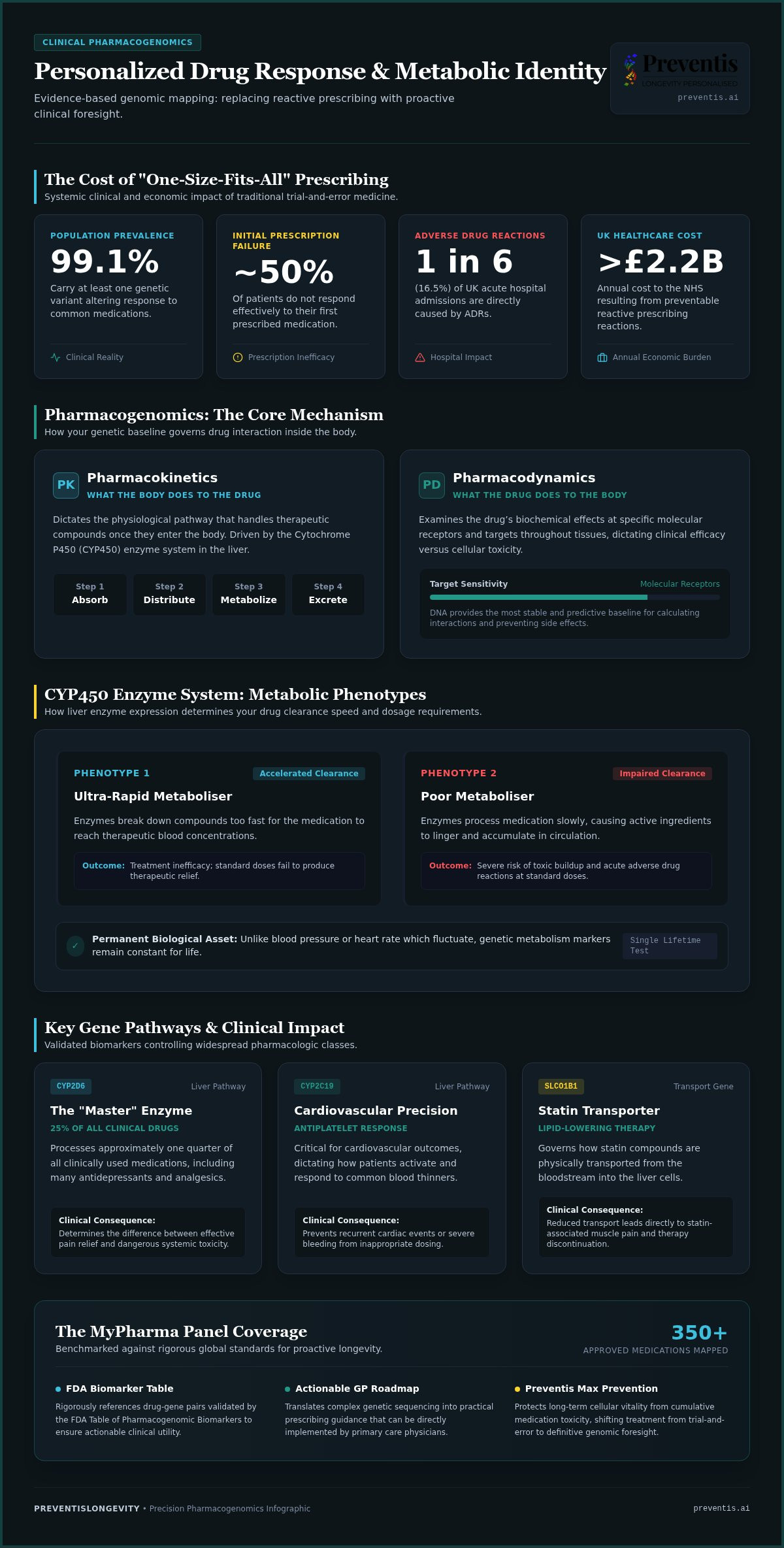
Recent clinical data reveals that 99.1% of individuals carry at least one genetic variant that fundamentally alters their response to common medications. This biological reality means that for most people, a personalized drug response test isn't just an elective luxury; it's a vital tool for avoiding the adverse reactions that account for one in six hospital admissions across the UK. It's exhausting to treat your health like a trial-and-error experiment when your DNA already holds the answers. You deserve a healthcare strategy that prioritizes foresight over reaction.
Selecting the right pharmacogenomic panel allows you to eliminate prescribing guesswork and build a foundational genomic asset for your long-term health roadmap. In this guide, we'll provide a definitive 2026 checklist for identifying a test that offers true clinical rigor. You'll discover how to evaluate enzyme pathway coverage, ensure copy number variation detection, and secure actionable insights you can share with your GP to optimize your vitality for years to come.
Key Takeaways
- Move from reactive medicine to a strategy of foresight by understanding how your DNA dictates medication efficacy and safety.
- Use our 2026 checklist to select a high-quality personalized drug response test that covers essential enzyme pathways and carries recognized clinical accreditation.
- Learn to bridge the gap between the lab and the clinic by presenting your MyPharma results as a clear, actionable roadmap for your GP.
- Discover how pharmacogenomics serves as a cornerstone of the Preventis Max Prevention strategy, shielding your vitality from cumulative drug toxicity.
- Secure a lifelong biological asset that replaces the frustration of trial-and-error prescribing with the calm assurance of precision data.
The Evolution of Prescribing: Why Personalized Drug Response Matters
The traditional medical model has long relied on a "one size fits all" approach to prescribing. It's a method that often leads to unnecessary frustration. Clinical data suggests that roughly 50% of patients don't respond effectively to their first prescription. This inefficiency isn't just a clinical hurdle; it's a systemic crisis that forces patients into an exhausting cycle of trial and error. A personalized drug response test changes this dynamic by using your unique genetic code to predict how you'll process specific compounds before they ever enter your bloodstream.
In the UK, the physical and economic consequences of reactive prescribing are stark. Adverse Drug Reactions (ADRs) account for approximately 16.5%, or one in six, of acute hospital admissions. This costs the NHS upwards of £2.2 billion annually. These aren't just abstract statistics; they represent preventable suffering and wasted time. By adopting genomic foresight, we can replace reactive treatments with a model of clinical precision that prioritizes your safety and recovery from day one.
Understanding the Genetic Factor in Medication
Your liver is the primary engine for drug metabolism, powered by a complex network of proteins called the Cytochrome P450 (CYP450) enzyme system. Genetic variations in these enzymes dictate your metabolic phenotype. Some individuals are ultra-rapid metabolisers, who clear medication too quickly for it to reach therapeutic levels. Others are poor metabolisers, who risk toxic buildup even at standard doses. This genetic diversity is a primary reason why medications don't work DNA results vary so significantly between patients. Understanding your specific status allows for a dosage strategy tailored to your internal chemistry.
The Shift Toward Precision Medicine in 2026
By 2026, the medical community has moved beyond viewing pharmacogenomics as a niche research field. It's now an essential pillar of proactive longevity. A personalized drug response test serves as a permanent biological asset. Unlike your blood pressure or heart rate, which fluctuate based on lifestyle, your genetic metabolism markers remain constant throughout your life. Completing this screening once provides a foundational roadmap that future-proofs your healthcare. It ensures that every future prescription, from cardiology to mental health, is optimized for your specific biology. This meticulous approach is central to the Preventis Max Prevention strategy, positioning you as an active participant in your biological future.
The Science of Pharmacogenomics: Mapping Your Metabolic Identity
A personalized drug response test operates at the intersection of pharmacology and genetics, providing a microscopic view of how your body interacts with chemical compounds. To understand this, we must distinguish between pharmacokinetics and pharmacodynamics. Pharmacokinetics refers to what your body does to the drug, specifically how you absorb, distribute, metabolize, and excrete it. Pharmacodynamics focuses on what the drug does to your body, examining its effects at the molecular target. While many factors influence these processes, your DNA provides the most stable and predictive baseline for these interactions. For those seeking the most robust foundation, integrating these insights with Whole Genome sequencing ensures no genetic nuance is overlooked.
The MyPharma Panel focuses on specific drug-gene pairs that have been rigorously validated by global health authorities. By referencing the FDA Table of Pharmacogenomic Biomarkers, we can map your unique genetic markers to over 350 approved medications. This technical precision allows us to move away from guesswork and toward a future where every dose is optimized for your metabolic identity.
Key Gene Groups and Their Impact
The liver's enzyme pathways are the primary focus of this mapping. The CYP2D6 enzyme is often called the "master" enzyme because it's responsible for processing roughly 25% of all clinically used drugs, including many antidepressants and analgesics. Variations here can mean the difference between effective pain relief and dangerous toxicity. Similarly, the CYP2C19 enzyme is critical for cardiovascular health, as it dictates how patients respond to common blood thinners. Beyond the liver, the SLCO1B1 gene governs how statins are transported to the liver. If your genetic profile indicates reduced transport, you may experience the muscle pain often associated with statin use. Understanding these pathways is a vital step as you explore our genomic suites for long-term health.
From Genetic Code to Clinical Category
Once your DNA is sequenced, your results are translated into one of four metabolic phenotypes. Poor metabolisers lack the functional enzymes to break down certain drugs, leading to buildup and side effects. Intermediate metabolisers have reduced activity, while Normal metabolisers process drugs at the expected rate. Ultra-rapid metabolisers clear medications so quickly that standard doses often fail to work. These categories are then distilled into a simplified "Green, Yellow, Red" action list. Green indicates standard use, Yellow suggests caution or dosage adjustment, and Red warns of a high risk of failure or toxicity. For a deeper dive into these classifications, consult our guide on pharmacogenomic testing UK protocols to see how this data transforms into a clinical roadmap.
The Essential Checklist: Selecting a Personalized Drug Response Test
Selecting a personalized drug response test requires a meticulous approach to ensure the data you receive is both clinically valid and practically useful. By 2026, the market is flooded with options, but not all are created equal. To secure a foundational asset for your health, you must look beyond the marketing and evaluate the technical rigour of the service. Use this four-point checklist to verify the quality of your provider.
- Check 1: Breadth of the Panel. A comprehensive test must cover more than just one or two genes. Ensure the panel includes interactions for cardiology, oncology, and mental health. If a test lacks these "Big Three" areas, it won't provide the foresight needed for a lifelong medical roadmap.
- Check 2: Clinical Validity. This is non-negotiable. The laboratory performing the analysis must hold recognized accreditation, such as UKAS or ISO 15189. This certification ensures the results are accurate enough for a GP to act upon with confidence.
- Check 3: Actionability. Data without direction is useless. Your report should provide specific prescribing guidelines rather than just a list of genetic variants. It must translate complex diplotypes into clear, actionable dosage recommendations.
- Check 4: Data Longevity. Your genetic code doesn't change, but medical science does. Opt for a provider that allows for re-analysis of your data as new medications are released or clinical guidelines evolve.
Clinical Rigour vs. Recreational DNA Tests
Lifestyle DNA tests often focus on ancestry or fitness traits, which are insufficient for medical prescribing. Clinical-grade tests adhere to strict pharmacogenetic testing guidelines set by organizations like the Clinical Pharmacogenetics Implementation Consortium (CPIC). These frameworks ensure every recommendation is backed by high-level, peer-reviewed evidence. When choosing a test, look for services like the Preventis MyPharma Panel that offer clinical support to help you and your doctor interpret the findings effectively.
Data Privacy and Genomic Security
Your genomic data is your most private asset. It's vital to verify that your provider uses high-level encryption for both storage and transmission. You should also understand the difference between 'de-identified' data and shared data. De-identified data has personal markers removed, but you must confirm if this information is shared with pharmaceutical companies or third-party researchers. A transparent privacy policy is a sign of a trustworthy partner. At Preventis, we treat your genetic information as a premium, personalized service, prioritizing your security as much as your clinical outcomes.
Interpreting Your Roadmap: From Lab Report to Clinical Action
Receiving the results of your personalized drug response test marks the transition from curiosity to clinical agency. The real value of this data emerges when it's integrated into your active medical strategy. Presenting your MyPharma report to your GP or specialist creates a collaborative environment built on objective biological facts. Instead of reacting to side effects after they occur, your medical team can use your genomic profile to select the most effective treatment from the start. This proactive approach transforms your healthcare from a series of experiments into a guided journey toward optimization.
From a clinical perspective, pharmacists and specialists act as the essential translators of your genetic code. They look beyond the raw data to determine how specific diplotypes influence your required dosage. For instance, if your report identifies you as an intermediate metabolizer for a specific enzyme pathway, your doctor might suggest a lower starting dose to avoid the risk of accumulation. This level of precision is why a DNA test for medication effectiveness has become a cornerstone of sophisticated long-term care protocols. It provides a permanent reference point that informs both your current prescriptions and any medical needs that may arise in the future.
Navigating the 'Red List' of Medications
If your test flags a high-risk interaction on the 'Red List,' it's a clear signal for a clinical review. These flags indicate medications that your body likely cannot process safely or effectively. When this happens, your clinical team will use the report's actionable guidelines to identify alternative therapies that bypass the problematic metabolic pathway. It's vital that you don't stop taking any prescribed medication without a professional consultation. Your doctor will manage any necessary transitions, ensuring your treatment remains stable while moving toward a safer, more compatible option. You can start building your precision roadmap today to ensure your prescriptions align with your biology.
Integrating Results into Your Electronic Health Record
Having your genomic drug response on file within your electronic health record is a significant asset for emergency care. In situations where every second counts, having immediate access to your metabolic identity can prevent life-threatening adverse reactions. This data also streamlines specialist referrals, whether you're consulting with a cardiologist or a psychiatrist. It removes the need for repetitive testing and ensures that every specialist you visit operates from the same foundational genomic truth. By keeping this data accessible, you ensure that your medical team always has the foresight needed to protect your long-term vitality.
Optimising Longevity with the Preventis MyPharma Panel
Longevity is often discussed in terms of biological age or metabolic health, but the tactical role of drug safety is frequently overlooked. A personalized drug response test is a fundamental component of the Preventis Max Prevention strategy because it protects your most vital filtration systems. Over a lifetime, the cumulative toxic load from ineffective or poorly metabolized medications can significantly impair liver and kidney function. By ensuring every pharmaceutical intervention aligns with your genetic blueprint, you preserve your organ reserve and maintain higher vitality as you age.
This precision isn't just about avoiding adverse reactions; it's about total biological foresight. When you combine the insights from the Preventis MyPharma Panel with the Preventis Whole Genome, you create a comprehensive health roadmap. This integration allows for a sophisticated understanding of how your hereditary risks and metabolic pathways intersect. It provides a level of clarity that traditional reactive medicine simply cannot match, offering the psychological peace of mind that comes from knowing you've eliminated the guesswork from your future care.
The Preventis Advantage: Clinical Authority Meets Wellness
PreventisLongevity bridges the gap between high-register clinical rigor and the convenience of modern wellness. Our process features sophisticated, home-based collection kits that allow you to secure clinical-grade data without visiting a lab. These results don't exist in a vacuum. The MyPharma Panel is designed to integrate seamlessly with our specialized suites, such as the Preventis Men's Cancer Cardio or Women's Cancer Cardio panels. This holistic approach ensures that your cardiovascular and oncology prescriptions are as personalized as your preventive screenings, positioning you at the forefront of the proactive health revolution.
Your Next Steps Toward Precision Health
Taking control of your pharmaceutical future is a straightforward, professional process. When you order the Preventis MyPharma Panel, you receive a comprehensive package that includes a non-invasive collection kit and detailed instructions for return. Your results arrive in a clear, actionable format, categorized for immediate clinical use by your healthcare provider. This isn't just a lab report; it's a lifelong manual for your biological health.
Don't leave your long-term wellness to chance. Empower your future health with Preventis MyPharma and secure the data-driven foundation your body deserves.
Securing Your Biological Future with Precision Data
The journey toward clinical precision begins with a fundamental shift in perspective. By moving away from the reactive nature of traditional prescribing, you embrace a philosophy of foresight that protects your biological reserve. A high-quality personalized drug response test isn't just a one-time diagnostic; it's a permanent roadmap for your metabolic health. You've learned how to identify clinical rigor, interpret actionable reporting, and integrate these insights into a broader longevity strategy that prioritizes your long-term safety.
PreventisLongevity provides the visionary clinical oversight needed to navigate this complex landscape. With our comprehensive UK-wide genomic logistics and options for advanced 17-gene BRCA/Lynch integration, we ensure your health data is both actionable and secure. Transitioning from trial-and-error medicine to data-driven optimization allows you to preserve your vitality and approach every future prescription with calm assurance. Secure your personalized drug response profile with the Preventis MyPharma Panel and take command of your medical trajectory. Your DNA holds the blueprint for a more resilient, optimized future.
Frequently Asked Questions
What is a personalized drug response test exactly?
A personalized drug response test is a clinical screening that examines specific genetic markers to predict your reaction to over 100 common medications. It analyzes the Cytochrome P450 enzyme system in your liver to determine if you are a poor, normal, or ultra-rapid metabolizer. This data allows your healthcare provider to select the most effective treatment and dosage from the start, effectively eliminating the risks associated with traditional trial-and-error prescribing.
How long does it take to get results from a pharmacogenomic test?
The timeline for receiving your results typically spans three to four weeks from the moment our laboratory receives your saliva sample. This period allows for meticulous clinical-grade analysis and peer-reviewed interpretation of your genomic data. Once the analysis is complete, your comprehensive MyPharma report is delivered through a secure digital portal, providing you with a clear and actionable roadmap that you can immediately share with your general practitioner or specialist.
Can a DNA test tell me which antidepressant will work best for me?
Pharmacogenomic testing provides critical insights into antidepressant efficacy by analyzing genes like CYP2D6 and CYP2C19. These enzymes are responsible for processing most mental health medications. If your DNA indicates you metabolize these drugs too quickly or too slowly, your doctor can adjust the dosage or select a different class of medication entirely. This foresight reduces the time spent searching for an effective treatment and minimizes the risk of debilitating side effects.
Do I need to take the test more than once in my life?
You only need to complete a personalized drug response test once in your lifetime. Because your genetic code remains constant, the metabolic phenotypes identified in your report serve as a permanent biological asset. While clinical guidelines for new drugs may evolve, your foundational data remains a consistent reference point. You can share these results with different specialists over the years, ensuring every new prescription you receive is optimized for your unique internal chemistry.
Will my health insurance cover the cost of a pharmacogenomics panel?
Coverage for a pharmacogenomics panel varies significantly between private health insurance providers in the UK. Some premium policies may cover the cost if the test is deemed clinically necessary for managing specific chronic conditions or mental health treatments. We recommend contacting your insurance representative directly to discuss your policy's specific benefits. Regardless of coverage, many individuals view the test as a vital self-funded investment in their long-term safety and pharmaceutical efficacy.
What is the difference between the Preventis MyPharma and standard DNA tests?
Unlike recreational DNA tests that focus on ancestry or lifestyle traits, the Preventis MyPharma Panel is a clinical-grade diagnostic tool. It adheres strictly to CPIC and DPWG guidelines to ensure every recommendation is backed by high-level medical evidence. While standard tests offer generalized data, our panel provides specific prescribing directions for cardiology, psychiatry, and pain management. It is designed to integrate seamlessly into a broader longevity strategy, such as our Preventis Max Prevention suite.
Is my genetic data safe and private when testing for drug response?
Security is a cornerstone of our genomic services. Your genetic data is protected by high-level encryption and stored in compliance with UK data protection regulations. We ensure that your information is de-identified, meaning your personal markers are separated from your genomic data during the analysis process. Preventis does not share your private biological information with third-party pharmaceutical companies or researchers without your explicit consent, maintaining your status as the sole owner of your biological blueprint.
How do I explain my pharmacogenomic results to my doctor?
You should present your clinical report directly to your doctor, focusing on the actionable Green, Yellow, and Red lists provided in the summary. These lists translate complex genetic data into clear prescribing guidelines that GPs and specialists can easily implement. Explain that the results are based on established pharmacogenetic guidelines and indicate how your specific metabolic phenotype might require a dosage adjustment or an alternative medication to ensure the best possible therapeutic outcome.


